Practise 22 questions on Square and cube numbers for Year 6 Maths. Tap your answer and find out straight away if you are right, with the Study Helper on hand if you get stuck.
22 questions
1–4 marks each
Instant marking
No sign-up needed
20 questions, marked as you go
Sample questions with model answers
Here are 4 of the questions in this topic, each with a model answer, an explanation of why it earns the marks and the mark scheme.
Question 1
1 mark
Which calculation is the same as \(4^3\)?
Model answer
\(4 \times 4 \times 4\)
Explanation
\(4^3\) means 4 cubed: three 4s multiplied together, \(4 \times 4 \times 4 = 64\). \(4 \times 3\) and \(4 + 4 + 4\) both make 12, which is a common mistake. \(3 \times 3 \times 3 \times 3\) mixes up the two numbers.
Mark scheme
1 mark
\(4 \times 4 \times 4\)
Accept 64 if it is clearly given as the value of the chosen calculation \(4 \times 4 \times 4\). Do not accept more than one choice.
Work out the cube and the square first: \(10^3 = 1{,}000\) and \(5^2 = 25\). Then subtract to get 975. A common mistake is to multiply by the small number, working out \(10 \times 3 - 5 \times 2 = 20\).
Mark scheme
1 mark
1,000 and 25 seen; or the correct answer 975 with no working
1 mark
975
Do not accept 20 (\(30 - 10\)). A correct answer with no working scores full marks.
Question 3
2 marks
Two square numbers add up to 45.
What are the two square numbers?
Model answer
Square numbers: 1, 4, 9, 16, 25, 36 \(45 - 36 = 9\), and 9 is a square number. The two square numbers are 9 and 36.
Explanation
List the square numbers smaller than 45: 1, 4, 9, 16, 25, 36. Take each one away from 45 and check whether the answer is also a square number. \(45 - 36 = 9\) works. A common mistake is to try numbers that are not square, such as 20 and 25.
Mark scheme
1 mark
Lists square numbers, or tries pairs of square numbers that add up to 45 or close to it; or the correct answer 9 and 36 with no working
1 mark
9 and 36
Accept \(3^2\) and \(6^2\). This is the only pair. A correct answer with no working scores full marks.
Question 4
4 marks
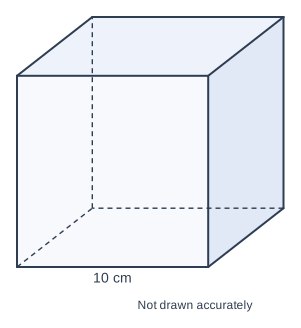
Bea has a box shaped like a cube. Each edge is 10 cm long.
How many 1 cm cubes would fill the box exactly?
Bea fills the box with 2 cm cubes instead. How many 2 cm cubes fit in the box exactly?
Model answer
1 cm cubes: \(10 \times 10 \times 10 = 1{,}000\) 2 cm cubes: \(10 \div 2 = 5\) along each edge \(5 \times 5 \times 5 = 125\)
Explanation
10 of the 1 cm cubes fit along each edge, so the box holds \(10^3 = 1{,}000\) of them. Only 5 of the 2 cm cubes fit along each edge, so it holds \(5^3 = 125\) of those. A common mistake is to halve 1,000 to get 500: each 2 cm cube is 2 cubes long, 2 wide and 2 tall, so it takes the space of 8 small cubes, and \(1{,}000 \div 8 = 125\).
Mark scheme
1 mark
\(10 \times 10 \times 10\) or \(10^3\) seen; or the correct answers with no working
1 mark
1,000 cubes of 1 cm
Accept 1000.
1 mark
5 of the 2 cm cubes fit along each edge (\(10 \div 2 = 5\))
1 mark
125 cubes of 2 cm
Do not accept 500 (\(1{,}000 \div 2\)). A correct answer with no working scores full marks.
Ready to try the rest? Tap your answers and see straight away how you did.
Ctrl + Enter to check
Study HelperHints first, answers after you try
Stuck on this one? Ask for a hint and I’ll point you in the right direction, without giving the answer away. Once you’ve checked your answer, I’ll show you how the marks are awarded.