Level:
Correct: 0
Incorrect: 0
Marks: 0/0
Practice
Course:
Topics:
Year 6 Maths Smart practice A mixed round aimed at your weak spots
Unit 1
Place value
Number and place value
Numbers up to ten million
Quick practice5 skills
Rounding whole numbers
Quick practice5 skills
Negative numbers
Quick practice5 skills
Roman numerals
Quick practice4 skills
Unit 2
Calculating
Unit 3
Fractions
Unit 4
Decimals
Unit 5
Fractions, decimals and percentages
Unit 6
Ratio and proportion
Unit 7
Algebra
Unit 8
Measurement
Unit 9
Shapes and angles
Unit 10
Position and direction
Geometry: position and direction
Coordinates in four quadrants
Quick practice5 skills
Translations
Quick practice4 skills
Reflections
Quick practice4 skills
Unit 11
Statistics
Statistics
Tables, timetables and bar charts
Quick practice4 skills
Line graphs
Quick practice4 skills
Pie charts
Quick practice5 skills
The mean
Quick practice5 skills
Avg
score:
–
Topics
done:
0/60

Short multiplication

Practise 22 questions on Short multiplication for Year 6 Maths. Tap your answer and find out straight away if you are right, with the Study Helper on hand if you get stuck.

  • 22 questions
  • 1–4 marks each
  • Instant marking
  • No sign-up needed
20 questions, marked as you go

Sample questions with model answers

Here are 4 of the questions in this topic, each with a model answer, an explanation of why it earns the marks and the mark scheme.

Question 1

1 mark

Work out \(470 \times 100\)

Model answer

Multiplying by 100 moves every digit two places to the left.
\(470 \times 100 = 47{,}000\)

Explanation

When you multiply by 100, each digit becomes 100 times bigger, so it moves two places to the left, and zeros fill the empty places. The 4 hundreds become 4 ten thousands. A common mistake is to write 4,700, which is only \(470 \times 10\).

Mark scheme
  1. 1 mark

    47,000

    Accept 47000.

Question 2

2 marks

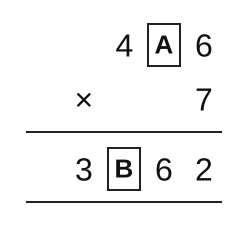
The diagram shows a short multiplication.

Two digits are missing. They are shown by the letters A and B.

Work out the values of A and B.

A short multiplication with two missing digits shown as boxes with letters. The top number is 4, a box marked A, then 6. It is multiplied by 7. Under the line, the answer is 3, a box marked B, then 6, 2.

Model answer

Ones: \(6 \times 7 = 42\), write 2 and carry 4 (matches)
Tens: \(A \times 7 + 4\) must end in 6, so \(A \times 7\) ends in 2: \(A = 6\) (\(42 + 4 = 46\)), carry 4
Hundreds: \(4 \times 7 + 4 = 32\), so \(B = 2\)
Check: \(466 \times 7 = 3{,}262\)
Answer: A = 6, B = 2

Explanation

Work from the ones, just as you would when multiplying, and keep track of the carries. The tens digit of the answer is 6, so \(A \times 7\) plus the carried 4 must end in 6. The only digit that works is 6. A common mistake is to forget the carried 4, which gives the wrong value for A.

Mark scheme
  1. 1 mark

    A = 6

    Accept the number written in full as 466.

  2. 1 mark

    B = 2

    Accept the answer written in full as 3,262. A correct answer with no working scores full marks.

Question 3

2 marks

A factory makes 2,375 toy cars every day.

How many toy cars does it make in 30 days?

Model answer

\(30 = 3 \times 10\)
\(2{,}375 \times 3 = 7{,}125\)
\(7{,}125 \times 10 = 71{,}250\)
Answer: 71,250 toy cars

Explanation

To multiply by 30, multiply by 3 and then by 10. Short multiplication gives \(2{,}375 \times 3 = 7{,}125\), and multiplying by 10 moves every digit one place to the left. A common mistake is to multiply by 3 and forget the \(\times 10\), giving 7,125.

Mark scheme
  1. 1 mark

    A correct method, e.g. \(2{,}375 \times 3 = 7{,}125\) and then \(\times 10\), or \(2{,}375 \times 10 = 23{,}750\) and then \(\times 3\); or the correct answer 71,250 with no working

    Allow one arithmetic slip in a complete method.

  2. 1 mark

    71,250

    Accept 71250. A correct answer with no working scores full marks.

Question 4

4 marks

A school is taking 175 pupils to the theatre. Each ticket costs £8.

The school also hires 4 coaches. Each coach costs £385.

The school has £3,000 to spend on the trip. How much do the tickets cost? How much do the coaches cost? What is the total cost?

Is £3,000 enough?

Model answer

Tickets: \(175 \times 8 = 1{,}400\)
Coaches: \(385 \times 4 = 1{,}540\)
Total: \(1{,}400 + 1{,}540 = 2{,}940\)
£2,940 is less than £3,000.
Yes, it is enough. There is £60 left over.

Explanation

Find the two costs separately with short multiplication, then add them and compare the total with £3,000. A common mistake is to work out only one coach, or to multiply the coach cost by the number of pupils. Writing each step on its own line makes it easy to check.

Mark scheme
  1. 1 mark

    Tickets cost £1,400 (\(175 \times 8\))

  2. 1 mark

    Coaches cost £1,540 (\(385 \times 4\))

  3. 1 mark

    Total cost £2,940

    Follow through: the sum of their two costs.

  4. 1 mark

    Yes, with a correct total (£60 is left over)

    'Yes' with no working, or with a wrong total, scores 0 for this mark: the question asks pupils to show how they know.

Ready to try the rest? Tap your answers and see straight away how you did.

Topic notes

Short multiplication

The big idea

Short multiplication is a written method for multiplying a number by a one-digit number, such as \(2{,}947 \times 6\). You multiply one digit at a time, starting with the ones, and carry into the next column, just as in column addition.

The method

  1. Write the big number on top and the one-digit number under its ones digit.
  2. Multiply the ones digit. Write down the last digit of what you get, and carry the rest into the tens column: write it small, under the answer line.
  3. Multiply the tens digit, then add the carried digit. Again, write down the last digit and carry the rest.
  4. Keep going to the left. At the last column, write the whole answer down.

A farmer has 6 fields of cabbages. Each field has 2,947 cabbages. How many cabbages are there altogether?

\[ \begin{array}{cccccc} & & 2 & 9 & 4 & 7 \\ \times & & & & & 6 \\ \hline & 1 & 7 & 6 & 8 & 2 \\ & & {\scriptsize 5} & {\scriptsize 2} & {\scriptsize 4} & \end{array} \]

Ones: \(7 \times 6 = 42\). Put down 2 and carry 4.

Tens: \(4 \times 6 = 24\), and 24 plus the carried 4 is 28. Put down 8 and carry 2.

Hundreds: \(9 \times 6 = 54\), and 54 plus 2 is 56. Put down 6 and carry 5.

Thousands: \(2 \times 6 = 12\), and 12 plus 5 is 17. Write 17.

There are 17,682 cabbages. Estimate to check: \(3{,}000 \times 6 = 18{,}000\), which is close.

Multiplying by 10, 100 and 1,000

Multiplying by 10 shifts each digit one column to the left, and a 0 fills the empty ones column. Multiplying by 100 shifts them two columns, and by 1,000 three columns.

CalculationAnswer
\(4{,}086 \times 10\)40,860
\(4{,}086 \times 100\)408,600
\(4{,}086 \times 1{,}000\)4,086,000

The zeros are place holders. They keep the digits in their new columns.

Multiplying by multiples of 10 and 100

To multiply by 40, first multiply by 4. Then multiply that answer by 10, because \(40 = 4 \times 10\). For 300, use \(\times 3\) and then \(\times 100\).

A theatre has 186 seats. Every seat is sold for each of 40 shows. How many tickets are sold?

\(40 = 4 \times 10\), so work out \(186 \times 4\) first.

Ones: \(6 \times 4 = 24\), put down 4, carry 2. Tens: \(8 \times 4 + 2 = 34\), put down 4, carry 3. Hundreds: \(1 \times 4 + 3 = 7\). So \(186 \times 4 = 744\).

Then multiply by 10: \(744 \times 10 = 7{,}440\) tickets.

Scaling

"8 times as heavy" or "5 times as long" means multiply. This is called scaling.

A puppy weighs 2,450 g. Its mother is 8 times as heavy. How heavy is the mother?

Work out \(2{,}450 \times 8\).

Ones: \(0 \times 8 = 0\). Tens: \(5 \times 8 = 40\), put down 0, carry 4. Hundreds: \(4 \times 8 + 4 = 36\), put down 6, carry 3. Thousands: \(2 \times 8 + 3 = 19\).

The mother weighs 19,600 g.

Missing digits

Work from the ones, one column at a time, and think about what was carried. In \(2\square 3 \times 4 = 1{,}092\): \(3 \times 4 = 12\), so put down 2 and carry 1. In the hundreds, \(2 \times 4 = 8\), but the answer shows 10, so 2 must have been carried from the tens. The tens must make 29: \(\square \times 4 + 1 = 29\), so \(\square \times 4 = 28\) and the missing digit is 7.

Common mistakes

  • Adding the carried digit before multiplying. In the cabbage example, the tens are \(4 \times 6 + 4\), not \((4 + 4) \times 6\).
  • Forgetting a carried digit, which makes the answer a little too small.
  • Losing a place holder: \(4{,}086 \times 100\) is 408,600, not 40,860.
  • Multiplying by 4 instead of 40 and forgetting the final \(\times 10\).

Top tip

Estimate first by rounding the big number: \(2{,}947 \times 6\) is about \(3{,}000 \times 6 = 18{,}000\). If your answer is near 1,800 or 180,000, a digit is in the wrong column.

Study Helper Hints first, answers after you try

Stuck on this one? Ask for a hint and I’ll point you in the right direction, without giving the answer away. Once you’ve checked your answer, I’ll show you how the marks are awarded.