Perimeter and area of rectangles and compound shapes
Practise 22 questions on Perimeter and area of rectangles and compound shapes for Year 6 Maths. Tap your answer and find out straight away if you are right, with the Study Helper on hand if you get stuck.
22 questions
1–4 marks each
Instant marking
No sign-up needed
20 questions, marked as you go
Sample questions with model answers
Here are 4 of the questions in this topic, each with a model answer, an explanation of why it earns the marks and the mark scheme.
Question 1
1 mark
A square patio has sides of 8 m.
Work out the area of the patio.
Model answer
\(8 \times 8 = 64\) 64 m²
Explanation
All four sides of a square are the same length, so its area is side × side: \(8 \times 8 = 64\) m². The sides are in metres, so the area is in square metres, m². A common mistake is to work out \(8 \times 4 = 32\), which is the perimeter.
Mark scheme
1 mark
64 m²
Accept 64 with no unit, or 64 square metres. Do not accept 32 (the perimeter) or 16 (from 8 + 8).
Question 2
2 marks
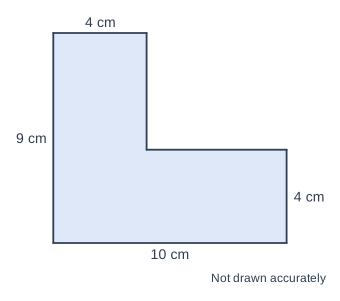
The diagram shows a shape. All its corners are right angles. Two of its sides are not labelled.
First find the two sides that are not labelled. The two top edges together match the 10 cm bottom, so the missing one is \(10 - 4 = 6\) cm. The two right-hand edges together match the 9 cm side, so the missing one is \(9 - 4 = 5\) cm. Then add all six sides to get 38 cm. A common mistake is to add only the labelled sides.
Mark scheme
1 mark
Both missing sides found: 6 cm (\(10 - 4\)) and 5 cm (\(9 - 4\)); or the correct answer 38 with no working
Also accept the method 'the perimeter is the same as a 10 cm by 9 cm rectangle', e.g. \(10 + 9 + 10 + 9\).
1 mark
38 cm
Accept 38 with no unit. Do not accept 27 (only the four labelled sides added). A correct answer with no working scores full marks.
Question 3
2 marks
Lucy says, "If two rectangles have the same area, they must have the same perimeter."
Is Lucy right? How do you know?
Model answer
No. A 1 cm by 12 cm rectangle and a 3 cm by 4 cm rectangle both have an area of 12 cm². But the first has a perimeter of 26 cm and the second has a perimeter of 14 cm.
Explanation
To show that a statement is wrong, one example that breaks it is enough. Rectangles 1 cm by 12 cm and 3 cm by 4 cm both cover 12 cm², but their perimeters are 26 cm and 14 cm. Long, thin rectangles have longer perimeters than square-like ones with the same area.
Mark scheme
1 mark
No, with a relevant but incomplete reason, e.g. 'they can be different shapes' or 'a long thin rectangle has a longer perimeter', with no correct example
'No' alone scores 0.
1 mark
A complete correct reason: an example of two rectangles with the same area but different perimeters, with the areas and perimeters correct, e.g. 1 cm by 12 cm (area 12 cm², perimeter 26 cm) and 3 cm by 4 cm (area 12 cm², perimeter 14 cm)
Any correct example scores, e.g. 2 by 6 (perimeter 16) and 3 by 4 (perimeter 14), or 1 by 16 (perimeter 34) and 4 by 4 (perimeter 16). The example must show the same area and different perimeters. A complete correct reason on its own scores both marks.
Question 4
4 marks
Mr Lee is tiling a bathroom wall. The wall is a rectangle 2.4 m wide and 1.6 m high. He uses square tiles that are 20 cm long and 20 cm wide.
How many tiles does he need to cover the wall exactly?
Model answer
2.4 m = 240 cm and 1.6 m = 160 cm Across: \(240 \div 20 = 12\) tiles Up: \(160 \div 20 = 8\) tiles \(12 \times 8 = 96\) 96 tiles
Explanation
First put all the lengths in the same unit: the wall is 240 cm by 160 cm. Then find how many tiles fit along each edge: 12 across and 8 up. The tiles make 8 rows of 12, so he needs \(12 \times 8 = 96\) tiles. A common mistake is to divide 2.4 by 20 without changing metres to centimetres first.
Mark scheme
1 mark
The lengths written in the same unit, e.g. 240 cm and 160 cm, or 20 cm = 0.2 m; or the correct answer 96 with no working
1 m = 100 cm.
1 mark
12 tiles across the width (\(240 \div 20\))
Area method: award this mark for the wall area 38,400 cm² (or 3.84 m²).
1 mark
8 tiles up the height (\(160 \div 20\))
Area method: award this mark for the tile area 400 cm² (or 0.04 m²).
1 mark
96 (tiles)
Do not accept 0.96 or 9.6 (mixing metres and centimetres) or 20 (from 12 + 8). A correct answer with no working scores full marks.
Ready to try the rest? Tap your answers and see straight away how you did.
Ctrl + Enter to check
Study HelperHints first, answers after you try
Stuck on this one? Ask for a hint and I’ll point you in the right direction, without giving the answer away. Once you’ve checked your answer, I’ll show you how the marks are awarded.