Level:
Correct: 0
Incorrect: 0
Marks: 0/0
Practice
Course:
Topics:
Year 6 Maths Smart practice A mixed round aimed at your weak spots
Unit 1
Place value
Number and place value
Numbers up to ten million
Quick practice5 skills
Rounding whole numbers
Quick practice5 skills
Negative numbers
Quick practice5 skills
Roman numerals
Quick practice4 skills
Unit 2
Calculating
Unit 3
Fractions
Unit 4
Decimals
Unit 5
Fractions, decimals and percentages
Unit 6
Ratio and proportion
Unit 7
Algebra
Unit 8
Measurement
Unit 9
Shapes and angles
Unit 10
Position and direction
Geometry: position and direction
Coordinates in four quadrants
Quick practice5 skills
Translations
Quick practice4 skills
Reflections
Quick practice4 skills
Unit 11
Statistics
Statistics
Tables, timetables and bar charts
Quick practice4 skills
Line graphs
Quick practice4 skills
Pie charts
Quick practice5 skills
The mean
Quick practice5 skills
Avg
score:
–
Topics
done:
0/60

Linear number sequences

Practise 22 questions on Linear number sequences for Year 6 Maths. Tap your answer and find out straight away if you are right, with the Study Helper on hand if you get stuck.

  • 22 questions
  • 1–4 marks each
  • Instant marking
  • No sign-up needed
20 questions, marked as you go

Sample questions with model answers

Here are 4 of the questions in this topic, each with a model answer, an explanation of why it earns the marks and the mark scheme.

Question 1

1 mark

Here is a sequence of numbers. It goes down by the same amount each time.

9,   5,   1,   \(-3\),   ...

What are the next two numbers in the sequence?

Model answer

The rule is subtract 4.
\(-3 - 4 = -7\)
\(-7 - 4 = -11\)
The next two numbers are \(-7\) and \(-11\).

Explanation

Each number is 4 less than the one before. Below zero, keep counting down in steps of 4: from \(-3\), 4 more steps down is \(-7\), and 4 more is \(-11\). A number line helps. A common mistake is to count towards zero and write \(-7\) as 7 or \(-1\).

Mark scheme
  1. 1 mark

    \(-7\) and \(-11\)

    Both numbers are needed, in this order. Accept −7, −11 written with a hyphen as minus sign (-7, -11). Do not accept 7 and 11, or 1 and 5 (counting back up).

Question 2

2 marks

Here is a sequence of numbers. It goes up by the same amount each time. Two numbers are missing.

8,   \(\square\),   \(\square\),   29

Work out the two missing numbers.

Model answer

From 8 to 29 is \(29 - 8 = 21\).
There are 3 steps, so each step is \(21 \div 3 = 7\).
\(8 + 7 = 15\), \(15 + 7 = 22\)
The missing numbers are 15 and 22.

Explanation

From the first number to the fourth there are 3 equal steps. The total gap is 21, so each step is \(21 \div 3 = 7\). Then count on in 7s from 8: 15, 22, 29. A common mistake is to divide by 2 (the number of missing terms) instead of 3 (the number of steps).

Mark scheme
  1. 1 mark

    A step of 7 found, e.g. \(29 - 8 = 21\) and \(21 \div 3 = 7\); or one missing number correct; or the correct answer 15 and 22 with no working

  2. 1 mark

    15 and 22

    Both needed, in this order. A correct answer with no working scores full marks. A common wrong answer is 18.5 and 29 (dividing 21 by 2).

Question 3

2 marks

A sequence goes down by the same amount each time.

The second number in the sequence is 3.
The fifth number in the sequence is \(-9\).

Work out the first number in the sequence.

Model answer

From 3 down to \(-9\) is 12.
That is 3 steps (2nd to 5th), so each step is \(12 \div 3 = 4\).
The sequence is 7, 3, \(-1\), \(-5\), \(-9\).
The first number is 7.

Explanation

From 3 down to 0 is 3, and from 0 down to \(-9\) is 9, so the total drop is 12. There are 3 steps from the 2nd number to the 5th number, so each step is 4. The first number is one step before 3, so it is 4 more: 7. A common mistake is to count 4 steps between the 2nd and 5th numbers instead of 3.

Mark scheme
  1. 1 mark

    A step of 4 found, e.g. \(3 - (-9) = 12\) and \(12 \div 3 = 4\); or the sequence \(-1\), \(-5\) seen between 3 and \(-9\); or the correct answer 7 with no working

  2. 1 mark

    7

    Follow through: 3 + their step. A correct answer with no working scores full marks. Common wrong answers: 6 (a step of 3, from 12 ÷ 4) and −1 (going down instead of up).

Question 4

4 marks

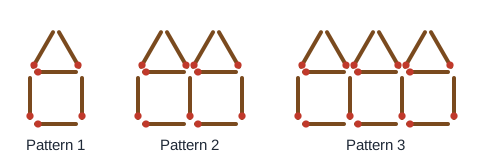
Here are the first three patterns in a sequence made from matchsticks.

The sequence continues in the same way.

Ravi has 60 matchsticks. He makes the biggest pattern in the sequence that he can.

Which pattern does he make, and how many matchsticks are left over?

Three patterns of house shapes made from matchsticks. Pattern 1 is one house: a square of 4 matchsticks with a triangle roof made from 2 more matchsticks, 6 matchsticks in all. Pattern 2 is two houses side by side sharing a wall, made from 11 matchsticks. Pattern 3 is three houses in a row, each sharing a wall with the next, made from 16 matchsticks.

Model answer

Pattern 1: 6, Pattern 2: 11, Pattern 3: 16. Each pattern needs 5 more.
6, 11, 16, 21, 26, 31, 36, 41, 46, 51, 56, 61
Pattern 11 uses 56 and Pattern 12 needs 61, which is too many.
Ravi makes Pattern 11 and has \(60 - 56 = 4\) matchsticks left over.

Explanation

Each new house shares a wall with the one before, so it needs 5 more matchsticks (3 for the square and 2 for the roof). Continue the sequence 6, 11, 16, ... until you would go past 60: Pattern 11 uses 56 and Pattern 12 would need 61. So Ravi makes Pattern 11 with 4 matchsticks left over. A common mistake is to divide 60 by 6, as if every house needed 6 new matchsticks.

Mark scheme
  1. 1 mark

    Adds 5 each time, e.g. 21 or 26 seen as the next terms; or the correct answer (Pattern 11, 4 left over) with no working

    Or a rule such as 5 times the pattern number, add 1.

  2. 1 mark

    Pattern 11 uses 56 matchsticks, or the list continued correctly to 56 (and 61 for Pattern 12)

  3. 1 mark

    Pattern 11

  4. 1 mark

    4 matchsticks left over

    Follow through: 60 − their number of matchsticks for their pattern, if it is at most 60. A correct answer with no working scores full marks. Common wrong answers: Pattern 10 (from 60 ÷ 6) and Pattern 12 (it needs 61 matchsticks, too many).

Ready to try the rest? Tap your answers and see straight away how you did.

Topic notes

Linear number sequences

The big idea

A sequence is a list of numbers that follows a rule. Each number in it is a term. In a linear sequence, the terms go up or down by the same amount every time, like 2, 7, 12, 17. Once you know the rule, you can continue the sequence, fill in gaps and check whether a number belongs to it.

The term-to-term rule

The term-to-term rule says what to do to each term to get the one after it. To find it, work out the gap between neighbouring terms. Check every gap, not just the first one. A rule needs a direction as well as a number: "add 3" or "subtract 3", not just "3".

Flow chart of 5 boxes joined by arrows, read from left to right. The first box is "7 °C", which leads (along an arrow labelled "− 3") to "4 °C", which leads (along an arrow labelled "− 3") to "1 °C", which leads (along an arrow labelled "− 3") to "−2 °C", which leads (along an arrow labelled "− 3") to "−5 °C".
The temperature each hour from 6 pm to 10 pm. The rule is subtract 3, and it carries on below zero.

At 6 pm the temperature is 7 °C. It falls by 3 °C every hour. What is the temperature at 11 pm?

The rule is subtract 3. Write a term for each hour, and keep counting down in 3s below zero.

6 pm: 7 °C, 7 pm: 4 °C, 8 pm: 1 °C, 9 pm: −2 °C, 10 pm: −5 °C, 11 pm: −8 °C

At 11 pm the temperature is −8 °C.

Sequences can go up or down in decimals or fractions too. Take care when you cross a whole number.

  • 1.2, 1.9, 2.6, 3.3, ... goes up by 0.7. The next term is \(3.3 + 0.7 = 4\), which you can write as 4.0, not 3.10.
  • \(\dfrac{1}{3}\), 1, \(1\dfrac{2}{3}\), \(2\dfrac{1}{3}\), ... goes up by \(\dfrac{2}{3}\). The next term is 3.

Missing terms

When the two terms you know have a gap between them, count the steps from one to the other. From the 1st term to the 6th term there are 5 steps, not 6.

Fence posts are spaced out equally along a path. The 1st post is 2 m from the gate and the 6th post is 37 m from the gate. How far from the gate is the 3rd post?

From the 1st post to the 6th post is \(37 - 2 = 35\) m.

That distance is made of 5 equal gaps, and \(35 \div 5 = 7\), so the posts are 7 m apart.

The posts are 2, 9, 16, 23, 30 and 37 m from the gate, so the 3rd post is 16 m from the gate.

Is a number in the sequence?

One way is to keep counting on past the number. For a big number, there is a quicker way: take away the first term, then see whether what is left divides exactly by the step.

A frog starts on 4 on a number track and jumps 6 along each time: 4, 10, 16, 22, ... Will it land on 70? On 90?

70: \(70 - 4 = 66\) and \(66 \div 6 = 11\). It divides exactly, so the frog lands on 70 (after 11 jumps).

90: \(90 - 4 = 86\), and 86 divided by 6 is 14 remainder 2. It does not divide exactly, so the frog never lands on 90.

Patterns of shapes

Square tables are pushed together in a row. Each table has one chair at the front and one at the back, and there is one more chair at each end of the row.

Tables1234
Chairs46810

The term-to-term rule for the chairs is add 2.

Stretch: the position-to-term rule

For 20 tables you would need a long list. A position-to-term rule links the number of tables (the position) straight to the number of chairs.

Write a rule in words for the number of chairs. Use it to find the chairs needed for 20 tables.

Each table brings 2 chairs, one at the front and one at the back. The 2 end chairs are extra.

Rule: multiply the number of tables by 2, then add 2.

Check with 3 tables: \(3 \times 2 + 2 = 8\). This matches the table.

20 tables: \(20 \times 2 + 2 = 42\) chairs.

Remember

  • In a linear sequence, the gap between neighbouring terms never changes.
  • The term-to-term rule needs a direction and a number: "subtract 3".
  • Between the 1st and 6th terms there are 5 steps.
  • A position-to-term rule gets any term without a list.

Common mistakes

  • Checking only the first gap. Check every gap before you write the rule.
  • Counting the terms instead of the steps between them.
  • Counting back up after zero. With subtract 3, the term after 1 is −2, not 2.
  • Multiplying in a pattern. 3 tables need 8 chairs, not \(3 \times 4 = 12\), because there are no chairs where the tables touch.

Top tip

Write each step as a little jump above the gap between two terms, such as "+6". You will spot a wrong gap at once.

Study Helper Hints first, answers after you try

Stuck on this one? Ask for a hint and I’ll point you in the right direction, without giving the answer away. Once you’ve checked your answer, I’ll show you how the marks are awarded.