Practise 22 questions on Angles in quadrilaterals and regular polygons for Year 6 Maths. Tap your answer and find out straight away if you are right, with the Study Helper on hand if you get stuck.
22 questions
1–4 marks each
Instant marking
No sign-up needed
20 questions, marked as you go
Sample questions with model answers
Here are 4 of the questions in this topic, each with a model answer, an explanation of why it earns the marks and the mark scheme.
Question 1
1 mark
Three of the angles in a quadrilateral are 90°, 90° and 125°.
Work out the size of the fourth angle.
Model answer
\(90 + 90 + 125 = 305\) \(360 - 305 = 55\) The fourth angle is 55°.
Explanation
The angles in a quadrilateral add up to 360°. The three angles you know add up to 305°, so the fourth angle is \(360 - 305 = 55\)°. A common mistake is to add the angles wrongly; check by adding all four: \(90 + 90 + 125 + 55 = 360\).
Mark scheme
1 mark
55°
Accept 55 with or without the degree sign. Do not accept 125 or −125 (using 180°).
Question 2
2 marks
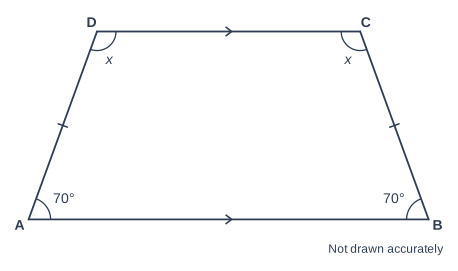
The diagram shows an isosceles trapezium ABCD. The two angles marked x are equal.
The four angles add up to 360°. The two 70° angles use 140°, which leaves 220° for the two equal angles, so each one is \(220 \div 2 = 110\)°. Notice that 70° and 110° on the same sloping side add up to 180°. A common mistake is to forget to halve the 220°.
Mark scheme
1 mark
\(360 - 70 - 70 = 220\); or the correct answer 110° with no working
Also award for 180 − 70 seen.
1 mark
110°
Accept 110 or x = 110, with or without the degree sign. Do not accept 220. A correct answer with no working scores full marks.
Question 3
2 marks
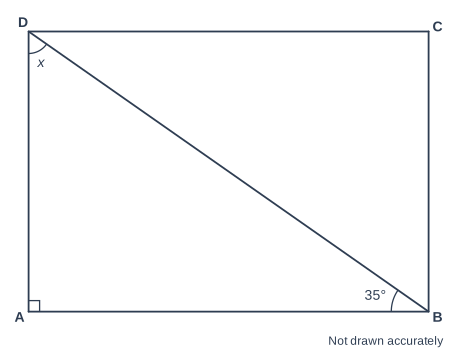
The diagram shows a rectangle ABCD with a diagonal BD.
Work out the size of angle x.
Model answer
Triangle ABD has a right angle at A. \(x = 180 - 90 - 35 = 55\) x = 55°
Explanation
Every angle of a rectangle is 90°, so triangle ABD has a right angle at A. The angles of the triangle add up to 180°, so \(x = 180 - 90 - 35 = 55\)°. You could also say the corner at D is 90°, and the diagonal splits it into x and another angle. A common mistake is to think the diagonal cuts the corners exactly in half (it only does that in a square).
Mark scheme
1 mark
The angle at A used as 90°, e.g. \(90 + 35 = 125\) or \(180 - 90 - 35\); or the correct answer 55° with no working
Also award for 90 − 35 using the right angle at D.
1 mark
55°
Accept 55 or x = 55, with or without the degree sign. Do not accept 35 or 145. A correct answer with no working scores full marks.
Question 4
4 marks
A decagon is a shape with 10 sides.
You can split any polygon into triangles by drawing lines from one corner to all the other corners. For example, a pentagon splits into 3 triangles and a hexagon splits into 4 triangles.
Work out the size of each angle of a regular decagon.
Model answer
A pentagon (5 sides) makes 3 triangles and a hexagon (6 sides) makes 4, so a decagon (10 sides) makes 8. \(8 \times 180 = 1440\) \(1440 \div 10 = 144\) Each angle is 144°.
Explanation
Look for the pattern: the number of triangles is always 2 less than the number of sides, so a decagon splits into 8 triangles. Their angles fill the decagon, so the decagon's angles add up to \(8 \times 180 = 1440\)°. A regular decagon has 10 equal angles, so each is \(1440 \div 10 = 144\)°. A common mistake is to think there are 10 triangles, one for each side.
Mark scheme
1 mark
8 triangles (always 2 fewer triangles than sides); or the correct answer 144° with no working
1 mark
\(8 \times 180 = 1440\)
Follow through their number of triangles × 180.
1 mark
Their total divided by 10, e.g. \(1440 \div 10\)
1 mark
144°
Accept 144 with or without the degree sign. Do not accept 36 (360 ÷ 10) or 180 (10 triangles). A correct answer with no working scores full marks.
Ready to try the rest? Tap your answers and see straight away how you did.
Ctrl + Enter to check
Study HelperHints first, answers after you try
Stuck on this one? Ask for a hint and I’ll point you in the right direction, without giving the answer away. Once you’ve checked your answer, I’ll show you how the marks are awarded.