Level:
Correct: 0
Incorrect: 0
Marks: 0/0
Practice
Course:
Topics:
Year 6 Maths Smart practice A mixed round aimed at your weak spots
Unit 1
Place value
Number and place value
Numbers up to ten million
Quick practice5 skills
Rounding whole numbers
Quick practice5 skills
Negative numbers
Quick practice5 skills
Roman numerals
Quick practice4 skills
Unit 2
Calculating
Unit 3
Fractions
Unit 4
Decimals
Unit 5
Fractions, decimals and percentages
Unit 6
Ratio and proportion
Unit 7
Algebra
Unit 8
Measurement
Unit 9
Shapes and angles
Unit 10
Position and direction
Geometry: position and direction
Coordinates in four quadrants
Quick practice5 skills
Translations
Quick practice4 skills
Reflections
Quick practice4 skills
Unit 11
Statistics
Statistics
Tables, timetables and bar charts
Quick practice4 skills
Line graphs
Quick practice4 skills
Pie charts
Quick practice5 skills
The mean
Quick practice5 skills
Avg
score:
–
Topics
done:
0/60

Converting metric units

Practise 25 questions on Converting metric units for Year 6 Maths. Tap your answer and find out straight away if you are right, with the Study Helper on hand if you get stuck.

  • 25 questions
  • 1–5 marks each
  • Instant marking
  • No sign-up needed
20 questions, marked as you go

Sample questions with model answers

Here are 4 of the questions in this topic, each with a model answer, an explanation of why it earns the marks and the mark scheme.

Question 1

1 mark

A path is 2,300 m long.

What is this length in kilometres?

Model answer

1 km = 1,000 m
\(2{,}300 \div 1{,}000 = 2.3\)
The path is 2.3 km long.

Explanation

There are 1,000 metres in a kilometre, so divide by 1,000: 2,300 m is 2.3 km. You can check: 2,000 m is 2 km, and 300 m is 0.3 of a kilometre. A common mistake is to divide by 100 and get 23.

Mark scheme
  1. 1 mark

    2.3 km

    Accept 2.3 or 2.30, with or without the unit. Do not accept 23 or 0.23.

Question 2

2 marks

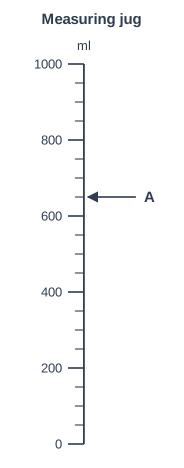
The diagram shows the scale on the side of a measuring jug. Arrow A shows the level of the water in the jug.

How much water is in the jug? Give your answer in litres.

Measuring jug. A vertical scale from 0 to 1000 ml, divided into 5 equal parts by long marks, each split into 4 small divisions by short marks. Every long mark is numbered (0, 200, 400, 600, 800 and 1000). An arrow labelled A points to a mark on the scale.

Model answer

Each small mark is 50 ml (4 gaps between 0 and 200).
Arrow A is 1 small mark above 600 ml: 650 ml.
\(650 \div 1{,}000 = 0.65\)
There are 0.65 litres of water.

Explanation

First work out what each small mark is worth: there are 4 gaps between 0 and 200 ml, so each gap is \(200 \div 4 = 50\) ml. Arrow A is one gap above 600, so it shows 650 ml. Then divide by 1,000 to change to litres: 0.65 litres. A common mistake is to count each small mark as 10 ml.

Mark scheme
  1. 1 mark

    650 ml read from the scale; or the correct answer 0.65 litres with no working

  2. 1 mark

    0.65 litres

    Accept 0.65 or .65, with or without the unit. Follow through: their reading correctly changed to litres. A correct answer with no working scores full marks. Do not accept 6.5 or 65.

Question 3

2 marks

Mr Khan has a piece of ribbon 3 m long.

He cuts it into 8 equal pieces.

How long is each piece? Give your answer in centimetres.

Model answer

3 m = 300 cm
\(300 \div 8 = 37.5\)
(\(8 \times 37 = 296\), remainder 4, and \(4 \div 8 = 0.5\))
Each piece is 37.5 cm long.

Explanation

Change 3 m to centimetres first: 300 cm. Then share it into 8 equal pieces: \(300 \div 8 = 37\) remainder 4, and the remainder 4 shared between 8 is 0.5, so each piece is 37.5 cm. With measurements, a remainder should be shared out as a decimal. A common mistake is to write 37 r 4, which is not a length.

Mark scheme
  1. 1 mark

    3 m = 300 cm, with a correct method for \(300 \div 8\); or the correct answer 37.5 cm with no working

    Or 3 ÷ 8 = 0.375 m seen.

  2. 1 mark

    37.5 cm

    Accept 37.5 or 37 1/2, with or without the unit. Do not accept 37 r 4 or 37 alone. A correct answer with no working scores full marks. Common wrong answer: 0.375 (in metres).

Question 4

4 marks

Mrs Ali needs 4.2 m of wooden edging for a flower bed.

The edging is sold in strips that are 60 cm long. Each strip costs £1.35.

How much will the edging cost?

Model answer

4.2 m = 420 cm
\(420 \div 60 = 7\) strips
\(7 \times 1.35 = 7 + 2.45 = 9.45\)
The edging costs £9.45.

Explanation

Change the metres to centimetres so both lengths are in the same unit: 4.2 m is 420 cm. Then \(420 \div 60 = 7\) strips. Seven strips cost \(7 \times £1 = £7\) plus \(7 \times 35\)p \(= 245\)p, which is £9.45 altogether. A common mistake is to change 4.2 m to 4,200 cm, which would mean 70 strips.

Mark scheme
  1. 1 mark

    4.2 m = 420 cm (or 60 cm = 0.6 m); or the correct answer £9.45 with no working

  2. 1 mark

    7 strips

    420 ÷ 60 = 7.

  3. 1 mark

    A correct method for 7 × £1.35, e.g. \(7 \times 135 = 945\) or \(7 \times 1 + 7 \times 0.35\)

    Follow through: their whole number of strips × £1.35.

  4. 1 mark

    £9.45

    Accept 9.45 or 945p. A correct answer with no working scores full marks. Common wrong answers: £94.50 (70 strips, from 4.2 m = 4,200 cm ÷ 60) and £5.67 (4.2 × 1.35).

Ready to try the rest? Tap your answers and see straight away how you did.

Topic notes

Converting metric units

The big idea

Metric units measure length, mass and capacity. They are built on 10, 100 and 1,000, just like place value. So converting (changing) from one unit to another just means using × or ÷ with 10, 100 or 1,000. Before you add, take away or compare measures, give them all the same unit.

The facts to learn

MeasureFacts
Length10 mm = 1 cm, 100 cm = 1 m, 1,000 m = 1 km
Mass1,000 g = 1 kg
Capacity1,000 ml = 1 l

Length is how long something is, mass is how heavy it is, and capacity is how much liquid a container holds. "Kilo" means a thousand: a kilogram is 1,000 grams and a kilometre is 1,000 metres.

Flow chart of 4 boxes joined by arrows, read from left to right. The first box is "kilometres (km)", which leads (along an arrow labelled "× 1,000") to "metres (m)", which leads (along an arrow labelled "× 100") to "centimetres (cm)", which leads (along an arrow labelled "× 10") to "millimetres (mm)".
To change to a smaller unit, multiply. To go back the other way, to a bigger unit, divide by the same number.
  • Bigger unit to smaller unit: multiply. You need more of the small units. 6.2 km = 6,200 m, and 0.375 l = 375 ml.
  • Smaller unit to bigger unit: divide. You need fewer of the big units. 35 mm = 3.5 cm, and 1,450 g = 1.45 kg.

Multiplying by 1,000 makes a number 1,000 times bigger, so its digits move up three columns. Dividing by 1,000 moves them down three columns.

Mixed units, such as 2 kg 60 g, can be written in one unit. 60 g is 60 thousandths of a kilogram, so 2 kg 60 g = 2.06 kg = 2,060 g.

Reading scales

Rulers, measuring jugs and weighing scales have small marks between the numbers. Before you read a scale, work out what one small mark is worth: divide the gap between two numbers by the number of small spaces between them.

A horizontal scale from 0 to 3 kg, divided into 3 equal parts by long marks, each split into 5 small divisions by short marks. Every long mark is numbered (0, 1, 2 and 3). Long marks are every 1 kg and each small division is 0.2 kg. Arrow A points to 1.6 kg.
There are 5 small spaces between 1 kg and 2 kg, so each one is 0.2 kg. Arrow A is 3 spaces past 1 kg: 1.6 kg, which is 1,600 g.

Comparing and ordering

To compare measures, first write them all in one unit. The smaller unit usually gives whole numbers, which are easier to compare.

Order these distances from shortest to longest: 1.3 km, 1,080 m, 1.03 km, 1 km 200 m

Change them all to metres:

1.3 km = 1,300 m, 1.03 km = 1,030 m, 1 km 200 m = 1,200 m

In order: 1,030 m, 1,080 m, 1,200 m, 1,300 m

So the order is 1.03 km, 1,080 m, 1 km 200 m, 1.3 km.

Problems with measures

A box 40 cm tall is put on a table 0.75 m tall. A vase 280 mm tall stands on the box. How high above the floor is the top of the vase? Give your answer in metres.

Change everything to centimetres: 0.75 m = 75 cm, and 280 mm = 28 cm.

Add: \(75 + 40 + 28 = 143\) cm

Change to metres: \(143 \div 100 = 1.43\)

The top of the vase is 1.43 m above the floor.

A dog eats 350 g of food a day. A bag holds 5 kg of food. Will one bag last for 2 weeks?

2 weeks is 14 days, which is 10 days and 4 days.

Food for 10 days: \(350 \times 10 = 3{,}500\) g. Food for 4 days: \(350 \times 4 = 1{,}400\) g.

Food for 14 days: \(3{,}500 + 1{,}400 = 4{,}900\) g

The bag holds 5 kg = 5,000 g.

\(5{,}000 - 4{,}900 = 100\), so the bag lasts 2 weeks, with 100 g left over.

Remember

  • 10 mm = 1 cm, 100 cm = 1 m, 1,000 m = 1 km, 1,000 g = 1 kg, 1,000 ml = 1 l.
  • To a smaller unit, multiply. To a bigger unit, divide.
  • Change everything to the same unit before you calculate or compare.
  • Work out what one small mark is worth before you read a scale.

Common mistakes

  • Using 100 instead of 1,000. 2.4 kg is 2,400 g, not 240 g.
  • Converting the wrong way. A smaller unit always gives a bigger number: 3.6 m is 360 cm, not 0.036 cm.
  • Mixed units with a zero. 3 m 5 cm is 3.05 m, not 3.5 m.
  • Counting every small mark on a scale as 1 or 10 without checking.
  • Adding measures in different units, such as 2 kg + 300 g = 302.

Top tip

Ask yourself, "Should my answer be a bigger or a smaller number?" If you change to a smaller unit, such as kilograms to grams, the number must get bigger.

Study Helper Hints first, answers after you try

Stuck on this one? Ask for a hint and I’ll point you in the right direction, without giving the answer away. Once you’ve checked your answer, I’ll show you how the marks are awarded.