Level:
Correct: 0
Incorrect: 0
Marks: 0/0
Practice
Course:
Topics:
Year 6 Maths Smart practice A mixed round aimed at your weak spots
Unit 1
Place value
Number and place value
Numbers up to ten million
Quick practice5 skills
Rounding whole numbers
Quick practice5 skills
Negative numbers
Quick practice5 skills
Roman numerals
Quick practice4 skills
Unit 2
Calculating
Unit 3
Fractions
Unit 4
Decimals
Unit 5
Fractions, decimals and percentages
Unit 6
Ratio and proportion
Unit 7
Algebra
Unit 8
Measurement
Unit 9
Shapes and angles
Unit 10
Position and direction
Geometry: position and direction
Coordinates in four quadrants
Quick practice5 skills
Translations
Quick practice4 skills
Reflections
Quick practice4 skills
Unit 11
Statistics
Statistics
Tables, timetables and bar charts
Quick practice4 skills
Line graphs
Quick practice4 skills
Pie charts
Quick practice5 skills
The mean
Quick practice5 skills
Avg
score:
–
Topics
done:
0/60

Measuring and classifying angles

Practise 22 questions on Measuring and classifying angles for Year 6 Maths. Tap your answer and find out straight away if you are right, with the Study Helper on hand if you get stuck.

  • 22 questions
  • 1–4 marks each
  • Instant marking
  • No sign-up needed
20 questions, marked as you go

Sample questions with model answers

Here are 4 of the questions in this topic, each with a model answer, an explanation of why it earns the marks and the mark scheme.

Question 1

1 mark

Which of these angles is a reflex angle?

Model answer

205°

Explanation

A reflex angle is more than 180° (a straight line) but less than 360° (a full turn). Only 205° is bigger than 180°. A common mistake is to choose 175°, which is large but still less than a straight angle, so it is obtuse.

Mark scheme
  1. 1 mark

    205°

    205 only. 95° and 175° are obtuse and 90° is a right angle.

Question 2

2 marks

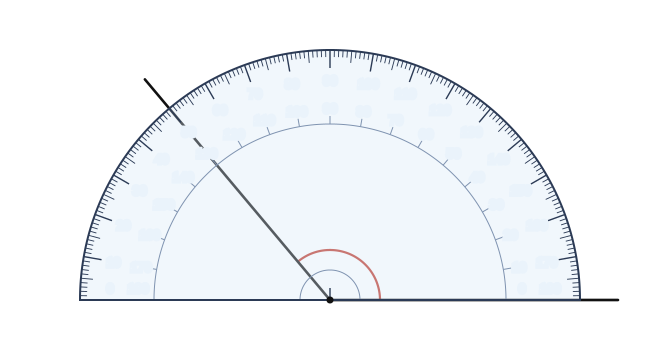
In the diagram, Ali uses a protractor to measure the angle marked with an arc.

He says the angle is 50°.

What is the size of the angle? Is Ali right?

A protractor is laid on an angle. Its centre is on the point where the two arms meet. The protractor has two scales of numbers: the outer scale goes from 0 on the left to 180 on the right, and the inner scale goes from 0 on the right to 180 on the left, with a small mark for every degree. One arm lies along the base line of the protractor, pointing right. The other arm points up and to the left. The angle between the arms is marked with an arc.

Model answer

No. The angle is bigger than a right angle, so it is obtuse and cannot be 50°. One arm is on 0 of the inner scale, so the inner scale gives the size: 130°.

Explanation

Always start from the 0 on the arm that lies along the base line. Here that 0 is on the inner scale, and the inner scale reaches 130 at the other arm. Ali read 50 from the outer scale. A quick check stops this mistake: the angle is wider than a right angle, so its size must be more than 90°.

Mark scheme
  1. 1 mark

    No, with a relevant but incomplete reason, e.g. 'he used the wrong scale'

    'No' alone scores 0.

  2. 1 mark

    No, with a complete correct reason, e.g. the angle is 130°; or the angle is obtuse (bigger than a right angle), so it cannot be 50°; or the arm on the base line is at 0 on the inner scale, so the reading is 130° not 50°

    A complete correct reason on its own scores both marks.

Question 3

2 marks

A wheel turns through two and a half full turns.

How many degrees does the wheel turn through?

Model answer

Two full turns: \(2 \times 360 = 720\)
Half a turn: 180
\(720 + 180 = 900\)
The wheel turns through 900°.

Explanation

One full turn is 360°, so two full turns are 720°. Half a turn is half of 360°, which is 180°. Add them: \(720 + 180 = 900\)°. A common mistake is to add 360 and 180 and forget that there are two full turns.

Mark scheme
  1. 1 mark

    \(2 \times 360 = 720\), or a half turn = 180° seen; or the correct answer 900° with no working

  2. 1 mark

    900°

    Accept 900 with or without the degree sign. A correct answer with no working scores full marks.

Question 4

4 marks

A robot is facing north.

It turns 90° clockwise. Then it turns 270° clockwise. Then it turns 180° anticlockwise.

Which direction is the robot facing now?

How many degrees clockwise must it turn to face north again?

Model answer

North, then 90° clockwise: east.
Then 270° clockwise: east to south to west to north. It faces north.
Then 180° anticlockwise: south.
It faces south. It must turn 180° to face north again.

Explanation

Take each turn in order. 90° is a quarter turn, 270° is three quarters of a turn, and 180° is a half turn. After the first two turns the robot has turned \(90 + 270 = 360\)°, a full turn, so it faces north again. A half turn then leaves it facing south, and another half turn (180°) brings it back to north. A common mistake is to mix up clockwise and anticlockwise.

Mark scheme
  1. 1 mark

    Facing east after the first turn; or the correct answer (south, 180°) with no working

  2. 1 mark

    Facing north after the second turn

    Also award for 90 + 270 = 360, a full turn, seen.

  3. 1 mark

    South

  4. 1 mark

    180°

    Follow through: the clockwise turn from their direction back to north (east 270°, west 90°). Accept 180 with or without the degree sign. A correct answer with no working scores full marks.

Ready to try the rest? Tap your answers and see straight away how you did.

Topic notes

Measuring and classifying angles

The big idea

An angle is an amount of turn. When two lines (called arms) meet at a point, the angle tells you how far one arm has turned away from the other. We measure angles in degrees, written °. A full turn all the way round is 360°.

Turns and degrees

TurnDegrees
quarter turn90°
half turn180°
three-quarter turn270°
full turn360°

A skater spins through 540°. How many turns is that?

One full turn is 360°. Take it away: \(540 - 360 = 180\)

180° is a half turn. So 540° is one and a half turns.

Types of angle

NameSize
acute angleless than 90°
right angleexactly 90° (marked with a small square)
obtuse anglemore than 90° but less than 180°
straight angleexactly 180° (a straight line)
reflex anglemore than 180° but less than 360°
Geometry diagram, drawn accurately to scale. A horizontal line with no labelled ends is drawn. A sloping line with no labelled ends is drawn. A horizontal line with no labelled ends is drawn. A vertical line with no labelled ends is drawn. A horizontal line with no labelled ends is drawn. A sloping line with no labelled ends is drawn. A horizontal line with no labelled ends is drawn. A sloping line with no labelled ends is drawn. The angle at an unlabelled point is marked 50°. The angle at an unlabelled point is marked as a right angle (90°). The angle at an unlabelled point is marked 130°. The reflex angle at an unlabelled point is marked 240°. The text "acute" is written. The text "right" is written. The text "obtuse" is written. The text "reflex" is written.
An acute angle, a right angle, an obtuse angle and a reflex angle. The reflex angle goes the long way round.

Two arms that meet always make two angles, one each side. Together they make 360°, so if one is obtuse, the other is reflex.

Estimating angles

Before you measure, estimate by comparing with angles you know. Half a right angle is 45°, a right angle is 90° and a straight line is 180°. An angle a little wider than a right angle might be about 100°. Long arms do not make an angle bigger: only the turn between them matters, so compare the turns when you put angles in order of size.

Using a protractor

A protractor has two scales of numbers from 0 to 180, one running each way round. On the protractor in the picture, the outer scale starts at 0 on the left and the inner scale starts at 0 on the right.

Geometry diagram, drawn accurately to scale. A semicircle on the straight line joining its ends as diameter, drawn above it. A horizontal line with no labelled ends is drawn. A sloping line with no labelled ends is drawn. A sloping line with no labelled ends is drawn. A sloping line with no labelled ends is drawn. A sloping line with no labelled ends is drawn. A sloping line with no labelled ends is drawn. A sloping line with no labelled ends is drawn. A sloping line with no labelled ends is drawn. A sloping line with no labelled ends is drawn. A horizontal line with no labelled ends is drawn. A sloping line with no labelled ends is drawn. The angle at an unlabelled point is marked 140°. The text "180" is written. The text "0" is written. The text "160" is written. The text "20" is written. The text "140" is written. The text "40" is written. The text "120" is written. The text "60" is written. The text "100" is written. The text "80" is written. The text "80" is written. The text "100" is written. The text "60" is written. The text "120" is written. The text "40" is written. The text "140" is written. The text "20" is written. The text "160" is written. The text "0" is written. The text "180" is written. The text "outer scale" is written. The text "inner scale" is written.
Measuring an angle of 140°. One arm lies on the base line and reaches 0 on the inner scale, so read that scale. This protractor is numbered every 20°; a real one has a mark for every degree.
  1. Put the centre of the protractor exactly on the vertex (the point where the arms meet).
  2. Turn the protractor so that its straight base line lies along one arm.
  3. Look at the end of the base line where that arm is. One scale shows 0 there: use only that scale. In the picture the arm points right, to 0 on the inner scale.
  4. Follow that scale round from 0 to the other arm and read the number. In the picture the inner scale goes 0, 20, 40 and so on, and meets the other arm at 140.
  5. Check against your estimate. The angle in the picture is obtuse, so 140° makes sense. The 40 on the outer scale cannot be right.

At any point on a protractor, the two scales add up to 180 (in the picture, 140 and 40). That is why it is easy to read the wrong one.

To find a reflex angle, measure the smaller angle on the other side, then take it away from 360°.

Angles on a clock

A clock face is a full turn, 360°, split into 12 equal gaps, so neighbouring numbers are 30° apart. In one hour the hour hand moves one gap, 30°. In one hour the minute hand makes a full turn, so each minute it moves 6°.

Sam starts reading when the minute hand points to 12. He stops when it has turned through 240°. How long did he read for?

The minute hand moves 30° from one number to the next, and that takes 5 minutes.

\(240 \div 30 = 8\), so the hand has moved 8 numbers round the clock.

8 lots of 5 minutes is 40 minutes. Sam read for 40 minutes, and the minute hand now points to 8.

Remember

  • A right angle is 90°, a straight line is 180° and a full turn is 360°.
  • Acute: under 90°. Obtuse: between 90° and 180°. Reflex: between 180° and 360°.
  • On a clock, neighbouring numbers are 30° apart.

Common mistakes

  • Reading the wrong protractor scale, such as 145° for an acute angle of 35°. Read from the 0 that sits on your lined-up arm, and check your estimate.
  • Calling 90° acute or 180° obtuse. Acute angles are less than 90°; obtuse angles are less than 180°.
  • Thinking an angle with long arms is bigger. Only the turn between the arms counts.
  • Looking at the wrong side of the arms. Check which side the angle's arc is on.

Top tip

Say the type of angle out loud before you read a protractor: "This is obtuse, so the answer is between 90 and 180." Then you will spot a wrong reading at once.

Study Helper Hints first, answers after you try

Stuck on this one? Ask for a hint and I’ll point you in the right direction, without giving the answer away. Once you’ve checked your answer, I’ll show you how the marks are awarded.