Practise 18 questions on Area of parallelograms for Year 6 Maths. Tap your answer and find out straight away if you are right, with the Study Helper on hand if you get stuck.
18 questions
1–4 marks each
Instant marking
No sign-up needed
18 questions, marked as you go
Sample questions with model answers
Here are 4 of the questions in this topic, each with a model answer, an explanation of why it earns the marks and the mark scheme.
Question 1
1 mark
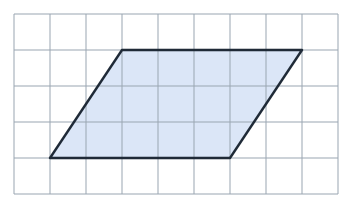
The parallelogram is drawn on a grid of centimetre squares.
Work out the area of the parallelogram.
Model answer
Base = 5 cm, height = 3 cm \(5 \times 3 = 15\) 15 cm²
Explanation
Count the squares along the base: 5 cm. Count straight up from the base to the top side: 3 cm. The area is \(5 \times 3 = 15\) cm². If you cut the triangle off one end and slide it to the other end, the parallelogram becomes a 5 by 3 rectangle, which you can count. A common mistake is to use the whole width of the shape, 7 squares, as the base.
Mark scheme
1 mark
15 cm²
Accept 15 with no unit. Do not accept 7.5 (halved) or 21 (from the full width of 7 squares times 3).
Question 2
2 marks
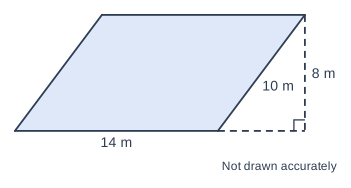
The diagram shows the plan of a field. The field is a parallelogram. The dashed lines show its perpendicular height, drawn outside the field.
Work out the area of the field.
Model answer
Base = 14 m, perpendicular height = 8 m \(14 \times 8 = 112\) 112 m²
Explanation
Use base \(\times\) perpendicular height. The height is the dashed 8 m line, which meets the line of the base at a right angle; it can be drawn outside the shape and is still the same height. The 10 m side slopes, so it is not the height. So the area is \(14 \times 8 = 112\) m², which you can work out as \(10 \times 8 + 4 \times 8 = 80 + 32\).
Mark scheme
1 mark
\(14 \times 8\); or the correct answer 112 with no working
Do not award for a calculation using the 10 m sloping side, e.g. \(14 \times 10\).
1 mark
112 m²
Accept 112 with no unit. Do not accept 140 (from \(14 \times 10\)), 56 (halved) or 80. A correct answer with no working scores full marks.
Question 3
3 marks
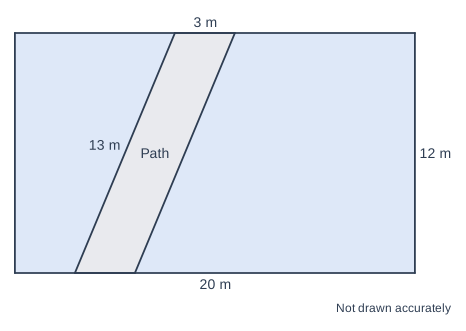
The diagram shows a rectangular lawn, 20 m long and 12 m wide. A path in the shape of a parallelogram crosses the lawn. The path is 3 m wide where it meets the top and bottom edges of the lawn.
Work out the area of the lawn that is grass.
Model answer
Lawn: \(20 \times 12 = 240\) m² Path: \(3 \times 12 = 36\) m² Grass: \(240 - 36 = 204\) 204 m²
Explanation
The grass is the whole lawn take away the path. The lawn is \(20 \times 12 = 240\) m². The path is a parallelogram with a base of 3 m, and its perpendicular height is the width of the lawn, 12 m, so it is \(3 \times 12 = 36\) m². That leaves \(240 - 36 = 204\) m² of grass. A common mistake is to use the 13 m sloping edge of the path as its height.
Mark scheme
1 mark
Area of the lawn 240 m² (\(20 \times 12\)); or the correct answer 204 with no working
1 mark
Area of the path 36 m² (\(3 \times 12\))
The path's base is 3 m and its perpendicular height is the width of the lawn, 12 m. Do not award for 39 (from \(3 \times 13\), using the sloping edge).
1 mark
204 m²
Accept 204 with no unit. Do not accept 201 (path worked out as \(3 \times 13\)) or 222 (path halved). A correct answer with no working scores full marks.
Question 4
4 marks
A car park has 8 parking spaces side by side in a row. Each space is a parallelogram with a base of 2.5 m along the kerb and a perpendicular height of 5 m.
Work out the total area of the 8 parking spaces.
Model answer
One space: \(2.5 \times 5 = 12.5\) m² 8 spaces: \(12.5 \times 8 = 100\) 100 m²
Explanation
Each space is a parallelogram, so its area is base \(\times\) perpendicular height: \(2.5 \times 5 = 12.5\) m². Eight spaces make \(12.5 \times 8 = 100\) m². Another way: the 8 bases together are \(8 \times 2.5 = 20\) m along the kerb, and the row of spaces is one big parallelogram, \(20 \times 5 = 100\) m².
Mark scheme
1 mark
A correct method for one space, e.g. \(2.5 \times 5\); or the correct answer 100 with no working
Also accept finding the total base first: \(8 \times 2.5 = 20\) m.
1 mark
12.5 m² for one space
For the total-base method, award this mark for 20 m.
1 mark
A correct method for 8 spaces using their area, e.g. \(12.5 \times 8\)
For the total-base method, award this mark for \(20 \times 5\).
1 mark
100 m²
Accept 100 with no unit. Do not accept 50 (halved) or 12.5. A correct answer with no working scores full marks.
Ready to try the rest? Tap your answers and see straight away how you did.
Ctrl + Enter to check
Study HelperHints first, answers after you try
Stuck on this one? Ask for a hint and I’ll point you in the right direction, without giving the answer away. Once you’ve checked your answer, I’ll show you how the marks are awarded.