Level:
Correct: 0
Incorrect: 0
Marks: 0/0
Practice
Course:
Topics:
Year 6 Maths Smart practice A mixed round aimed at your weak spots
Unit 1
Place value
Number and place value
Numbers up to ten million
Quick practice5 skills
Rounding whole numbers
Quick practice5 skills
Negative numbers
Quick practice5 skills
Roman numerals
Quick practice4 skills
Unit 2
Calculating
Unit 3
Fractions
Unit 4
Decimals
Unit 5
Fractions, decimals and percentages
Unit 6
Ratio and proportion
Unit 7
Algebra
Unit 8
Measurement
Unit 9
Shapes and angles
Unit 10
Position and direction
Geometry: position and direction
Coordinates in four quadrants
Quick practice5 skills
Translations
Quick practice4 skills
Reflections
Quick practice4 skills
Unit 11
Statistics
Statistics
Tables, timetables and bar charts
Quick practice4 skills
Line graphs
Quick practice4 skills
Pie charts
Quick practice5 skills
The mean
Quick practice5 skills
Avg
score:
–
Topics
done:
0/60

Area of triangles

Practise 20 questions on Area of triangles for Year 6 Maths. Tap your answer and find out straight away if you are right, with the Study Helper on hand if you get stuck.

  • 20 questions
  • 1–5 marks each
  • Instant marking
  • No sign-up needed
20 questions, marked as you go

Sample questions with model answers

Here are 4 of the questions in this topic, each with a model answer, an explanation of why it earns the marks and the mark scheme.

Question 1

1 mark

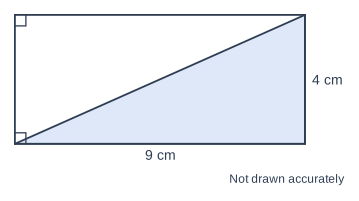
The diagram shows a rectangle 9 cm long and 4 cm wide. A diagonal splits it into two triangles. One of the triangles is shaded.

What is the area of the shaded triangle?

Geometry diagram, marked "Not drawn accurately". A triangle (its vertices are not labelled) (shaded). A rectangle (its vertices are not labelled). The unlabelled side going to the right is labelled 9 cm. The unlabelled side going upwards is labelled 4 cm. The angle at an unlabelled point is marked as a right angle (90°). The angle at an unlabelled point is marked as a right angle (90°).

Model answer

Rectangle: \(9 \times 4 = 36\) cm²
The triangle is half: \(36 \div 2 = 18\)
18 cm²

Explanation

The diagonal cuts the rectangle into two triangles that are exactly the same, so each one is half of the rectangle. The rectangle is \(9 \times 4 = 36\) cm², so the shaded triangle is 18 cm². This is why the area of a triangle is half of base \(\times\) height.

Mark scheme
  1. 1 mark

    18 cm²

    Accept 18 with no unit. Do not accept 36 (the whole rectangle) or 13.

Question 2

2 marks

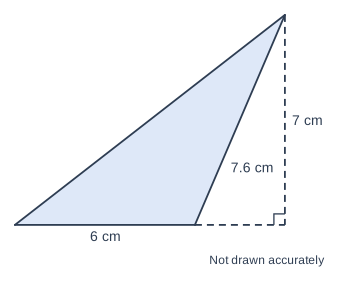
The diagram shows a triangle. The dashed lines show its perpendicular height, which is outside the triangle.

Work out the area of the triangle.

Geometry diagram, marked "Not drawn accurately". A triangle (its vertices are not labelled) (shaded). A dashed horizontal line with no labelled ends is drawn. A dashed vertical line with no labelled ends is drawn. The unlabelled side going to the right is labelled 6 cm. The unlabelled side going up and to the right is labelled 7.6 cm. An unlabelled line going downwards is labelled 7 cm. The angle at an unlabelled point is marked as a right angle (90°).

Model answer

Base = 6 cm, perpendicular height = 7 cm
\(\dfrac{1}{2} \times 6 \times 7 = 21\)
21 cm²

Explanation

The perpendicular height is the distance straight up from the line of the base to the top corner. For a triangle that leans over like this, it is measured outside the triangle, from the base line made longer. The base is still 6 cm, so the area is \(\dfrac{1}{2} \times 6 \times 7 = 21\) cm². A common mistake is to use the 7.6 cm sloping side.

Mark scheme
  1. 1 mark

    \(\dfrac{1}{2} \times 6 \times 7\), or \(6 \times 7 = 42\) and then halved; or the correct answer 21 with no working

    The base is 6 cm and the perpendicular height is 7 cm. Do not award for a calculation using 7.6 cm.

  2. 1 mark

    21 cm²

    Accept 21 with no unit. Do not accept 42 (not halved), 22.8 (from \(\dfrac{1}{2} \times 6 \times 7.6\)) or 26.6. A correct answer with no working scores full marks.

Question 3

2 marks

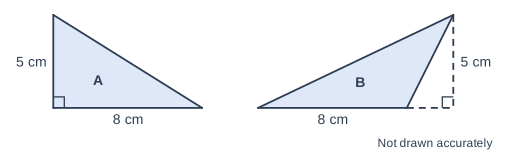
The diagram shows two triangles, A and B.

Mia says that triangles A and B have the same area.

What is the area of each triangle? Is Mia right?

Geometry diagram, marked "Not drawn accurately". A right-angled triangle A (its vertices are not labelled) (shaded). A triangle B (its vertices are not labelled) (shaded). A dashed horizontal line with no labelled ends is drawn. A dashed vertical line with no labelled ends is drawn. The angle at an unlabelled point is marked as a right angle (90°). The unlabelled side going to the right is labelled 8 cm. The unlabelled side going downwards is labelled 5 cm. The unlabelled side going to the right is labelled 8 cm. An unlabelled line going downwards is labelled 5 cm. The angle at an unlabelled point is marked as a right angle (90°). The text "A" is written inside the shape. The text "B" is written inside the shape.

Model answer

Yes. Both triangles have a base of 8 cm and a perpendicular height of 5 cm.
A: \(\dfrac{1}{2} \times 8 \times 5 = 20\) cm²
B: \(\dfrac{1}{2} \times 8 \times 5 = 20\) cm²

Explanation

The area of a triangle only depends on its base and its perpendicular height, not on how slanted it is. Both triangles have a base of 8 cm and a height of 5 cm, so both have an area of 20 cm². Triangle B looks longer because it leans over, but its height is still 5 cm.

Mark scheme
  1. 1 mark

    Yes, with a relevant but incomplete reason, e.g. 'they have the same numbers' or 'they both have 8 cm and 5 cm' (without saying that these are the base and the height, or giving the areas)

    'Yes' alone scores 0. 'No' scores 0.

  2. 1 mark

    A complete correct reason, e.g. both triangles have the same base (8 cm) and the same perpendicular height (5 cm), so they have the same area; or both areas worked out correctly as 20 cm² (\(\dfrac{1}{2} \times 8 \times 5\))

    A complete correct reason on its own scores both marks. Saying that both triangles have the same base and the same height is complete: the areas do not have to be worked out. A reason based on the triangles 'looking the same size' is not enough.

Question 4

4 marks

A triangle has an area of 12 cm². Its base and its perpendicular height are both whole numbers of centimetres.

Find all the possible pairs of base and height.

Model answer

\(\dfrac{1}{2} \times\) base \(\times\) height = 12, so base \(\times\) height = 24.
Pairs that multiply to 24:
base 1, height 24
base 2, height 12
base 3, height 8
base 4, height 6
base 6, height 4
base 8, height 3
base 12, height 2
base 24, height 1

Explanation

Half of base \(\times\) height is 12, so base \(\times\) height must be 24. Now list the factor pairs of 24 in order so you do not miss any: 1 and 24, 2 and 12, 3 and 8, 4 and 6. Each pair works either way round, because a base of 4 cm with a height of 6 cm is a different triangle from a base of 6 cm with a height of 4 cm. A common mistake is to find pairs that multiply to 12, which forgets the half.

Mark scheme
  1. 1 mark

    Base \(\times\) height = 24 (double the area), or at least one correct pair; or all 8 correct pairs with no working

  2. 1 mark

    At least 4 correct pairs

    The pairs (base, height) are 1 and 24, 2 and 12, 3 and 8, 4 and 6, 6 and 4, 8 and 3, 12 and 2, 24 and 1.

  3. 1 mark

    No wrong pairs in the list

    Award only if the previous mark was awarded. A list with a wrong extra pair, such as 3 and 4 or 2 and 6 (base × height = 12, forgetting to halve), does not score this mark.

  4. 1 mark

    All 8 pairs: base 1 cm height 24 cm, base 2 cm height 12 cm, base 3 cm height 8 cm, base 4 cm height 6 cm, base 6 cm height 4 cm, base 8 cm height 3 cm, base 12 cm height 2 cm, base 24 cm height 1 cm

    There are exactly 8 pairs. Also award this mark for the 4 pairs 1 and 24, 2 and 12, 3 and 8, 4 and 6 with a clear statement that each can be either way round (base and height swapped). This mark does not depend on the previous one: all 8 pairs with one wrong extra pair scores 3 marks, and the 4 pairs with no wrong pairs but not swapped round also scores 3 marks. A complete correct list of all 8 pairs with no working scores full marks.

Ready to try the rest? Tap your answers and see straight away how you did.

Topic notes

Area of triangles

The big idea

Every triangle is exactly half of a rectangle. Draw a rectangle around a triangle, with a matching base and height, and the triangle covers half of it. That gives a quick way to find the area of any triangle.

Why a triangle is half a rectangle

Geometry diagram, drawn accurately to scale. A rectangle (its vertices are not labelled). A triangle (its vertices are not labelled) (shaded). A dashed vertical line with no labelled ends is drawn. The unlabelled side going to the right is labelled base. An unlabelled line going downwards is labelled height. The angle at an unlabelled point is marked as a right angle (90°).
The dashed height cuts the rectangle into two smaller rectangles. The shaded triangle is half of each one, so it is half of the whole rectangle.

The area of the rectangle is base × height, so:

\[ \text{area of a triangle} = \dfrac{1}{2} \times \text{base} \times \text{perpendicular height} \]

Base and perpendicular height

  • The base can be any side of the triangle. It can point any way, even upside down.
  • Perpendicular means "at right angles". The perpendicular height measures straight from the base to the opposite corner. The height and the base (or the base made longer) make a right angle.
  • A sloping side is not the height. Diagrams often show the height as a dashed line with a small square for the right angle.
  • In a right-angled triangle, use the two shorter sides that form the right angle: one is the base and the other is the height.
  • On squared paper, count squares along the base, then count straight up (or across) to the far corner for the height.

The area is in square units, such as cm² or m², and it can end in .5. Do not round it.

Each flag on a string of bunting is a triangle. Its top edge is 16 cm long, and the point hangs 20 cm below the top edge. How much fabric do 10 flags need?

The top edge is the base, 16 cm. The height is the straight-down distance to the point, 20 cm. (The base is at the top here, and that is fine.)

One flag: \(\dfrac{1}{2} \times 16 \times 20\). Halve 16 first: \(8 \times 20 = 160\) cm²

10 flags: \(160 \times 10 = 1600\) cm² of fabric.

Compound shapes

Split the shape into rectangles and triangles, find each area, then add.

Geometry diagram, drawn accurately to scale. A garden (its vertices are not labelled) (shaded). A dashed vertical line with no labelled ends is drawn. The unlabelled side going to the right is labelled 8 m. The unlabelled side going to the right is labelled 7 m. The unlabelled side going downwards is labelled 5 m. The unlabelled side going down and to the right is labelled 8.6 m. The angle at an unlabelled point is marked as a right angle (90°). The angle at an unlabelled point is marked as a right angle (90°). The angle at an unlabelled point is marked as a right angle (90°).
The plan of a garden: a rectangle with a right-angled triangle on the end.

One box of grass seed covers 10 m². How many boxes are needed to sow the whole garden in the diagram?

Rectangle: 8 m long and 5 m wide, so its area is 40 m².

Triangle: its base is 7 m and its height is 5 m, the same as the end of the rectangle. The 8.6 m edge is sloping, so leave it out.

\(\dfrac{1}{2} \times 7 \times 5 = 17.5\) m²

Whole garden: \(40 + 17.5 = 57.5\) m²

5 boxes cover only 50 m², so 6 boxes are needed.

Stretch: finding a missing height

If you know the area and the base, double the area (that gives the rectangle around the triangle), then divide by the base.

Triangle P is 16 cm along its base and 9 cm high. Triangle Q has the same area, but its base is only 8 cm. How tall is triangle Q?

Area of P: \(\dfrac{1}{2} \times 16 \times 9 = 72\) cm²

The rectangle around Q is double that: \(72 \times 2 = 144\) cm²

Height of Q: \(144 \div 8 = 18\) cm

To check, put the numbers back in the formula: half of 8 times 18 does give 72. Halving the base doubled the height.

Remember

  • Area of a triangle = \(\dfrac{1}{2} \times\) base \(\times\) perpendicular height.
  • The height and the base make a right angle.
  • A triangle covers half of the rectangle drawn around it.
  • Area is in square units: cm² or m².

Common mistakes

  • Forgetting to halve. Base × height on its own gives the rectangle, which is double the triangle.
  • Taking a sloping side for the height. Look for the line that makes a right angle with the base.
  • On squared paper, counting past the end of the base to the spot under a leaning corner. Count only the side itself.
  • Writing cm instead of cm² for an area.

Top tip

Halve whichever number is even before you multiply: \(\dfrac{1}{2} \times 22 \times 7\) is \(11 \times 7 = 77\), which is easier than multiplying first and then halving.

Study Helper Hints first, answers after you try

Stuck on this one? Ask for a hint and I’ll point you in the right direction, without giving the answer away. Once you’ve checked your answer, I’ll show you how the marks are awarded.