Practise 25 questions on Order of operations for Year 6 Maths. Tap your answer and find out straight away if you are right, with the Study Helper on hand if you get stuck.
25 questions
1–4 marks each
Instant marking
No sign-up needed
20 questions, marked as you go
Sample questions with model answers
Here are 4 of the questions in this topic, each with a model answer, an explanation of why it earns the marks and the mark scheme.
Question 1
1 mark
Look at this calculation.
\(15 - 3 \times 4\)
Which part should you work out first?
Model answer
\(3 \times 4\)
Explanation
Multiplication comes before subtraction, so you work out \(3 \times 4 = 12\) first, and then \(15 - 12 = 3\). Doing \(15 - 3\) first gives \(12 \times 4 = 48\), a different answer, so the order really does matter.
Both multiplications come before the subtraction. Work out \(8 \times 5 = 40\) and \(6 \times 3 = 18\), then \(40 - 18 = 22\). A common mistake is to work from left to right: \(40 - 6 = 34\), then \(34 \times 3 = 102\).
Mark scheme
1 mark
40 and 18 seen; or the correct answer 22 with no working
1 mark
22
Do not accept 102 (working from left to right). A correct answer with no working scores full marks.
Question 3
2 marks
Find the missing number.
\(40 - \square \times 6 = 10\)
Model answer
The multiplication is done first, so 40 take away something makes 10. \(40 - 30 = 10\) \(\square \times 6 = 30\) \(30 \div 6 = 5\) The missing number is 5.
Explanation
Because multiplication comes first, \(\square \times 6\) is worked out and then taken from 40. 40 take away 30 makes 10, so \(\square \times 6 = 30\) and the missing number is 5. Check: \(40 - 5 \times 6 = 40 - 30 = 10\).
Mark scheme
1 mark
Sees that \(\square \times 6\) must be 30 (\(40 - 10 = 30\)); or the correct answer 5 with no working
1 mark
5
Do not accept 30 (forgetting to divide by 6). A correct answer with no working scores full marks.
Question 4
4 marks
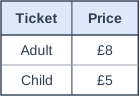
The table shows the prices of zoo tickets.
Mr Lee buys tickets for 2 adults and 3 children. He pays with a £50 note.
Which one calculation gives his change? Then work out his change.
First find the total cost, \(2 \times 8 + 3 \times 5 = 31\), then take it away from £50. Putting the cost in brackets makes sure it is all worked out before the subtraction. A common mistake is to write \(50 - 2 \times 8 + 3 \times 5\), which adds the children's tickets on instead of taking them away.
Mark scheme
1 mark
A correct single calculation, e.g. \(50 - (2 \times 8 + 3 \times 5)\) or \(50 - 2 \times 8 - 3 \times 5\)
Accept any correct single calculation, in any order (e.g. \(50 - (3 \times 5 + 2 \times 8)\)). Do not accept \(50 - 2 \times 8 + 3 \times 5\) (this adds the children's tickets on). Separate steps do not score this mark.
1 mark
16 and 15 seen (\(2 \times 8\) and \(3 \times 5\)); or the correct answer £19
1 mark
Total cost 31 seen, or 50 minus their total; or the correct answer £19
1 mark
£19
Accept 19. The correct answer with no single calculation scores 3 marks.
Ready to try the rest? Tap your answers and see straight away how you did.
Ctrl + Enter to check
Study HelperHints first, answers after you try
Stuck on this one? Ask for a hint and I’ll point you in the right direction, without giving the answer away. Once you’ve checked your answer, I’ll show you how the marks are awarded.