Practise 20 questions on Mixed numbers and improper fractions for Year 6 Maths. Tap your answer and find out straight away if you are right, with the Study Helper on hand if you get stuck.
20 questions
1–5 marks each
Instant marking
No sign-up needed
20 questions, marked as you go
Sample questions with model answers
Here are 4 of the questions in this topic, each with a model answer, an explanation of why it earns the marks and the mark scheme.
Question 1
1 mark
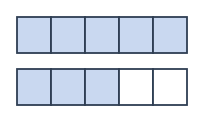
The diagram shows two bars. Each bar is one whole, split into fifths.
What is the amount that is shaded, as an improper fraction?
Model answer
The first bar has 5 fifths shaded and the second bar has 3 fifths shaded. 5 + 3 = 8 fifths \(\dfrac{8}{5}\)
Explanation
Each part is one fifth of a whole bar. Count every shaded part: 5 in the first bar and 3 in the second bar make 8 fifths. A common mistake is to write \(\dfrac{8}{10}\), as if both bars together were one whole, but each bar is one whole on its own.
Mark scheme
1 mark
\(\dfrac{8}{5}\)
Accept 'eight fifths'. Only an improper fraction scores the mark, because the question asks for one: 1 3/5 on its own scores 0. Do not accept 8/10 (counting all 10 parts as one whole).
Each whole cake is 6 slices, so the 3 whole cakes make 18 slices. The \(\dfrac{5}{6}\) of a cake is 5 more slices, so there are 23 slices. This is the same as writing \(3\dfrac{5}{6}\) as the improper fraction \(\dfrac{23}{6}\). A common mistake is to work out \(3 \times 5\) instead of \(3 \times 6\).
Mark scheme
1 mark
\(3 \times 6 = 18\) slices in the 3 whole cakes, or \(3\dfrac{5}{6} = \dfrac{23}{6}\); or the correct answer 23 with no working
1 mark
23 (slices)
Do not accept 23/6 as the final answer, because the question asks for the number of slices. A correct answer with no working scores full marks.
Question 3
2 marks
Sam says, "\(3\dfrac{2}{5} = \dfrac{6}{5}\) because \(3 \times 2 = 6\)."
To change a mixed number into an improper fraction, multiply the whole number by the denominator to find how many fifths are in the wholes, then add the numerator. Sam multiplied the whole number by the numerator instead. You can also see he is wrong because \(\dfrac{6}{5}\) is only a little more than 1, but \(3\dfrac{2}{5}\) is more than 3.
Mark scheme
1 mark
No, with a reason that is correct but not complete, e.g. '6/5 is too small' or 'you should multiply 3 by 5' without finishing
'No' alone scores 0. 'Yes' scores 0.
1 mark
No, with a complete reason, e.g. 3 wholes are 15 fifths, and 15 + 2 = 17, so \(3\dfrac{2}{5} = \dfrac{17}{5}\); or \(\dfrac{6}{5}\) is only \(1\dfrac{1}{5}\), which is less than 3
A complete correct reason on its own scores both marks.
Question 4
4 marks
Max writes every fraction with a denominator of 3 that is bigger than 4 and smaller than 6.
Write each of Max's fractions as a mixed number or a whole number.
Model answer
\(4 = \dfrac{12}{3}\) and \(6 = \dfrac{18}{3}\) Max's fractions are \(\dfrac{13}{3}, \dfrac{14}{3}, \dfrac{15}{3}, \dfrac{16}{3}, \dfrac{17}{3}\). \(4\dfrac{1}{3}\), \(4\dfrac{2}{3}\), 5, \(5\dfrac{1}{3}\), \(5\dfrac{2}{3}\)
Explanation
Write 4 and 6 as thirds: 4 is \(\dfrac{12}{3}\) and 6 is \(\dfrac{18}{3}\). Max's fractions have numerators between 12 and 18, so they are 13 to 17 thirds. Then change each one: \(\dfrac{15}{3}\) is exactly 5, and the others are 4 or 5 wholes with one or two thirds left over. A common mistake is to include \(\dfrac{12}{3}\) and \(\dfrac{18}{3}\), but those are equal to 4 and 6, not between them.
Mark scheme
1 mark
4 written as \(\dfrac{12}{3}\) and 6 written as \(\dfrac{18}{3}\), or the numerators 13 to 17 found; or the correct answer with no working
1 mark
All five fractions: \(\dfrac{13}{3}, \dfrac{14}{3}, \dfrac{15}{3}, \dfrac{16}{3}, \dfrac{17}{3}\), and no others
A list that includes 12/3 or 18/3 (which equal 4 and 6) does not score this mark.
1 mark
\(\dfrac{15}{3} = 5\)
1 mark
The other four written as mixed numbers: \(4\dfrac{1}{3}, 4\dfrac{2}{3}, 5\dfrac{1}{3}, 5\dfrac{2}{3}\)
All four needed, typed as 4 1/3 or 4 and 1/3 and so on. The final list 4 1/3, 4 2/3, 5, 5 1/3, 5 2/3 (in any order) with no working scores full marks.
Ready to try the rest? Tap your answers and see straight away how you did.
Ctrl + Enter to check
Study HelperHints first, answers after you try
Stuck on this one? Ask for a hint and I’ll point you in the right direction, without giving the answer away. Once you’ve checked your answer, I’ll show you how the marks are awarded.