Level:
Correct: 0
Incorrect: 0
Marks: 0/0
Exam Practice
Course:
Topics:
Edexcel GCSE Maths (Foundation calculator) Smart practice A mixed round aimed at your weak spots
Unit 1
Number
Unit 2
Algebra
Unit 3
Ratio, proportion and rates of change
Unit 4
Geometry and measures
Unit 5
Probability
Unit 6
Statistics
Avg
score:
–
Topics
done:
0/86

Systematic listing

Practise 19 exam-style questions on Systematic listing for Edexcel GCSE Maths (Foundation calculator). Write your answer as you would in the exam and get it marked in seconds against the mark scheme, point by point, with the Study Helper on hand if you get stuck.

  • 19 questions
  • 1–5 marks each
  • Instant marking
  • No sign-up needed
19 questions, marked as you go

Sample questions with model answers

Here are 4 of the questions in this topic, each with a model answer, an explanation of why it earns the marks and the mark scheme an examiner would use.

Question 1

1 mark

Three friends, Amy, Ben and Cal, stand in a line for a photo.

How many different orders can they stand in?

Model answer

Amy first: ABC, ACB
Ben first: BAC, BCA
Cal first: CAB, CBA
There are 6 different orders.

Explanation

Use initials and list the orders systematically: choose who is first, then the two ways of arranging the other two. Each of the 3 people can be first, and each time there are 2 orders, so 6 altogether.

Mark scheme
  1. 1 mark

    B1 for 6

    cao

Question 2

2 marks

Mia has 3 tops: red, blue and white.
She has 2 skirts: black and grey.
She has 2 pairs of shoes: trainers and boots.

She chooses one top, one skirt and one pair of shoes.

How many different outfits can she choose?

Model answer

Red top: black skirt with trainers, black skirt with boots, grey skirt with trainers, grey skirt with boots (4 outfits)
Blue top: the same 4 outfits
White top: the same 4 outfits
Total = 4 + 4 + 4 = 12 outfits

Explanation

List the outfits in order: fix the top, then go through every skirt, and for each skirt every pair of shoes. Each top gives 2 × 2 = 4 outfits, and there are 3 tops, so 12 outfits altogether.

Mark scheme
  1. 1 mark

    M1 for a systematic list of at least 6 correct outfits, or for 3 × 2 × 2

  2. 1 mark

    A1 for 12

    cao; correct answer with no working scores full marks

Question 3

2 marks

Ben has 24 square tiles.
He arranges all the tiles to make a rectangle.

List all the different rectangles he could make.
Give the length and width of each rectangle, in tiles.

Model answer

The length × width must be 24.
1 × 24
2 × 12
3 × 8
4 × 6
There are 4 different rectangles.

Explanation

The number of tiles in a rectangle is length × width, so you need the factor pairs of 24. Try widths 1, 2, 3, 4, ... in order; after 4 × 6 the pairs repeat (6 × 4 is the same rectangle turned round).

Mark scheme
  1. 2 marks

    B2 for 1 by 24, 2 by 12, 3 by 8, 4 by 6 and no others

    accept in either order, e.g. 24 by 1; do not count a rectangle and its rotation as different; B1 for at least 2 correct rectangles

Question 4

4 marks

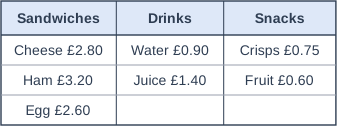
The table shows the prices of some items in a café.

Lena buys one sandwich, one drink and one snack.
She has £5

How many different combinations of one sandwich, one drink and one snack can Lena afford?

Table with columns "Sandwiches", "Drinks", "Snacks". Sandwiches: Cheese £2.80; Drinks: Water £0.90; Snacks: Crisps £0.75 | Sandwiches: Ham £3.20; Drinks: Juice £1.40; Snacks: Fruit £0.60 | Sandwiches: Egg £2.60; Drinks: (blank); Snacks: (blank).

Model answer

Cheese (£2.80): water + crisps £4.45, water + fruit £4.30, juice + crisps £4.95, juice + fruit £4.80
Ham (£3.20): water + crisps £4.85, water + fruit £4.70, juice + crisps £5.35, juice + fruit £5.20
Egg (£2.60): water + crisps £4.25, water + fruit £4.10, juice + crisps £4.75, juice + fruit £4.60
There are 12 combinations and 2 of them cost more than £5.
12 − 2 = 10 combinations

Explanation

List the combinations in order: fix the sandwich, then go through each drink, and for each drink each snack. Work out each total and count the ones that are £5 or less. Only the ham sandwich with juice is too expensive.

Mark scheme
  1. 1 mark

    P1 for a systematic list of combinations (at least 6 correct)

    correct answer with no working scores full marks

  2. 1 mark

    P1 for working out the total cost of at least 4 combinations correctly

  3. 1 mark

    P1 for identifying that ham, juice and crisps (£5.35) and ham, juice and fruit (£5.20) cost more than £5

    or for 12 combinations altogether

  4. 1 mark

    A1 for 10

    cao

Ready to try the rest? Every answer you write is marked against the mark scheme, so you can see exactly where the marks are.

Study Helper Hints first, answers after you try

Stuck on this one? Ask for a hint and I’ll point you in the right direction, without giving the answer away. Once you’ve checked your answer, I’ll show you how the marks are awarded.