
Level:
Correct: 0
Incorrect: 0
Marks: 0/0
Exam Practice
Course:
Topics:
Edexcel GCSE Maths (Foundation calculator) Smart practice A mixed round aimed at your weak spots
Unit 1
Number
Unit 2
Algebra
Unit 3
Ratio, proportion and rates of change
Unit 4
Geometry and measures
Unit 5
Probability
Unit 6
Statistics
Avg
score:
–
Topics
done:
0/86

Forming and solving equations

Practise 28 exam-style questions on Forming and solving equations for Edexcel GCSE Maths (Foundation calculator). Write your answer as you would in the exam and get it marked in seconds against the mark scheme, point by point, with the Study Helper on hand if you get stuck.

  • 28 questions
  • 1–5 marks each
  • Instant marking
  • No sign-up needed
20 questions, marked as you go

Sample questions with model answers

Here are 4 of the questions in this topic, each with a model answer, an explanation of why it earns the marks and the mark scheme an examiner would use.

Question 1

1 mark

A regular hexagon has sides of length \(s\) cm.

Write a formula for the perimeter, \(P\) cm, of the hexagon.

Model answer

A regular hexagon has 6 equal sides.
\(P = 6s\)

Explanation

A regular hexagon has 6 sides, all the same length, so the perimeter is 6 lots of s. A formula connects two letters, so it must start 'P ='. An expression such as 6s on its own is not a formula.

Mark scheme
  1. 1 mark

    B1 for \(P = 6s\)

    oe, e.g. \(P = s + s + s + s + s + s\); do not accept \(6s\) without \(P =\)
Question 2

2 marks

To change a temperature in degrees Celsius into degrees Fahrenheit:
multiply the Celsius temperature by 1.8, then add 32

Write a formula for \(F\), the temperature in degrees Fahrenheit, in terms of \(C\), the temperature in degrees Celsius.

Model answer

Multiply by 1.8: \(1.8C\)
Then add 32: \(1.8C + 32\)
\(F = 1.8C + 32\)

Explanation

Follow the instructions in order: multiply C by 1.8 first, then add 32. Writing 1.8(C + 32) would mean adding 32 first, which is a different rule. Remember 'F =' to make it a formula.

Mark scheme
  1. 1 mark

    B1 for \(1.8C + 32\), or \(F = 1.8C + k\)

    award this mark if the formula is fully correct; do not award for 1.8(C + 32); correct answer with no working scores full marks

  2. 1 mark

    B1 for \(F = 1.8C + 32\)

    oe, e.g. \(F = \frac{9}{5}C + 32\) or \(F = 32 + 1.8C\)

Question 3

3 marks

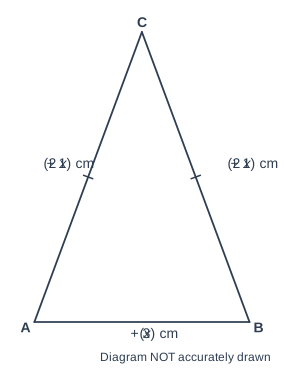
The diagram shows an isosceles triangle.
The lengths of the sides, in cm, are \(2x + 1\), \(2x + 1\) and \(x + 3\)
The perimeter of the triangle is 34.5 cm.

Work out the length of the shortest side.

Geometry diagram, marked "Diagram NOT accurately drawn". Isosceles triangle ABC. Side AB is labelled (x + 3) cm. Side BC is labelled (2x + 1) cm. Side CA is labelled (2x + 1) cm. BC and CA are each marked with one short dash (equal lengths).

Model answer

\(2x + 1 + 2x + 1 + x + 3 = 34.5\)
\(5x + 5 = 34.5\)
\(5x = 29.5\)
\(x = 5.9\)
Shortest side \(= x + 3 = 8.9\) cm
(The other sides are \(2 \times 5.9 + 1 = 12.8\) cm.)

Explanation

The perimeter is the sum of all three sides, so add the expressions and set them equal to 34.5. Solve to find x, then substitute to find each length. The sides are 12.8 cm, 12.8 cm and 8.9 cm, so the shortest is 8.9 cm.

Mark scheme
  1. 1 mark

    M1 for \(2x + 1 + 2x + 1 + x + 3 = 34.5\)

    oe, e.g. \(5x + 5 = 34.5\)

  2. 1 mark

    M1 for \(x = 5.9\)

    or for \(5x = 29.5\)

  3. 1 mark

    A1 for 8.9 cm

    correct answer with no working scores full marks

Question 4

4 marks

Two shops hire out bikes.

Shop A charges £12 plus £3.50 for each hour.
Shop B charges £5.50 for each hour.

Find the number of hours for which the two shops charge the same amount.
Which shop is cheaper for hires longer than this? Give a reason for your answer.

Model answer

Shop A: \(12 + 3.5h\)
Shop B: \(5.5h\)
\(12 + 3.5h = 5.5h\)
\(12 = 2h\)
\(h = 6\)
They charge the same (£33) for 6 hours.
For longer hires Shop A is cheaper, because each extra hour costs £3.50 at Shop A but £5.50 at Shop B.
(e.g. 7 hours: Shop A £36.50, Shop B £38.50)

Explanation

Write an expression for each shop's cost for h hours and set them equal. Solving gives 6 hours, where both cost £33. After that, the shop with the lower hourly rate becomes cheaper, so Shop A is cheaper for hires of more than 6 hours.

Mark scheme
  1. 1 mark

    P1 for \(12 + 3.5h\) and \(5.5h\)

    oe; correct values with no working score the calculation marks

  2. 1 mark

    P1 for \(12 + 3.5h = 5.5h\) leading to \(2h = 12\)

    oe; or for a table of costs for both shops

  3. 1 mark

    A1 for 6 hours

  4. 1 mark

    C1 for Shop A, with a reason, e.g. 7 hours costs £36.50 at Shop A and £38.50 at Shop B, or Shop A charges less for each extra hour

Ready to try the rest? Every answer you write is marked against the mark scheme, so you can see exactly where the marks are.

Study Helper Hints first, answers after you try

Stuck on this one? Ask for a hint and I’ll point you in the right direction, without giving the answer away. Once you’ve checked your answer, I’ll show you how the marks are awarded.