
Level:
Correct: 0
Incorrect: 0
Marks: 0/0
Exam Practice
Course:
Topics:
Edexcel GCSE Maths (Foundation calculator) Smart practice A mixed round aimed at your weak spots
Unit 1
Number
Unit 2
Algebra
Unit 3
Ratio, proportion and rates of change
Unit 4
Geometry and measures
Unit 5
Probability
Unit 6
Statistics
Avg
score:
–
Topics
done:
0/86

Sharing in a ratio and ratio problems

Practise 36 exam-style questions on Sharing in a ratio and ratio problems for Edexcel GCSE Maths (Foundation calculator). Write your answer as you would in the exam and get it marked in seconds against the mark scheme, point by point, with the Study Helper on hand if you get stuck.

  • 36 questions
  • 1–5 marks each
  • Instant marking
  • No sign-up needed
20 questions, marked as you go

Sample questions with model answers

Here are 4 of the questions in this topic, each with a model answer, an explanation of why it earns the marks and the mark scheme an examiner would use.

Question 1

1 mark

The ratio of the number of boys to the number of girls in a class is 2 : 3

Zara says,
"\(\dfrac{2}{3}\) of the students in the class are boys."

Is Zara correct?
Give a reason for your answer.

Model answer

No. There are 2 + 3 = 5 parts altogether and the boys are 2 of them, so \(\dfrac{2}{5}\) of the class are boys.

Explanation

A ratio of 2 : 3 means 2 boys for every 3 girls, so in every group of 5 students, 2 are boys. The fraction of boys is \(\frac{2}{5}\), not \(\frac{2}{3}\). Zara has compared the boys with the girls instead of with the whole class.

Mark scheme
  1. 1 mark

    C1 for No, with a correct reason, e.g. 'there are 2 + 3 = 5 parts, so \(\frac{2}{5}\) are boys' or 'the ratio compares boys with girls, not boys with the whole class'

    do not accept 'No' with no reason
Question 2

2 marks

Ella makes a drink by mixing orange squash and water in the ratio 1 : 6
She wants to make 1.75 litres of the drink.

How much orange squash does she need?
Give your answer in millilitres.

Model answer

1.75 litres = 1750 ml
Total parts = 1 + 6 = 7
Squash = 1750 ÷ 7 = 250 ml

Explanation

The 1.75 litres is the whole drink, which is 1 + 6 = 7 parts. The squash is 1 part, so divide by 7. Change litres to millilitres by multiplying by 1000. Dividing 1.75 by 6 is a common mistake.

Mark scheme
  1. 1 mark

    M1 for 1.75 ÷ (1 + 6) (= 0.25) or 1750 ÷ 7

  2. 1 mark

    A1 for 250 ml

    cao; 0.25 (litres) scores M1 A0; correct answer with no working scores full marks

Question 3

3 marks

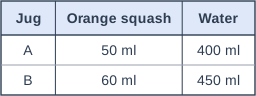
The table shows the amounts of orange squash and water in two jugs of drink.

Which jug has the stronger drink?
You must show your working.

Table with columns "Jug", "Orange squash", "Water". Jug: A; Orange squash: 50 ml; Water: 400 ml | Jug: B; Orange squash: 60 ml; Water: 450 ml.

Model answer

Jug A: squash : water = 50 : 400 = 1 : 8
Jug B: squash : water = 60 : 450 = 1 : 7.5
Jug B has less water for each 1 ml of squash, so Jug B has the stronger drink.

Explanation

Write each mixture as a ratio squash : water in the form 1 : n so they can be compared. The smaller the amount of water for each part of squash, the stronger the drink. Jug B has more squash, but also more water, so you must compare the ratios, not just the amounts of squash.

Mark scheme
  1. 1 mark

    M1 for a correct method to compare for one jug, e.g. 400 ÷ 50 (= 8) giving 1 : 8, or 450 ÷ 60 (= 7.5) giving 1 : 7.5, or \(\dfrac{50}{450}\) (= 0.111...)

    or squash per 100 ml of water, e.g. 12.5 ml

  2. 1 mark

    A1 for both values correct in a form that can be compared, e.g. 1 : 8 and 1 : 7.5, or 0.111... and 0.117..., or 12.5 ml and 13.3 ml of squash per 100 ml of water

  3. 1 mark

    C1 for Jug B, supported by correct figures

    answer only scores 0 (working required)

Question 4

3 marks

Jess and Leo share £1440 in the ratio 7 : 5

How much money must Jess give to Leo so that they each have the same amount?

Model answer

One part = 1440 ÷ 12 = £120
Jess = 7 × 120 = £840, Leo = 5 × 120 = £600
Equal shares = 1440 ÷ 2 = £720
Jess must give 840 − 720 = £120 to Leo.

Explanation

Share the money in the ratio 7 : 5 to find what each person has. If they have the same amount, each has half of £1440, which is £720. Jess has £120 more than £720, so she gives £120 to Leo. Giving the whole difference of £240 is a common mistake - that would make Leo have more.

Mark scheme
  1. 1 mark

    P1 for 1440 ÷ (7 + 5) (= 120)

  2. 1 mark

    P1 for Jess £840 and Leo £600, or 1440 ÷ 2 (= 720)

    both shares, or one share and the equal amount

  3. 1 mark

    A1 for £120

    cao; correct answer with no working scores full marks

Ready to try the rest? Every answer you write is marked against the mark scheme, so you can see exactly where the marks are.

Study Helper Hints first, answers after you try

Stuck on this one? Ask for a hint and I’ll point you in the right direction, without giving the answer away. Once you’ve checked your answer, I’ll show you how the marks are awarded.