Level:
Correct: 0
Incorrect: 0
Marks: 0/0
Exam Practice
Course:
Topics:
Edexcel GCSE Maths (Foundation calculator) Smart practice A mixed round aimed at your weak spots
Unit 1
Number
Unit 2
Algebra
Unit 3
Ratio, proportion and rates of change
Unit 4
Geometry and measures
Unit 5
Probability
Unit 6
Statistics
Avg
score:
–
Topics
done:
0/86

Powers and roots

Practise 28 exam-style questions on Powers and roots for Edexcel GCSE Maths (Foundation calculator). Write your answer as you would in the exam and get it marked in seconds against the mark scheme, point by point, with the Study Helper on hand if you get stuck.

  • 28 questions
  • 1–5 marks each
  • Instant marking
  • No sign-up needed
20 questions, marked as you go

Sample questions with model answers

Here are 4 of the questions in this topic, each with a model answer, an explanation of why it earns the marks and the mark scheme an examiner would use.

Question 1

1 mark

Write down a cube number that is between 50 and 100

Model answer

\(4^3 = 4 \times 4 \times 4 = 64\)
64 is a cube number between 50 and 100.

Explanation

Cube numbers are 1, 8, 27, 64, 125, ... (1 × 1 × 1, 2 × 2 × 2, 3 × 3 × 3, ...). The only one between 50 and 100 is 64. Do not confuse cube numbers with square numbers such as 81.

Mark scheme
  1. 1 mark

    B1 for 64

    cao

Question 2

2 marks

Amir says,
"\(4^3\) is greater than \(3^4\) because 4 is greater than 3"

Is Amir correct?
You must show how you get your answer.

Model answer

\(4^3 = 4 \times 4 \times 4 = 64\)
\(3^4 = 3 \times 3 \times 3 \times 3 = 81\)
64 is less than 81, so Amir is not correct.

Explanation

Work out both values and compare them. The power matters as well as the base: \(3^4\) uses four 3s, which gives a bigger answer than three 4s. Always show both values when you give your conclusion.

Mark scheme
  1. 1 mark

    M1 for 64 and 81 seen

    \(4^3 = 64\) and \(3^4 = 81\)

  2. 1 mark

    C1 for No, supported by 64 and 81

    answer only scores 0

Question 3

2 marks

Write 100 as the sum of a square number and a cube number.
Both numbers must be greater than 1.

Model answer

Cube numbers less than 100: 8, 27, 64
100 − 8 = 92 (not square)
100 − 27 = 73 (not square)
100 − 64 = 36 = \(6^2\) (square)
100 = 36 + 64, where 36 = \(6^2\) and 64 = \(4^3\)

Explanation

There are only three cube numbers between 1 and 100 (8, 27 and 64), so try subtracting each from 100 and check whether the answer is a square number. Only 100 − 64 = 36 works. Working through the possibilities in order like this means you will not miss the answer.

Mark scheme
  1. 1 mark

    M1 for listing square numbers and cube numbers, or a correct trial such as 100 − 64 = 36

    correct answer with no working scores full marks

  2. 1 mark

    A1 for 36 + 64

    cao (36 = \(6^2\), 64 = \(4^3\)); accept \(6^2 + 4^3\)

Question 4

4 marks

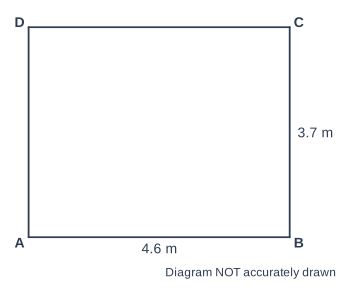
The diagram shows the floor of a room.
The floor is a rectangle 4.6 m long and 3.7 m wide.

Square carpet tiles are placed on the floor in rows, with their edges parallel to the walls.
Each tile has an area of 2025 cm².
Tiles cannot be cut.

What is the greatest number of whole tiles that can be placed on the floor?

Geometry diagram, marked "Diagram NOT accurately drawn". Rectangle ABCD. Side AB is labelled 4.6 m. Side BC is labelled 3.7 m.

Model answer

Side of one tile = \(\sqrt{2025} = 45\) cm
Length: 460 ÷ 45 = 10.2..., so 10 tiles fit
Width: 370 ÷ 45 = 8.2..., so 8 tiles fit
10 × 8 = 80 tiles

Explanation

The square root of a tile's area gives its side length, 45 cm. Change the floor sizes to cm, then see how many whole tiles fit along each side, rounding down because tiles cannot be cut. Dividing the floor area by the tile area gives 84, which is too many because the part tiles left at the edges cannot be used.

Mark scheme
  1. 1 mark

    P1 for \(\sqrt{2025}\) (= 45 cm)

    correct answer with no working scores full marks

  2. 1 mark

    P1 for using consistent units, e.g. 460 cm and 370 cm, or 0.45 m

  3. 1 mark

    P1 for 460 ÷ 45 (= 10.2...) and 370 ÷ 45 (= 8.2...), giving 10 and 8

    dependent on the first P1; dividing the areas (170 200 ÷ 2025 = 84.0...) does not score this mark

  4. 1 mark

    A1 for 80

    cao; 84 (from dividing the areas) scores A0

Ready to try the rest? Every answer you write is marked against the mark scheme, so you can see exactly where the marks are.

Study Helper Hints first, answers after you try

Stuck on this one? Ask for a hint and I’ll point you in the right direction, without giving the answer away. Once you’ve checked your answer, I’ll show you how the marks are awarded.