Practise 36 exam-style questions on Charts, tables and diagrams for Edexcel GCSE Maths (Foundation calculator). Write your answer as you would in the exam and get it marked in seconds against the mark scheme, point by point, with the Study Helper on hand if you get stuck.
36 questions
1–5 marks each
Instant marking
No sign-up needed
20 questions, marked as you go
Sample questions with model answers
Here are 4 of the questions in this topic, each with a model answer, an explanation of why it earns the marks and the mark scheme an examiner would use.
Question 1
1 mark
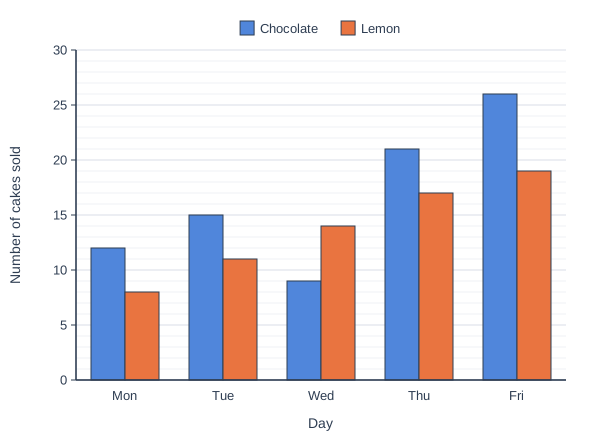
The dual bar chart shows the numbers of chocolate cakes and lemon cakes sold in a café on five days.
On which day were more lemon cakes sold than chocolate cakes?
Model answer
Wednesday: 9 chocolate cakes and 14 lemon cakes. Wednesday is the only day the lemon bar is taller.
Explanation
In a dual bar chart the two bars for each day are side by side, and the key tells you which colour is which cake. Look for the day where the lemon bar is taller than the chocolate bar.
Mark scheme
1 mark
B1 for Wednesday
accept Wed
Question 2
2 marks
60 students were asked how they travel to school. 18 of the students said they travel by bus.
Sara wants to show the results in a pie chart.
Work out the angle she should use for bus.
Model answer
360° ÷ 60 = 6° for each student 18 × 6° = 108°
Explanation
The whole pie chart, 360°, stands for all 60 students, so each student gets 360 ÷ 60 = 6°. Multiply by the number of students who travel by bus. A common mistake is to use 100 instead of 360.
Mark scheme
1 mark
M1 for \(\dfrac{18}{60} \times 360\)
oe, e.g. 360 ÷ 60 = 6° per student, then 18 × 6
1 mark
A1 for 108°
cao; correct answer with no working scores full marks
Question 3
3 marks
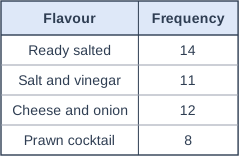
45 people were asked to name their favourite flavour of crisps. The table shows the results.
Jo wants to show this information in a pie chart.
Work out the angle she should use for each flavour.
Model answer
360° ÷ 45 = 8° for each person Ready salted: 14 × 8 = 112° Salt and vinegar: 11 × 8 = 88° Cheese and onion: 12 × 8 = 96° Prawn cocktail: 8 × 8 = 64° Check: 112 + 88 + 96 + 64 = 360°
Explanation
All 45 people share the 360° of the circle, so each person is worth 360 ÷ 45 = 8°. Multiply each frequency by 8. The angles must add up to 360°, which is a useful check.
Mark scheme
1 mark
M1 for 360 ÷ 45 (= 8° per person)
or \(\dfrac{14}{45} \times 360\) for one flavour; correct answer with no working scores full marks
1 mark
A1 for at least two correct angles
1 mark
A1 for all four correct: ready salted 112°, salt and vinegar 88°, cheese and onion 96°, prawn cocktail 64°
cao
Question 4
4 marks
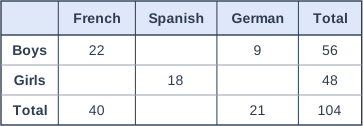
Each of the 104 students in Year 10 studies one language. The two-way table shows some information about the languages they study.
What percentage of the students who study Spanish are boys? Give your answer correct to 1 decimal place.
Model answer
Boys who study Spanish: 56 − 22 − 9 = 25 Students who study Spanish: 25 + 18 = 43 \(\dfrac{25}{43} \times 100 = 58.139...\%\) = 58.1% (1 d.p.)
Explanation
First fill in the gaps you need: each row and column adds up to its total. The question asks about the students who study Spanish, so divide the number of Spanish boys by the Spanish total (43), not by the number of boys or by 104.
Mark scheme
1 mark
P1 for 56 − 22 − 9 (= 25) boys who study Spanish
1 mark
P1 for 25 + 18 (= 43) students who study Spanish
ft their 25; or 104 − 40 − 21 (= 43)
1 mark
P1 for \(\dfrac{25}{43} \times 100\)
ft their 25 and 43
1 mark
A1 for 58.1%
awrt 58.1 (58.139...); correct answer with no working scores full marks
Ready to try the rest? Every answer you write is marked against the mark scheme, so you can see exactly where the marks are.
Ctrl + Enter to check
Study HelperHints first, answers after you try
Stuck on this one? Ask for a hint and I’ll point you in the right direction, without giving the answer away. Once you’ve checked your answer, I’ll show you how the marks are awarded.