
Level:
Correct: 0
Incorrect: 0
Marks: 0/0
Exam Practice
Course:
Topics:
Edexcel GCSE Maths (Foundation calculator) Smart practice A mixed round aimed at your weak spots
Unit 1
Number
Unit 2
Algebra
Unit 3
Ratio, proportion and rates of change
Unit 4
Geometry and measures
Unit 5
Probability
Unit 6
Statistics
Avg
score:
–
Topics
done:
0/86

Areas and volumes of prisms

Practise 37 exam-style questions on Areas and volumes of prisms for Edexcel GCSE Maths (Foundation calculator). Write your answer as you would in the exam and get it marked in seconds against the mark scheme, point by point, with the Study Helper on hand if you get stuck.

  • 37 questions
  • 1–5 marks each
  • Instant marking
  • No sign-up needed
20 questions, marked as you go

Sample questions with model answers

Here are 4 of the questions in this topic, each with a model answer, an explanation of why it earns the marks and the mark scheme an examiner would use.

Question 1

2 marks

The diagram shows a parallelogram.

Work out the area of the parallelogram.
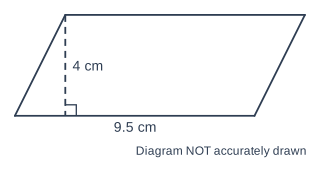
Geometry diagram, marked "Diagram NOT accurately drawn". A parallelogram (its vertices are not labelled). A dashed vertical line with no labelled ends is drawn. The angle at an unlabelled point is marked as a right angle (90°). The unlabelled side going to the right is labelled 9.5 cm. An unlabelled line going downwards is labelled 4 cm.

Model answer

Area of a parallelogram = base × perpendicular height
9.5 × 4 = 38
Area = 38 cm²

Explanation

A parallelogram can be cut along its height and rearranged into a rectangle, so its area is base × perpendicular height. Do not halve: that is only for triangles. Always use the height that is at right angles to the base.

Mark scheme
  1. 1 mark

    M1 for 9.5 × 4

  2. 1 mark

    A1 for 38 cm²

    correct answer with no working scores full marks
Question 2

2 marks

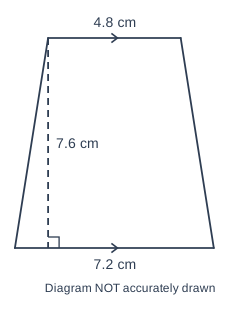
The diagram shows a trapezium.

Show that the area of the trapezium is 45.6 cm².

Geometry diagram, marked "Diagram NOT accurately drawn". A trapezium (its vertices are not labelled). A dashed vertical line with no labelled ends is drawn. The angle at an unlabelled point is marked as a right angle (90°). The unlabelled side going to the right is labelled 7.2 cm. The unlabelled side going to the right is labelled 4.8 cm. An unlabelled line going downwards is labelled 7.6 cm. An unlabelled line going to the right and an unlabelled line going to the right are each marked with an arrowhead (parallel lines).

Model answer

Area = \(\frac{1}{2} \times (4.8 + 7.2) \times 7.6\)
\(= \frac{1}{2} \times 12 \times 7.6\)
\(= 6 \times 7.6 = 45.6\) cm²

Explanation

In a 'show that' question the answer is given, so the marks are for showing every step. Write the formula with the numbers substituted, then each stage of the calculation, ending with 45.6.

Mark scheme
  1. 1 mark

    M1 for \(\frac{1}{2} \times (4.8 + 7.2) \times 7.6\)

    oe, e.g. 6 × 7.6

  2. 1 mark

    A1 for 45.6 from correct working

    must see working: a 'show that' answer with no working scores 0

Question 3

3 marks

A triangle has a base of 12 cm and a perpendicular height of 9 cm.
A parallelogram has a base of 7.5 cm.

The area of the parallelogram is the same as the area of the triangle.

Work out the perpendicular height of the parallelogram.

Model answer

Area of the triangle = \(\frac{1}{2} \times 12 \times 9 = 54\) cm²
Area of the parallelogram = 7.5 × height = 54
Height = 54 ÷ 7.5 = 7.2 cm

Explanation

First find the area of the triangle, which is also the area of the parallelogram. The area of a parallelogram is base × height, so divide the area by the base to find the height. Check: 7.5 × 7.2 = 54.

Mark scheme
  1. 1 mark

    M1 for \(\frac{1}{2} \times 12 \times 9\) (= 54)

  2. 1 mark

    M1 for their area ÷ 7.5

  3. 1 mark

    A1 for 7.2 cm

    correct answer with no working scores full marks

Question 4

4 marks

A crate is a cuboid 1.2 m long, 0.8 m wide and 0.5 m high.

Boxes in the shape of cuboids are packed into the crate.
Each box measures 25 cm by 15 cm by 20 cm.
All the boxes are packed the same way, with the 25 cm edges along the length of the crate, the 15 cm edges along the width and the 20 cm edges going up.

Work out the greatest number of boxes that can be packed into the crate.

Model answer

1.2 m = 120 cm, 0.8 m = 80 cm, 0.5 m = 50 cm
Along the length: 120 ÷ 25 = 4.8, so 4 boxes
Along the width: 80 ÷ 15 = 5.33..., so 5 boxes
Going up: 50 ÷ 20 = 2.5, so 2 layers
Number of boxes = 4 × 5 × 2 = 40

Explanation

Work out how many whole boxes fit along each edge of the crate, rounding down because you cannot use part of a box. Then multiply the three numbers. Dividing the volume of the crate by the volume of a box (480 000 ÷ 7500 = 64) is wrong here, because the boxes do not fill the crate exactly.

Mark scheme
  1. 1 mark

    P1 for changing to the same units, e.g. 120 cm, 80 cm and 50 cm

    correct answer with no working scores full marks

  2. 1 mark

    P1 for 120 ÷ 25 or 80 ÷ 15 or 50 ÷ 20

    may be implied by 4.8, 5.3 or 2.5

  3. 1 mark

    P1 for 4 × 5 × 2 (whole numbers of boxes in each direction)

  4. 1 mark

    A1 for 40

    do not accept 64 (from dividing the volumes)

Ready to try the rest? Every answer you write is marked against the mark scheme, so you can see exactly where the marks are.

Study Helper Hints first, answers after you try

Stuck on this one? Ask for a hint and I’ll point you in the right direction, without giving the answer away. Once you’ve checked your answer, I’ll show you how the marks are awarded.