Practise 19 exam-style questions on Plans and elevations for Edexcel GCSE Maths (Foundation calculator). Write your answer as you would in the exam and get it marked in seconds against the mark scheme, point by point, with the Study Helper on hand if you get stuck.
19 questions
1–5 marks each
Instant marking
No sign-up needed
19 questions, marked as you go
Sample questions with model answers
Here are 4 of the questions in this topic, each with a model answer, an explanation of why it earns the marks and the mark scheme an examiner would use.
Question 1
1 mark
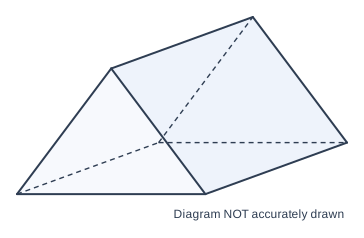
Here is a triangular prism. The prism is lying on one of its rectangular faces.
Write down the name of the shape of the plan of the prism.
Model answer
Rectangle (with a line along the middle, where the two sloping faces meet)
Explanation
The plan is the view from directly above. From above you see the two sloping rectangular faces side by side, so the outline of the plan is a rectangle with a line down the middle for the top edge. The triangle is what you see from the front.
Mark scheme
1 mark
B1 for rectangle
accept a rectangle with a line along the middle, or two rectangles; do not accept triangle
Question 2
2 marks
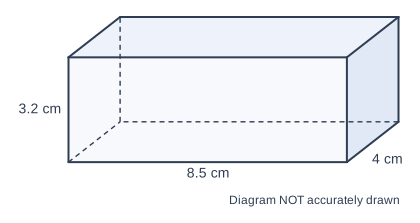
The diagram shows a cuboid.
Work out the area of the plan of the cuboid.
Model answer
The plan is the view from above, a rectangle 8.5 cm by 4 cm. Area = 8.5 × 4 = 34 cm²
Explanation
From above you see the top face of the cuboid, which has the same length (8.5 cm) and width (4 cm) as the base. The height does not appear on the plan. A common mistake is to use the height, 8.5 × 3.2, which is the area of the front elevation.
Mark scheme
1 mark
M1 for 8.5 × 4
1 mark
A1 for 34 cm²
correct answer with no working scores full marks
Question 3
2 marks
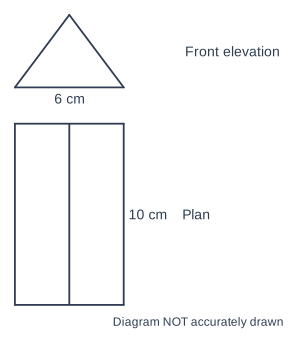
The diagram shows the front elevation and the plan of a 3D shape. The front elevation is a triangle. The plan is a rectangle with a line down the middle.
Write down the name of the 3D shape and its length.
Model answer
The front elevation is a triangle and the plan is a rectangle, so the shape is a triangular prism. The plan shows how far the prism goes back: its length is 10 cm.
Explanation
A shape that looks like a triangle from the front and a rectangle from above is a triangular prism: the triangle is its cross-section. The line down the middle of the plan is the top edge where the two sloping faces meet. The plan shows the width of the triangle (6 cm) and the length of the prism (10 cm).
Mark scheme
1 mark
B1 for triangular prism
do not accept prism on its own; correct answer with no working scores full marks
1 mark
B1 for 10 cm
cao
Question 4
3 marks
A box is a cuboid. The plan of the box is a rectangle with an area of 37.8 cm². The front elevation of the box is a rectangle with an area of 27 cm². The length of the box is 9 cm. The length is shown on both the plan and the front elevation.
Work out the volume of the box.
Model answer
Plan: length × width = 37.8, so width = 37.8 ÷ 9 = 4.2 cm Front elevation: length × height = 27, so height = 27 ÷ 9 = 3 cm Volume = 9 × 4.2 × 3 = 113.4 cm³
Explanation
The plan of a cuboid is length × width and the front elevation is length × height. Divide each area by the length to find the missing measurements. Then multiply the length, width and height to find the volume.
Mark scheme
1 mark
M1 for the width, 37.8 ÷ 9 (= 4.2)
1 mark
M1 for the height, 27 ÷ 9 (= 3)
1 mark
A1 for 113.4 cm³
correct answer with no working scores full marks
Ready to try the rest? Every answer you write is marked against the mark scheme, so you can see exactly where the marks are.
Ctrl + Enter to check
Study HelperHints first, answers after you try
Stuck on this one? Ask for a hint and I’ll point you in the right direction, without giving the answer away. Once you’ve checked your answer, I’ll show you how the marks are awarded.