
Level:
Correct: 0
Incorrect: 0
Marks: 0/0
Exam Practice
Course:
Topics:
Edexcel GCSE Maths (Foundation calculator) Smart practice A mixed round aimed at your weak spots
Unit 1
Number
Unit 2
Algebra
Unit 3
Ratio, proportion and rates of change
Unit 4
Geometry and measures
Unit 5
Probability
Unit 6
Statistics
Avg
score:
–
Topics
done:
0/86

Equations, identities and algebraic arguments

Practise 19 exam-style questions on Equations, identities and algebraic arguments for Edexcel GCSE Maths (Foundation calculator). Write your answer as you would in the exam and get it marked in seconds against the mark scheme, point by point, with the Study Helper on hand if you get stuck.

  • 19 questions
  • 1–4 marks each
  • Instant marking
  • No sign-up needed
19 questions, marked as you go

Sample questions with model answers

Here are 4 of the questions in this topic, each with a model answer, an explanation of why it earns the marks and the mark scheme an examiner would use.

Question 1

1 mark

Is \(x^2 = 4x\) an identity?
Give a reason for your answer.

Model answer

No.
When \(x = 1\): \(x^2 = 1\) and \(4x = 4\), which are not equal.
So it is not true for every value of \(x\), and it is not an identity. (It is only true when \(x = 0\) or \(x = 4\).)

Explanation

An identity must be true for every value of x. To show something is not an identity, find one value of x that makes the two sides different. Here x = 1 gives 1 on the left and 4 on the right.

Mark scheme
  1. 1 mark

    B1 for No, with a correct reason, e.g. when \(x = 1\), \(x^2 = 1\) but \(4x = 4\), or it is only true when \(x = 0\) or \(x = 4\)

    "No" with no reason scores 0
Question 2

2 marks

\(a(x + 5) \equiv 4x + b\)

Find the value of \(a\) and the value of \(b\).

Model answer

\(a(x + 5) = ax + 5a\)
Compare with \(4x + b\): \(ax = 4x\), so \(a = 4\)
\(b = 5a = 5 \times 4 = 20\)

Explanation

Because the two sides are identical, the x terms must match and the number terms must match. Expanding gives ax + 5a, so a must be 4 and b must be 5 × 4 = 20. Check: 4(x + 5) = 4x + 20.

Mark scheme
  1. 1 mark

    B1 for \(a = 4\)

    cao; correct answer with no working scores full marks

  2. 1 mark

    B1 for \(b = 20\)

    ft 5 × their a

Question 3

2 marks

Dev wants to find out if this is an identity.

\(2(x + 6) - 3(x - 1) \equiv 15 - x\)

Here is his working.

\(2(x + 6) - 3(x - 1) = 2x + 12 - 3x - 3\)
\(= 9 - x\)

Dev says, "This is not an identity."

Dev is wrong.
Explain the mistake Dev has made, and show that it is an identity.

Model answer

Dev has multiplied −3 by −1 and got −3. It should be +3.
\(2(x + 6) - 3(x - 1) = 2x + 12 - 3x + 3\)
\(= 15 - x\)
Both sides are the same, so it is an identity.

Explanation

When you multiply out −3(x − 1), the −3 multiplies both terms: −3 × x = −3x and −3 × −1 = +3, because a negative times a negative is positive. With the correct sign the left-hand side simplifies to 15 − x, which matches the right-hand side.

Mark scheme
  1. 1 mark

    B1 for explaining the mistake, e.g. \(-3 \times -1 = +3\), not −3

  2. 1 mark

    B1 for correct working, e.g. \(2x + 12 - 3x + 3 = 15 - x\)

Question 4

4 marks

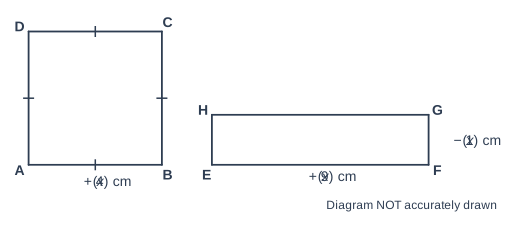
The diagram shows a square and a rectangle.
The square has sides of length \((x + 4)\) cm.
The rectangle has length \((x + 9)\) cm and width \((x - 1)\) cm.

Show that the area of the square is always 25 cm² more than the area of the rectangle.

Geometry diagram, marked "Diagram NOT accurately drawn". Square ABCD. Rectangle EFGH. Side AB is labelled (x + 4) cm. Side EF is labelled (x + 9) cm. Side FG is labelled (x − 1) cm. AB, BC, CD and DA are each marked with one short dash (equal lengths).

Model answer

Square: \((x + 4)^2 = x^2 + 4x + 4x + 16 = x^2 + 8x + 16\)
Rectangle: \((x + 9)(x - 1) = x^2 - x + 9x - 9 = x^2 + 8x - 9\)
Difference: \(x^2 + 8x + 16 - (x^2 + 8x - 9) = 16 + 9 = 25\)
The square's area is always 25 cm² more than the rectangle's area.

Explanation

Expand both area expressions, then subtract the rectangle's area from the square's area, using a bracket so that every sign changes. The x² and 8x terms cancel, leaving 25 whatever the value of x. A common mistake is to work out 16 − 9 = 7 instead of 16 − (−9) = 25.

Mark scheme
  1. 1 mark

    M1 for expanding \((x + 4)^2\) with at least three of the four terms \(x^2\), \(4x\), \(4x\), \(16\) correct

  2. 1 mark

    M1 for expanding \((x + 9)(x - 1)\) with at least three of the four terms \(x^2\), \(-x\), \(9x\), \(-9\) correct

  3. 1 mark

    M1 for subtracting, e.g. \(x^2 + 8x + 16 - (x^2 + 8x - 9)\)

  4. 1 mark

    C1 for showing the difference is 25 from correct working

    numerical examples only score 0

Ready to try the rest? Every answer you write is marked against the mark scheme, so you can see exactly where the marks are.

Study Helper Hints first, answers after you try

Stuck on this one? Ask for a hint and I’ll point you in the right direction, without giving the answer away. Once you’ve checked your answer, I’ll show you how the marks are awarded.