Practise 38 exam-style questions on Pythagoras' theorem and trigonometry for Edexcel GCSE Maths (Foundation calculator). Write your answer as you would in the exam and get it marked in seconds against the mark scheme, point by point, with the Study Helper on hand if you get stuck.
38 questions
1–5 marks each
Instant marking
No sign-up needed
20 questions, marked as you go
Sample questions with model answers
Here are 4 of the questions in this topic, each with a model answer, an explanation of why it earns the marks and the mark scheme an examiner would use.
Question 1
1 mark
Use your calculator to work out tan 52°
Give your answer correct to 3 decimal places.
Model answer
tan 52° = 1.27994... = 1.280 (3 d.p.)
Explanation
Make sure your calculator is in degrees mode (D on the display). The fourth decimal place is 9, so the third decimal place rounds up from 9 to 10, giving 1.280. Keep the final zero: it shows the answer is correct to 3 decimal places.
Mark scheme
1 mark
B1 for 1.280
awrt 1.280 (1.27994...); do not accept 1.27
Question 2
2 marks
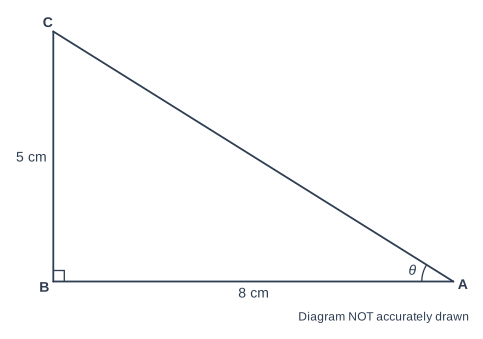
The diagram shows a right-angled triangle ABC.
Work out the size of the angle marked θ. Give your answer correct to 1 decimal place.
Model answer
5 cm is opposite θ and 8 cm is adjacent to θ. \(\tan\theta = \dfrac{5}{8} = 0.625\) \(\theta = \tan^{-1}(0.625) = 32.005...^\circ\) θ = 32.0° (1 d.p.)
Explanation
You know the opposite and adjacent sides, so use tan. Work out 5 ÷ 8, then use the inverse tan button (\(\tan^{-1}\), usually SHIFT then tan) to get the angle. A common mistake is to work out 8 ÷ 5, which gives the other angle, 58.0°.
Mark scheme
1 mark
M1 for \(\tan\theta = \frac{5}{8}\)
oe, e.g. \(\tan^{-1}(5 \div 8)\) or \(\tan^{-1}(0.625)\)
1 mark
A1 for 32.0°
awrt 32.0 (32.005...); accept 32; correct answer with no working scores full marks
Question 3
3 marks
A boat sails 14.5 km due east from a harbour. It then sails 9.2 km due north.
How far is the boat from the harbour now? Give your answer correct to 1 decimal place.
Model answer
East and north are at right angles, so the journey makes a right-angled triangle. \(d^2 = 14.5^2 + 9.2^2\) \(d^2 = 210.25 + 84.64 = 294.89\) \(d = \sqrt{294.89} = 17.1723...\) The boat is 17.2 km from the harbour.
Explanation
Due east and due north are at 90° to each other, so the straight line back to the harbour is the hypotenuse of a right-angled triangle. Add the squares of the two distances and square root. The answer is not 14.5 + 9.2 = 23.7 km, because the boat did not travel in a straight line.
M1 for \(\sqrt{294.89}\) or the square root of their sum of squares
1 mark
A1 for 17.2 km
awrt 17.2 (17.1723...); correct answer with no working scores full marks
Question 4
4 marks
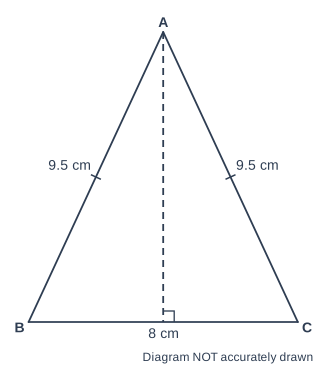
The diagram shows an isosceles triangle ABC. AB = AC = 9.5 cm and BC = 8 cm. The dashed line from A meets BC at right angles.
Work out the area of the triangle. Give your answer correct to 1 decimal place.
Model answer
The dashed line cuts BC in half: 8 ÷ 2 = 4 cm. \(h^2 = 9.5^2 - 4^2 = 90.25 - 16 = 74.25\) \(h = \sqrt{74.25} = 8.6168...\) cm Area = \(\frac{1}{2} \times 8 \times 8.6168... = 34.467...\) Area = 34.5 cm² (1 d.p.)
Explanation
To find the area you need the perpendicular height. In an isosceles triangle the height from the top vertex cuts the base exactly in half, giving a right-angled triangle with hypotenuse 9.5 cm and base 4 cm. Use Pythagoras to find the height, then use area = ½ × base × height with the whole base of 8 cm.
Mark scheme
1 mark
P1 for half of the base, 4 cm, used in a right-angled triangle
1 mark
P1 for \(9.5^2 - 4^2\) (= 74.25)
oe
1 mark
P1 for \(\frac{1}{2} \times 8 \times \sqrt{74.25}\)
or ½ × 8 × their height (height = 8.616...)
1 mark
A1 for 34.5 cm²
awrt 34.5 (34.467...); correct answer with no working scores full marks
Ready to try the rest? Every answer you write is marked against the mark scheme, so you can see exactly where the marks are.
Ctrl + Enter to check
Study HelperHints first, answers after you try
Stuck on this one? Ask for a hint and I’ll point you in the right direction, without giving the answer away. Once you’ve checked your answer, I’ll show you how the marks are awarded.