Practise 28 exam-style questions on Frequency trees and probability experiments for Edexcel GCSE Maths (Foundation calculator). Write your answer as you would in the exam and get it marked in seconds against the mark scheme, point by point, with the Study Helper on hand if you get stuck.
28 questions
1–5 marks each
Instant marking
No sign-up needed
20 questions, marked as you go
Sample questions with model answers
Here are 4 of the questions in this topic, each with a model answer, an explanation of why it earns the marks and the mark scheme an examiner would use.
Question 1
1 mark
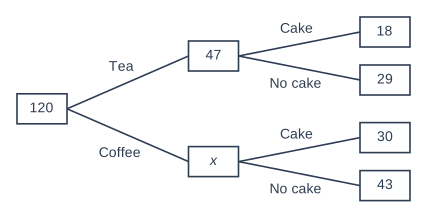
120 customers in a café were asked whether they bought tea or coffee, and whether they bought a cake. The frequency tree shows the results.
Work out the value of x.
Model answer
x = 120 − 47 = 73 (Check: 30 + 43 = 73)
Explanation
The numbers at the ends of a set of branches add up to the number they split from. So the tea and coffee customers add up to 120, and x = 120 − 47. You can also add the two coffee boxes: 30 + 43 = 73.
Mark scheme
1 mark
B1 for 73
cao
Question 2
2 marks
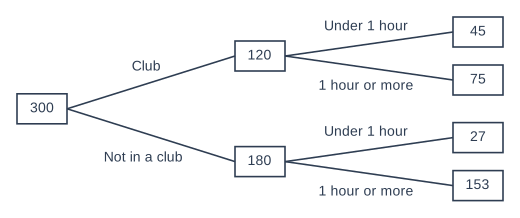
300 runners took part in a race. The frequency tree shows whether each runner belongs to a running club and whether they finished in under 1 hour.
What percentage of all the runners finished in under 1 hour?
Add the two 'Under 1 hour' boxes to get 72 runners. To write 72 out of 300 as a percentage, divide by 300 and multiply by 100.
Mark scheme
1 mark
M1 for \(\dfrac{45 + 27}{300} \times 100\)
or 72 ÷ 300 seen
1 mark
A1 for 24%
cao; correct answer with no working scores full marks
Question 3
3 marks
80 people went to a cinema. 36 of the people were children. 21 of the children bought popcorn. 15 of the adults bought popcorn.
How many of the 80 people did not buy popcorn? You may use a frequency tree to help you.
Model answer
Adults: 80 − 36 = 44 Children with no popcorn: 36 − 21 = 15 Adults with no popcorn: 44 − 15 = 29 Did not buy popcorn: 15 + 29 = 44 (Or: bought popcorn 21 + 15 = 36, so 80 − 36 = 44 did not.)
Explanation
A frequency tree helps: split 80 into 36 children and 44 adults, then split each group into popcorn and no popcorn. Add the two 'no popcorn' boxes. A quicker way is to subtract everyone who bought popcorn (21 + 15) from 80.
Mark scheme
1 mark
P1 for 80 − 36 (= 44) adults
or 21 + 15 (= 36) bought popcorn
1 mark
P1 for 36 − 21 (= 15) children and 44 − 15 (= 29) adults who did not buy popcorn
or 80 − 36 using the total who bought popcorn
1 mark
A1 for 44
cao; correct answer with no working scores full marks
Question 4
4 marks
1200 people visited a museum on Saturday. 45% of the visitors were adults. The rest were children. 60% of the adults bought a guidebook. 15% of the children bought a guidebook.
Work out the total number of guidebooks bought on Saturday. You may use a frequency tree to help you.
Model answer
Adults: 45% of 1200 = 0.45 × 1200 = 540 Children: 1200 − 540 = 660 Adults with a guidebook: 60% of 540 = 324 Children with a guidebook: 15% of 660 = 99 Total guidebooks: 324 + 99 = 423
Explanation
Split the 1200 visitors into adults and children first, then find the percentage of each group who bought a guidebook. The percentages 60% and 15% are of different groups, so you cannot just add them and use 75% of 1200.
Mark scheme
1 mark
P1 for 0.45 × 1200 (= 540) adults
or 0.55 × 1200 (= 660) children
1 mark
P1 for 0.6 × 540 (= 324)
ft their number of adults
1 mark
P1 for 1200 − 540 (= 660) children and 0.15 × 660 (= 99)
1 mark
A1 for 423
cao; correct answer with no working scores full marks
Ready to try the rest? Every answer you write is marked against the mark scheme, so you can see exactly where the marks are.
Ctrl + Enter to check
Study HelperHints first, answers after you try
Stuck on this one? Ask for a hint and I’ll point you in the right direction, without giving the answer away. Once you’ve checked your answer, I’ll show you how the marks are awarded.