Practise 29 exam-style questions on Properties of quadrilaterals and triangles for Edexcel GCSE Maths (Foundation calculator). Write your answer as you would in the exam and get it marked in seconds against the mark scheme, point by point, with the Study Helper on hand if you get stuck.
29 questions
1–5 marks each
Instant marking
No sign-up needed
20 questions, marked as you go
Sample questions with model answers
Here are 4 of the questions in this topic, each with a model answer, an explanation of why it earns the marks and the mark scheme an examiner would use.
Question 1
1 mark
A quadrilateral has four sides of equal length. None of its angles is a right angle.
Write down the mathematical name of the quadrilateral.
Model answer
Rhombus
Explanation
A quadrilateral with four equal sides is either a square or a rhombus. A square has four right angles, so a shape with four equal sides and no right angles is a rhombus. Use the mathematical name, not 'diamond'.
Mark scheme
1 mark
B1 for rhombus
do not accept square, kite or diamond
Question 2
2 marks
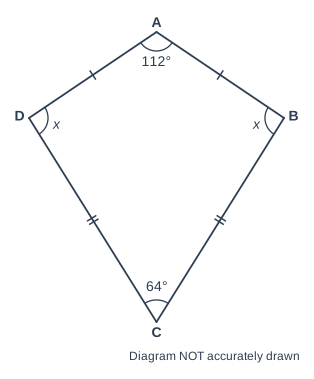
The diagram shows a kite ABCD.
Work out the value of \(x\).
Model answer
The angles in a quadrilateral add up to 360°. The kite has one pair of equal angles, both marked \(x\). \(2x = 360 - 112 - 64 = 184\) \(x = 184 \div 2 = 92\)
Explanation
A kite has one pair of equal opposite angles, between the unequal sides. The four angles add up to 360°, so subtract the two angles you know and share what is left equally between the two angles marked x. A common mistake is to forget to halve 184.
Mark scheme
1 mark
M1 for (360 − 112 − 64) ÷ 2
or 184 ÷ 2
1 mark
A1 for 92
cao; correct answer with no working scores full marks
Question 3
3 marks
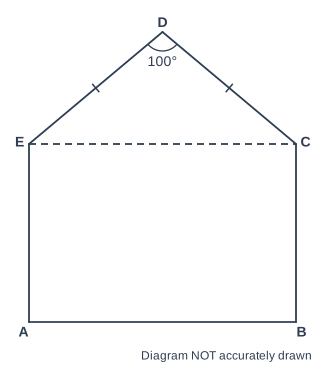
The diagram shows a pentagon ABCDE. It is made from the rectangle ABCE and the isosceles triangle CDE, with DC = DE. Angle CDE = 100°.
Work out the size of angle BCD.
Model answer
Triangle CDE is isosceles with DC = DE, so angle DCE = angle DEC. Angle DCE = (180 − 100) ÷ 2 = 40° ABCE is a rectangle, so angle BCE = 90°. Angle BCD = 90 + 40 = 130°
Explanation
Split angle BCD into two parts: the angle of the rectangle, 90°, and the base angle of the isosceles triangle. The base angles of the isosceles triangle are equal and share 180° − 100° = 80°. Add the two parts together.
Mark scheme
1 mark
M1 for angle DCE = (180 − 100) ÷ 2 (= 40°)
correct answer with no working scores full marks
1 mark
M1 for 90 + their 40
1 mark
A1 for 130°
cao
Question 4
4 marks
ABCD is a parallelogram. Angle DAB = \((3x + 10)^\circ\) and angle ABC = \((2x - 5)^\circ\).
Work out the size of angle BCD.
Model answer
Angles DAB and ABC are next to each other in a parallelogram, so they add up to 180° (co-interior angles). \(3x + 10 + 2x - 5 = 180\) \(5x + 5 = 180\) \(5x = 175\) \(x = 35\) Angle DAB = 3 × 35 + 10 = 115° Opposite angles of a parallelogram are equal, so angle BCD = angle DAB = 115°.
Explanation
In a parallelogram, angles next to each other add up to 180° and opposite angles are equal. Use the first fact to make an equation and solve it. Angle BCD is opposite angle DAB, so it is equal to 3x + 10, not 2x − 5. Check: 115 + 65 = 180.
Mark scheme
1 mark
M1 for \(3x + 10 + 2x - 5 = 180\)
oe, e.g. 2(3x + 10) + 2(2x − 5) = 360; correct answer with no working scores full marks
1 mark
A1 for \(x = 35\)
1 mark
M1 for substituting their x into 3x + 10, or 180 − (2 × their x − 5)
1 mark
A1 for 115°
cao; do not accept 65°
Ready to try the rest? Every answer you write is marked against the mark scheme, so you can see exactly where the marks are.
Ctrl + Enter to check
Study HelperHints first, answers after you try
Stuck on this one? Ask for a hint and I’ll point you in the right direction, without giving the answer away. Once you’ve checked your answer, I’ll show you how the marks are awarded.