Level:
Correct: 0
Incorrect: 0
Marks: 0/0
Exam Practice
Course:
Topics:
Edexcel GCSE Maths (Foundation calculator) Smart practice A mixed round aimed at your weak spots
Unit 1
Number
Unit 2
Algebra
Unit 3
Ratio, proportion and rates of change
Unit 4
Geometry and measures
Unit 5
Probability
Unit 6
Statistics
Avg
score:
–
Topics
done:
0/86

Sample spaces

Practise 28 exam-style questions on Sample spaces for Edexcel GCSE Maths (Foundation calculator). Write your answer as you would in the exam and get it marked in seconds against the mark scheme, point by point, with the Study Helper on hand if you get stuck.

  • 28 questions
  • 1–5 marks each
  • Instant marking
  • No sign-up needed
20 questions, marked as you go

Sample questions with model answers

Here are 4 of the questions in this topic, each with a model answer, an explanation of why it earns the marks and the mark scheme an examiner would use.

Question 1

1 mark

A fair 4-sided spinner numbered 1 to 4 is spun and a fair 6-sided dice is rolled.
The two numbers are multiplied to give a score.

The table shows all the possible scores. The first column gives the number on the spinner and the top row gives the number on the dice.

How many of the outcomes give a score of 12?
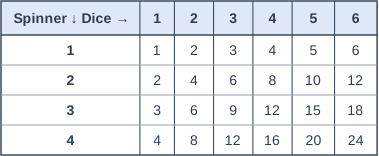
Table with columns "Spinner ↓ Dice →", "1", "2", "3", "4", "5", "6". Spinner ↓ Dice →: 1; 1: 1; 2: 2; 3: 3; 4: 4; 5: 5; 6: 6 | Spinner ↓ Dice →: 2; 1: 2; 2: 4; 3: 6; 4: 8; 5: 10; 6: 12 | Spinner ↓ Dice →: 3; 1: 3; 2: 6; 3: 9; 4: 12; 5: 15; 6: 18 | Spinner ↓ Dice →: 4; 1: 4; 2: 8; 3: 12; 4: 16; 5: 20; 6: 24.

Model answer

Scores of 12: spinner 2 and dice 6, spinner 3 and dice 4, spinner 4 and dice 3.
3 outcomes

Explanation

Look through every cell of the table and count the 12s. Each cell is a different outcome, so 3 × 4 and 4 × 3 count separately. There are 24 equally likely outcomes in total.

Mark scheme
  1. 1 mark

    B1 for 3

    cao (spinner 2 and dice 6, spinner 3 and dice 4, spinner 4 and dice 3)
Question 2

2 marks

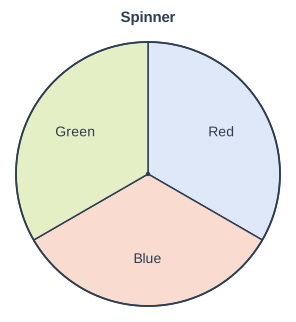
The diagram shows a fair spinner with three equal sections coloured red, blue and green.
The spinner is spun twice.

List all the possible outcomes.

Spinner. Pie chart. A circle divided into sectors, drawn clockwise from the top (12 o'clock): Red, 120°; Blue, 120°; Green, 120°. (Angles are not printed on the chart; these are the drawn sizes, which can be measured with a protractor.)

Model answer

First spin red: RR, RB, RG
First spin blue: BR, BB, BG
First spin green: GR, GB, GG
9 outcomes

Explanation

Fix the colour of the first spin, then list every colour for the second spin. Red then blue is a different outcome from blue then red, and the same colour twice (RR, BB, GG) is possible. There are 3 × 3 = 9 outcomes.

Mark scheme
  1. 2 marks

    B2 for all 9 outcomes: RR, RB, RG, BR, BB, BG, GR, GB, GG

    accept colour words or a correct sample space table; no extras or repeats; B1 for at least 6 correct outcomes

Question 3

3 marks

Jay has three cards numbered 1, 4 and 7.
He takes two of the cards at random, one after the other.
The first card is the tens digit and the second card is the units digit of a two-digit number.

Work out the probability that the number is greater than 40.

Model answer

Possible numbers: 14, 17, 41, 47, 71, 74 (6 equally likely numbers)
Greater than 40: 41, 47, 71, 74
P(greater than 40) = \(\dfrac{4}{6} = \dfrac{2}{3}\)

Explanation

List the numbers systematically: start with 1 as the tens digit, then 4, then 7. A card cannot be used twice, so numbers like 11 are impossible. The number is greater than 40 whenever the first card is 4 or 7.

Mark scheme
  1. 1 mark

    M1 for at least 4 correct two-digit numbers listed

    14, 17, 41, 47, 71, 74

  2. 1 mark

    M1 for all 6 numbers listed with no extras, and 41, 47, 71, 74 identified

    or \(\dfrac{k}{6}\) with k < 6

  3. 1 mark

    A1 for \(\dfrac{4}{6}\)

    oe, e.g. \(\dfrac{2}{3}\) or 0.666... (awrt 0.67); correct answer with no working scores full marks

Question 4

4 marks

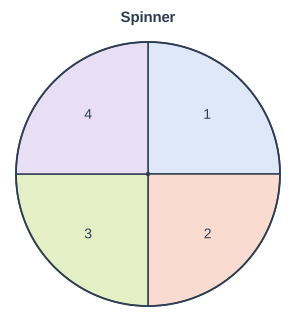
The diagram shows a fair 4-sided spinner numbered 1 to 4.

Raj spins the spinner and rolls a fair 6-sided dice.
If the number on the dice is greater than the number on the spinner, Raj wins.
Otherwise Sue wins.

Raj and Sue play the game 60 times.

Work out an estimate for the number of games Raj wins.

Spinner. Pie chart. A circle divided into sectors, drawn clockwise from the top (12 o'clock): 1, 90°; 2, 90°; 3, 90°; 4, 90°. (Angles are not printed on the chart; these are the drawn sizes, which can be measured with a protractor.)

Model answer

Spinner 1: dice 2, 3, 4, 5, 6 win - 5 outcomes
Spinner 2: dice 3, 4, 5, 6 win - 4 outcomes
Spinner 3: dice 4, 5, 6 win - 3 outcomes
Spinner 4: dice 5, 6 win - 2 outcomes
Raj wins in 5 + 4 + 3 + 2 = 14 of the 4 × 6 = 24 outcomes.
P(Raj wins) = \(\dfrac{14}{24}\)
Estimate = \(\dfrac{14}{24} \times 60 = 35\)

Explanation

There are 4 × 6 = 24 equally likely outcomes. For each spinner number, count the dice scores that are bigger; when they are equal, Sue wins, so equal scores are not counted for Raj. Multiply Raj's probability by 60 to get the expected number of wins.

Mark scheme
  1. 1 mark

    M1 for a correct sample space of 24 outcomes, or a systematic count for at least two spinner numbers (e.g. spinner 1: 5 winning dice scores, spinner 2: 4)

  2. 1 mark

    M1 for 14 winning outcomes for Raj identified (5 + 4 + 3 + 2)

    or \(\dfrac{14}{24}\) oe

  3. 1 mark

    M1 for \(\dfrac{14}{24} \times 60\)

    ft their probability (less than 1) × 60

  4. 1 mark

    A1 for 35

    cao; correct answer with no working scores full marks

Ready to try the rest? Every answer you write is marked against the mark scheme, so you can see exactly where the marks are.

Study Helper Hints first, answers after you try

Stuck on this one? Ask for a hint and I’ll point you in the right direction, without giving the answer away. Once you’ve checked your answer, I’ll show you how the marks are awarded.