
Level:
Correct: 0
Incorrect: 0
Marks: 0/0
Exam Practice
Course:
Topics:
Edexcel GCSE Maths (Foundation calculator) Smart practice A mixed round aimed at your weak spots
Unit 1
Number
Unit 2
Algebra
Unit 3
Ratio, proportion and rates of change
Unit 4
Geometry and measures
Unit 5
Probability
Unit 6
Statistics
Avg
score:
–
Topics
done:
0/86

Parts of a circle

Practise 20 exam-style questions on Parts of a circle for Edexcel GCSE Maths (Foundation calculator). Write your answer as you would in the exam and get it marked in seconds against the mark scheme, point by point, with the Study Helper on hand if you get stuck.

  • 20 questions
  • 1–5 marks each
  • Instant marking
  • No sign-up needed
20 questions, marked as you go

Sample questions with model answers

Here are 4 of the questions in this topic, each with a model answer, an explanation of why it earns the marks and the mark scheme an examiner would use.

Question 1

1 mark

A circle is cut into two equal halves along a diameter.

Write down the mathematical name of each half.

Model answer

Semicircle

Explanation

A diameter cuts a circle into two equal halves called semicircles. Each semicircle is also a sector with an angle of 180°, and a segment cut off by the diameter.

Mark scheme
  1. 1 mark

    B1 for semicircle

    accept 'semi-circle'; do not accept 'half circle' or 'segment' on its own
Question 2

2 marks

A sector of a circle has an angle of 72° at the centre.

What fraction of the whole circle is the sector?
Give your answer in its simplest form.

Model answer

The whole circle is 360°.
Fraction = \(\dfrac{72}{360} = \dfrac{1}{5}\)

Explanation

A full turn round the centre of a circle is 360°, so a sector with angle 72° is \(\frac{72}{360}\) of the circle. Simplify the fraction, for example by dividing the top and bottom by 72. Five of these sectors would make the whole circle.

Mark scheme
  1. 1 mark

    M1 for \(\dfrac{72}{360}\)

    oe

  2. 1 mark

    A1 for \(\dfrac{1}{5}\)

    cao; correct answer with no working scores full marks

Question 3

2 marks

A circle has a radius of 4.35 cm.

Ella says,
"The longest chord of this circle is 4.35 cm long."

Ella is wrong.
Explain why, and write down the length of the longest chord.

Model answer

The longest chord goes through the centre, so it is a diameter, not a radius.
Longest chord = 2 × 4.35 = 8.7 cm

Explanation

A radius only goes from the centre to the circle, so it is not a chord at all. The longest chord is the one through the centre: the diameter, which is twice the radius. Every other chord is shorter.

Mark scheme
  1. 1 mark

    B1 for saying that the longest chord is a diameter (it goes through the centre)

    oe

  2. 1 mark

    B1 for 8.7 cm

    cao

Question 4

3 marks

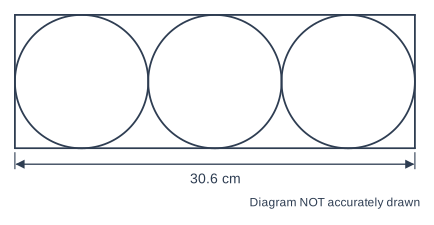
The diagram shows three identical circles inside a rectangle.
Each circle touches the circle next to it and the sides of the rectangle.
The rectangle is 30.6 cm long.

Work out the area of the rectangle.

Geometry diagram, marked "Diagram NOT accurately drawn". A circle. Another circle. Another circle. A rectangle (its vertices are not labelled). Sides an unlabelled line going to the right, an unlabelled line going to the left and an unlabelled line going downwards each touch circle a at one point (they are tangents). Sides an unlabelled line going to the right and an unlabelled line going to the left each touch circle b at one point (they are tangents). Sides an unlabelled line going to the right, an unlabelled line going upwards and an unlabelled line going to the left each touch circle d at one point (they are tangents). A double-headed dimension arrow alongside an unlabelled line going to the right (the distance from an unlabelled point to an unlabelled point) is labelled 30.6 cm.

Model answer

The length of the rectangle is 3 diameters.
Diameter = 30.6 ÷ 3 = 10.2 cm
The width of the rectangle is one diameter, 10.2 cm.
Area = 30.6 × 10.2 = 312.12 cm²

Explanation

The three circles fit exactly along the length, so the length is three diameters. Each circle also touches the top and bottom of the rectangle, so the width is one diameter. Be careful not to use the radius (5.1 cm) as the width.

Mark scheme
  1. 1 mark

    M1 for 30.6 ÷ 3 (= 10.2), the diameter of one circle

    or radius 30.6 ÷ 6 (= 5.1)

  2. 1 mark

    M1 for 30.6 × their 10.2, using the width of the rectangle = the diameter

  3. 1 mark

    A1 for 312.12 cm²

    accept 312.1; correct answer with no working scores full marks

Ready to try the rest? Every answer you write is marked against the mark scheme, so you can see exactly where the marks are.

Study Helper Hints first, answers after you try

Stuck on this one? Ask for a hint and I’ll point you in the right direction, without giving the answer away. Once you’ve checked your answer, I’ll show you how the marks are awarded.