
Level:
Correct: 0
Incorrect: 0
Marks: 0/0
Exam Practice
Course:
Topics:
Edexcel GCSE Maths (Foundation calculator) Smart practice A mixed round aimed at your weak spots
Unit 1
Number
Unit 2
Algebra
Unit 3
Ratio, proportion and rates of change
Unit 4
Geometry and measures
Unit 5
Probability
Unit 6
Statistics
Avg
score:
–
Topics
done:
0/86

Expected outcomes

Practise 31 exam-style questions on Expected outcomes for Edexcel GCSE Maths (Foundation calculator). Write your answer as you would in the exam and get it marked in seconds against the mark scheme, point by point, with the Study Helper on hand if you get stuck.

  • 31 questions
  • 1–5 marks each
  • Instant marking
  • No sign-up needed
20 questions, marked as you go

Sample questions with model answers

Here are 4 of the questions in this topic, each with a model answer, an explanation of why it earns the marks and the mark scheme an examiner would use.

Question 1

1 mark

Tom has a spinner.
He says,
"My spinner is fair."

What does Tom mean by "fair"?

Model answer

Each section of the spinner is equally likely to come up - the spinner has the same chance of landing on any section.

Explanation

A fair spinner, coin or dice is one where every outcome has the same probability. That is why we can say P(each section) = 1 ÷ number of sections. A biased spinner lands on some sections more often than others.

Mark scheme
  1. 1 mark

    B1 for each outcome (section or number) is equally likely

    accept "it has the same chance of landing on each section"; do not accept "it is not biased" alone, or "the sections are the same colour"

Question 2

2 marks

Jo has a fair spinner with 5 equal sections numbered 1, 2, 3, 4 and 5
She spins the spinner a number of times.
She expects the spinner to land on 3 about 40 times.

Work out how many times Jo spins the spinner.

Model answer

P(3) = \(\dfrac{1}{5}\)
\(\dfrac{1}{5}\) of the spins is 40, so the number of spins is 40 × 5 = 200

Explanation

Expected number = probability × number of spins, so number of spins = expected number ÷ probability. One fifth of the spins should be 3s, so 40 is one fifth of the total and the total is 40 × 5 = 200. Check: 1/5 × 200 = 40.

Mark scheme
  1. 1 mark

    M1 for 40 × 5 or \(40 \div \dfrac{1}{5}\)

    oe

  2. 1 mark

    A1 for 200

    cao; correct answer with no working scores full marks

Question 3

3 marks

Asif has a biased five-sided spinner.
The table shows the probabilities that the spinner lands on 1, 2, 3 and 5.
The probability for 4 is missing.

Asif spins the spinner 140 times.

Work out an estimate for the number of times the spinner lands on 4.

Table with columns "Number", "1", "2", "3", "4", "5". Number: Probability; 1: 0.12; 2: 0.3; 3: 0.25; 4: (blank); 5: 0.18.

Model answer

0.12 + 0.3 + 0.25 + 0.18 = 0.85
P(4) = 1 − 0.85 = 0.15
0.15 × 140 = 21

Explanation

The probabilities of all the possible outcomes add up to 1, so the missing probability is 1 − 0.85 = 0.15. Then multiply by the number of spins: 0.15 × 140 = 21. Check that your probability is between 0 and 1 before you use it.

Mark scheme
  1. 1 mark

    M1 for 1 − (0.12 + 0.3 + 0.25 + 0.18)

    oe; may be seen as 1 − 0.85

  2. 1 mark

    M1 for their 0.15 × 140

    their probability must be from 1 − the sum of the others

  3. 1 mark

    A1 for 21

    cao; correct answer with no working scores full marks

Question 4

3 marks

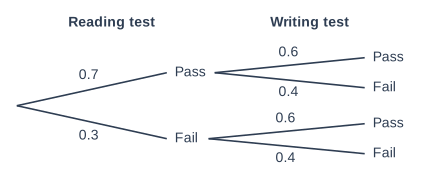
The probability tree diagram shows the probabilities that a student passes or fails a reading test and a writing test.

400 students take both tests.

Work out an estimate for the number of these students who pass both tests.

A probability tree diagram drawn from left to right with 2 stages of branches, headed "Reading test" and "Writing test". Each branch has its outcome written at its end and its probability written beside it. First stage, 2 branches: "Pass" with probability 0.7, "Fail" with probability 0.3. After "Pass", the second stage branches are "Pass" with probability 0.6, "Fail" with probability 0.4. After "Fail", the second stage branches are "Pass" with probability 0.6, "Fail" with probability 0.4.

Model answer

P(pass both) = 0.7 × 0.6 = 0.42
0.42 × 400 = 168

Explanation

To find the probability of passing both, multiply along the branches: 0.7 × 0.6 = 0.42. Then multiply by the number of students: 0.42 × 400 = 168. Another way: 0.7 × 400 = 280 pass reading, and 0.6 of those 280 = 168 also pass writing. Do not add 0.7 and 0.6.

Mark scheme
  1. 1 mark

    M1 for 0.7 × 0.6 (= 0.42)

    or 0.7 × 400 (= 280)

  2. 1 mark

    M1 for their 0.42 × 400

    or 0.6 × their 280

  3. 1 mark

    A1 for 168

    cao; correct answer with no working scores full marks

Ready to try the rest? Every answer you write is marked against the mark scheme, so you can see exactly where the marks are.

Study Helper Hints first, answers after you try

Stuck on this one? Ask for a hint and I’ll point you in the right direction, without giving the answer away. Once you’ve checked your answer, I’ll show you how the marks are awarded.