Practise 37 exam-style questions on Calculating with integers, decimals and fractions for Edexcel GCSE Maths (Foundation calculator). Write your answer as you would in the exam and get it marked in seconds against the mark scheme, point by point, with the Study Helper on hand if you get stuck.
37 questions
1–5 marks each
Instant marking
No sign-up needed
20 questions, marked as you go
Sample questions with model answers
Here are 4 of the questions in this topic, each with a model answer, an explanation of why it earns the marks and the mark scheme an examiner would use.
Question 1
1 mark
Kim works out 4.7 × 0.23 She gets the answer 10.81
Without working out the exact answer, explain why Kim's answer must be wrong.
Model answer
0.23 is less than 1, so 4.7 × 0.23 must be smaller than 4.7. 10.81 is bigger than 4.7, so Kim's answer must be wrong. (An estimate: 5 × 0.2 = 1, so the answer should be about 1.)
Explanation
Multiplying by a number less than 1 makes a number smaller, so the answer must be less than 4.7. Estimating with rounded numbers (5 × 0.2 = 1) also shows the answer should be about 1. Kim has put the decimal point in the wrong place: the correct answer is 1.081.
Mark scheme
1 mark
C1 for a correct explanation, e.g. 0.23 is less than 1, so the answer must be less than 4.7, or 4.7 × 0.23 is about 5 × 0.2 = 1
do not accept just 'the answer is 1.081' with no explanation
Question 2
2 marks
A recipe uses \(\dfrac{3}{4}\) of a cup of sugar for one cake.
Mo wants to make 5 cakes. He has 4 cups of sugar.
Does Mo have enough sugar? You must show your working.
Model answer
\(5 \times \dfrac{3}{4} = \dfrac{15}{4} = 3\frac{3}{4}\) cups \(3\frac{3}{4}\) is less than 4, so yes, Mo has enough sugar.
Explanation
Multiply the amount for one cake by the number of cakes: \(5 \times \dfrac{3}{4} = \dfrac{15}{4}\), which is \(3\frac{3}{4}\). Compare this with the 4 cups he has and write a clear conclusion. Only the numerator is multiplied by 5, not the denominator.
Mark scheme
1 mark
M1 for \(5 \times \dfrac{3}{4}\)
oe, e.g. 5 × 0.75
1 mark
C1 for Yes, with \(3\frac{3}{4}\) cups (or 3.75 cups) shown
accept 'Yes, he has \(\frac{1}{4}\) cup left over' with working; answer only scores 0
Question 3
3 marks
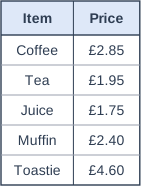
The table shows some prices in a café.
Ella buys 2 coffees, 1 tea and 3 muffins. She pays with a £20 note.
First find the cost of each item that is bought more than once, then add everything to get the total. The change is the amount paid minus the total cost. Check that you have used the right price for each item from the table.
Mark scheme
1 mark
M1 for a complete method to find the total cost, e.g. 2 × 2.85 + 1.95 + 3 × 2.40
correct total is £14.85
1 mark
M1 for 20 − their total
1 mark
A1 for £5.15
correct answer with no working scores full marks
Question 4
4 marks
Pencils are sold in boxes of 24. Each box costs £4.65
A school needs 3 pencils for each of its 285 students.
Work out the total cost of the boxes of pencils the school needs to buy.
Model answer
Pencils needed = 285 × 3 = 855 Boxes = 855 ÷ 24 = 35.625 The school must buy 36 boxes (35 boxes are not enough). Cost = 36 × £4.65 = £167.40
Explanation
First find how many pencils are needed, then how many boxes. 35.625 boxes is not possible, and 35 boxes would leave the school short, so round up to 36. A common mistake is to round down, or to multiply 35.625 by £4.65.
Mark scheme
1 mark
P1 for 285 × 3 (= 855)
1 mark
P1 for their 855 ÷ 24 (= 35.6...)
or for repeated addition of 24 to reach at least 855
1 mark
P1 for rounding up to 36 boxes and multiplying by 4.65
1 mark
A1 for £167.40
correct answer with no working scores full marks
Ready to try the rest? Every answer you write is marked against the mark scheme, so you can see exactly where the marks are.
Ctrl + Enter to check
Study HelperHints first, answers after you try
Stuck on this one? Ask for a hint and I’ll point you in the right direction, without giving the answer away. Once you’ve checked your answer, I’ll show you how the marks are awarded.