Level:
Correct: 0
Incorrect: 0
Marks: 0/0
Exam Practice
Course:
Topics:
Edexcel GCSE Maths (Foundation calculator) Smart practice A mixed round aimed at your weak spots
Unit 1
Number
Unit 2
Algebra
Unit 3
Ratio, proportion and rates of change
Unit 4
Geometry and measures
Unit 5
Probability
Unit 6
Statistics
Avg
score:
–
Topics
done:
0/86

Congruence and similar shapes

Practise 28 exam-style questions on Congruence and similar shapes for Edexcel GCSE Maths (Foundation calculator). Write your answer as you would in the exam and get it marked in seconds against the mark scheme, point by point, with the Study Helper on hand if you get stuck.

  • 28 questions
  • 1–5 marks each
  • Instant marking
  • No sign-up needed
20 questions, marked as you go

Sample questions with model answers

Here are 4 of the questions in this topic, each with a model answer, an explanation of why it earns the marks and the mark scheme an examiner would use.

Question 1

1 mark

Rectangle B is similar to rectangle A.
Rectangle A is 4 cm by 6 cm.
Rectangle B is 10 cm by 15 cm.

Work out the scale factor of the enlargement from rectangle A to rectangle B.

Model answer

Scale factor = 10 ÷ 4 = 2.5
(Check: 6 × 2.5 = 15)

Explanation

The scale factor is what each length in A is multiplied by to give the matching length in B. Divide a length in B by the matching length in A: 10 ÷ 4 = 2.5. The other pair gives the same answer, 15 ÷ 6 = 2.5.

Mark scheme
  1. 1 mark

    B1 for 2.5

    oe, e.g. \(\frac{5}{2}\) or \(2\frac{1}{2}\)
Question 2

2 marks

Rectangle P is 5 cm by 8 cm.
Rectangle Q is 10 cm by 14 cm.

Are rectangles P and Q similar?
You must show how you get your answer.

Model answer

Short sides: 10 ÷ 5 = 2
Long sides: 14 ÷ 8 = 1.75
The sides are not multiplied by the same number, so P and Q are not similar.

Explanation

For similar rectangles, both pairs of matching sides must be multiplied by the same scale factor. The short side is doubled, but the long side is multiplied by only 1.75. If Q were similar to P, its long side would be 16 cm.

Mark scheme
  1. 1 mark

    M1 for 10 ÷ 5 (= 2) and 14 ÷ 8 (= 1.75)

    or 8 ÷ 5 (= 1.6) and 14 ÷ 10 (= 1.4), or 8 × 2 = 16 compared with 14

  2. 1 mark

    C1 for No, with a correct reason, e.g. the scale factors 2 and 1.75 are different

    answer only scores 0

Question 3

3 marks

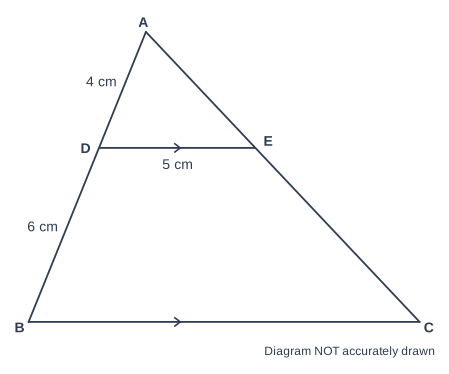
In the diagram, ADB and AEC are straight lines.
DE is parallel to BC.

AD = 4 cm
DB = 6 cm
DE = 5 cm

Work out the length of BC.

Geometry diagram, marked "Diagram NOT accurately drawn". Triangle ABC. Line segment DE is drawn. D lies on side AB. E lies on side AC. Side AD is labelled 4 cm. Side DB is labelled 6 cm. DE is labelled 5 cm. DE and BC are each marked with an arrowhead (parallel lines).

Model answer

Triangles ADE and ABC are similar, because DE is parallel to BC.
AB = 4 + 6 = 10 cm
Scale factor = 10 ÷ 4 = 2.5
BC = 5 × 2.5 = 12.5 cm

Explanation

Because DE is parallel to BC, the small triangle ADE and the large triangle ABC have the same angles, so they are similar. Compare AD with the whole side AB (10 cm), not with DB. A common mistake is to use 6 ÷ 4 as the scale factor.

Mark scheme
  1. 1 mark

    M1 for AB = 4 + 6 (= 10)

  2. 1 mark

    M1 for scale factor 10 ÷ 4 (= 2.5) or 5 ÷ 4 × 10

    oe

  3. 1 mark

    A1 for 12.5 cm

    cao; do not accept 7.5 (scale factor 6 ÷ 4 used); correct answer with no working scores full marks

Question 4

4 marks

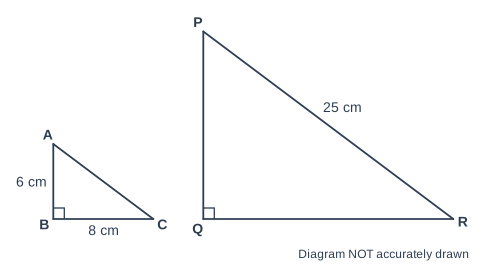
The diagram shows two right-angled triangles, ABC and PQR.
Triangle PQR is similar to triangle ABC.
AB corresponds to PQ, BC to QR and AC to PR.

AB = 6 cm
BC = 8 cm
PR = 25 cm

Work out the perimeter of triangle PQR.

Geometry diagram, marked "Diagram NOT accurately drawn". Triangle ABC. Triangle PQR. Angle ABC is marked as a right angle (90°). Angle PQR is marked as a right angle (90°). Side AB is labelled 6 cm. Side BC is labelled 8 cm. Side PR is labelled 25 cm.

Model answer

\(AC^2 = 6^2 + 8^2 = 36 + 64 = 100\), so AC = 10 cm
Scale factor = 25 ÷ 10 = 2.5
PQ = 6 × 2.5 = 15 cm and QR = 8 × 2.5 = 20 cm
Perimeter of PQR = 15 + 20 + 25 = 60 cm

Explanation

PR matches AC, so you need AC to find the scale factor. Use Pythagoras' theorem to find AC = 10 cm. The scale factor is then 2.5, and every side of PQR is 2.5 times the matching side of ABC.

Mark scheme
  1. 1 mark

    P1 for \(AC = \sqrt{6^2 + 8^2}\) (= 10)

    oe; correct answer with no working scores full marks

  2. 1 mark

    P1 for scale factor 25 ÷ their AC (= 2.5)

  3. 1 mark

    P1 for (6 + 8 + 10) × 2.5 or PQ = 15 and QR = 20

    ft their scale factor

  4. 1 mark

    A1 for 60 cm

    cao

Ready to try the rest? Every answer you write is marked against the mark scheme, so you can see exactly where the marks are.

Study Helper Hints first, answers after you try

Stuck on this one? Ask for a hint and I’ll point you in the right direction, without giving the answer away. Once you’ve checked your answer, I’ll show you how the marks are awarded.