
Level:
Correct: 0
Incorrect: 0
Marks: 0/0
Exam Practice
Course:
Topics:
Edexcel GCSE Maths (Foundation calculator) Smart practice A mixed round aimed at your weak spots
Unit 1
Number
Unit 2
Algebra
Unit 3
Ratio, proportion and rates of change
Unit 4
Geometry and measures
Unit 5
Probability
Unit 6
Statistics
Avg
score:
–
Topics
done:
0/86

Standard form

Practise 28 exam-style questions on Standard form for Edexcel GCSE Maths (Foundation calculator). Write your answer as you would in the exam and get it marked in seconds against the mark scheme, point by point, with the Study Helper on hand if you get stuck.

  • 28 questions
  • 1–5 marks each
  • Instant marking
  • No sign-up needed
20 questions, marked as you go

Sample questions with model answers

Here are 4 of the questions in this topic, each with a model answer, an explanation of why it earns the marks and the mark scheme an examiner would use.

Question 1

1 mark

Write 0.0072 in standard form.

Model answer

0.0072 = 7.2 ÷ 1000 = \(7.2 \times 10^{-3}\)

Explanation

Write the digits as a number between 1 and 10: 7.2. To get from 7.2 to 0.0072 the digits move 3 places to the right (the number gets smaller), so the power of 10 is −3. Small numbers less than 1 always have a negative power.

Mark scheme
  1. 1 mark

    B1 for \(7.2 \times 10^{-3}\)

    cao
Question 2

2 marks

Work out \((6.3 \times 10^8) \div (9 \times 10^3)\)

Give your answer in standard form.

Model answer

6.3 ÷ 9 = 0.7
\(10^8 \div 10^3 = 10^5\)
\(0.7 \times 10^5\) = 70 000 = \(7 \times 10^4\)

Explanation

Divide the number parts and subtract the powers of 10. 6.3 ÷ 9 = 0.7, which is less than 1, so it is not in standard form yet: \(0.7 \times 10^5 = 7 \times 10^4\). Always check your final answer has a first number between 1 and 10.

Mark scheme
  1. 1 mark

    M1 for 6.3 ÷ 9 (= 0.7) and \(10^8 \div 10^3\) (= \(10^5\)), or 70 000 seen

  2. 1 mark

    A1 for \(7 \times 10^4\)

    cao; \(0.7 \times 10^5\) scores M1 A0; correct answer with no working scores full marks

Question 3

2 marks

Write these numbers in order of size.
Start with the smallest number.

0.003 \(3.2 \times 10^{-3}\) \(2.9 \times 10^{-2}\) \(3 \times 10^{-4}\)

Model answer

0.003
\(3.2 \times 10^{-3}\) = 0.0032
\(2.9 \times 10^{-2}\) = 0.029
\(3 \times 10^{-4}\) = 0.0003
Order: \(3 \times 10^{-4}\), 0.003, \(3.2 \times 10^{-3}\), \(2.9 \times 10^{-2}\)

Explanation

Write each number as an ordinary decimal and compare place value. With negative powers, the more negative the power, the smaller the number, so \(10^{-4}\) numbers are smaller than \(10^{-3}\) numbers. 0.003 and 0.0032 are close, so compare them digit by digit.

Mark scheme
  1. 1 mark

    M1 for at least three numbers written in the same form, e.g. 0.0032, 0.029, 0.0003

    or 0.003 = \(3 \times 10^{-3}\); correct answer with no working scores full marks

  2. 1 mark

    A1 for \(3 \times 10^{-4}\), 0.003, \(3.2 \times 10^{-3}\), \(2.9 \times 10^{-2}\)

    cao; accept the numbers in another form if in the correct order

Question 4

3 marks

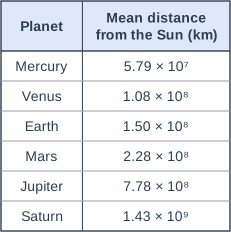
The table shows the mean distance from the Sun of six planets.

Lena says,
"Jupiter is more than 5 times as far from the Sun as Earth is."

Is Lena correct?
You must show how you get your answer.

Table with columns "Planet", "Mean distance from the Sun (km)". Planet: Mercury; Mean distance from the Sun (km): 5.79 × 10⁷ | Planet: Venus; Mean distance from the Sun (km): 1.08 × 10⁸ | Planet: Earth; Mean distance from the Sun (km): 1.50 × 10⁸ | Planet: Mars; Mean distance from the Sun (km): 2.28 × 10⁸ | Planet: Jupiter; Mean distance from the Sun (km): 7.78 × 10⁸ | Planet: Saturn; Mean distance from the Sun (km): 1.43 × 10⁹.

Model answer

\((7.78 \times 10^8) \div (1.50 \times 10^8)\) = 5.186...
5.186... is more than 5, so Lena is correct.

Explanation

To find how many times as far, divide Jupiter's distance by Earth's distance. Both are multiplied by \(10^8\), so this is just 7.78 ÷ 1.50 = 5.19. Alternatively, work out 5 times Earth's distance (\(7.5 \times 10^8\) km) and compare it with Jupiter's.

Mark scheme
  1. 1 mark

    M1 for \((7.78 \times 10^8) \div (1.50 \times 10^8)\)

    or 5 × \(1.50 \times 10^8\)

  2. 1 mark

    A1 for 5.18...

    or \(7.5 \times 10^8\)

  3. 1 mark

    C1 for Yes, supported by 5.18... (or \(7.78 \times 10^8 > 7.5 \times 10^8\))

    answer only scores 0

Ready to try the rest? Every answer you write is marked against the mark scheme, so you can see exactly where the marks are.

Study Helper Hints first, answers after you try

Stuck on this one? Ask for a hint and I’ll point you in the right direction, without giving the answer away. Once you’ve checked your answer, I’ll show you how the marks are awarded.