Practise 18 exam-style questions on Expressions, equations, formulae and identities for Edexcel GCSE Maths (Foundation calculator). Write your answer as you would in the exam and get it marked in seconds against the mark scheme, point by point, with the Study Helper on hand if you get stuck.
18 questions
1–5 marks each
Instant marking
No sign-up needed
18 questions, marked as you go
Sample questions with model answers
Here are 4 of the questions in this topic, each with a model answer, an explanation of why it earns the marks and the mark scheme an examiner would use.
Question 1
1 mark
Write down the coefficient of \(y\) in the expression \(8x - 5y + 3\)
Model answer
The term in \(y\) is \(-5y\), so the coefficient of \(y\) is −5.
Explanation
The coefficient is the number that multiplies the letter in a term. The sign in front of the term belongs to it, so the term is −5y and its coefficient is −5. Common mistakes are to leave out the negative sign or to write the whole term −5y.
Write down all the terms in the list that are like terms with \(6ab\).
Model answer
\(4ba\) and \(-ab\) (\(4ba\) is the same as \(4ab\), so all three terms contain \(ab\).)
Explanation
Like terms have exactly the same letters raised to the same powers; only the number in front can be different. ba is the same as ab because the order of multiplication does not matter. 3a, 2b and a² are not like terms with 6ab because their letters are different.
Mark scheme
1 mark
B1 for \(4ba\) or \(-ab\) given
allow one incorrect term listed with them for this mark; correct answer with no working scores full marks
1 mark
B1 for \(4ba\) and \(-ab\) and no other terms
cao
Question 3
3 marks
A shop hires out bikes. It charges a fixed fee of £12, plus £4.75 for each hour.
Write down a formula for the total cost, \(C\) pounds, of hiring a bike for \(h\) hours.
Model answer
Cost for \(h\) hours at £4.75 an hour: \(4.75h\) Add the fixed fee: \(4.75h + 12\) \(C = 12 + 4.75h\)
Explanation
A formula connects two or more quantities, so it must start with "C =". The hourly charge is multiplied by the number of hours, then the fixed fee is added once. A common mistake is to add 12 and 4.75 first to get 16.75h, which would charge the fixed fee every hour.
Mark scheme
1 mark
B1 for \(4.75h\) seen
oe; correct answer with no working scores full marks
1 mark
B1 for \(12 + 4.75h\), or \(C = 12 + kh\) for any number k
oe
1 mark
B1 for \(C = 12 + 4.75h\)
oe, e.g. \(C = 4.75h + 12\); do not accept \(C = 16.75h\)
Question 4
4 marks
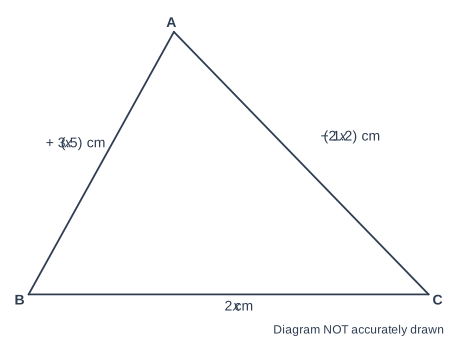
The diagram shows a triangle. The lengths of the sides are in centimetres.
The perimeter of the triangle is 37.3 cm.
Write an equation for the perimeter and solve it to find the value of \(x\).
The perimeter is the total of all the sides, so add the three expressions and collect like terms: x + 2x + 2x = 5x and 3.5 − 1.2 = 2.3. Setting this equal to 37.3 gives an equation you can solve with inverse operations. Check: the sides are 10.5, 14 and 12.8 cm, which add up to 37.3 cm.
Mark scheme
1 mark
M1 for adding the three sides, e.g. \(x + 3.5 + 2x + 2x - 1.2\)
oe
1 mark
M1 for \(5x + 2.3 = 37.3\)
oe equation
1 mark
M1 for a correct first step to solve their equation, e.g. \(5x = 35\)
ft their equation of the form ax + b = 37.3
1 mark
A1 for \(x = 7\)
cao; SC: x = 7 with no equation seen scores 1 mark
Ready to try the rest? Every answer you write is marked against the mark scheme, so you can see exactly where the marks are.
Ctrl + Enter to check
Study HelperHints first, answers after you try
Stuck on this one? Ask for a hint and I’ll point you in the right direction, without giving the answer away. Once you’ve checked your answer, I’ll show you how the marks are awarded.