Practise 29 exam-style questions on Fractions and percentages as operators for Edexcel GCSE Maths (Foundation calculator). Write your answer as you would in the exam and get it marked in seconds against the mark scheme, point by point, with the Study Helper on hand if you get stuck.
29 questions
1–5 marks each
Instant marking
No sign-up needed
20 questions, marked as you go
Sample questions with model answers
Here are 4 of the questions in this topic, each with a model answer, an explanation of why it earns the marks and the mark scheme an examiner would use.
Which calculation gives the result of decreasing £80 by 35%?
Model answer
A decrease of 35% leaves 100% − 35% = 65% of the amount. 65% = 0.65 The answer is C: 80 × 0.65
Explanation
After a 35% decrease you have 65% of the original amount, so the multiplier is 0.65. Calculation A only finds the 35% that is taken off, B increases £80 by 35%, and D takes away 35p, not 35%.
Mark scheme
1 mark
B1 for C
cao
Question 2
2 marks
A bar of chocolate has a mass of 180 g. 46.5% of the mass of the bar is sugar.
Work out the mass of sugar in the bar. Give your answer correct to the nearest gram.
Model answer
46.5% = 0.465 0.465 × 180 = 83.7 Mass of sugar = 84 g (to the nearest gram)
Explanation
Change the percentage to a decimal by dividing by 100 (46.5% = 0.465) and multiply. The calculator gives 83.7, and the question asks for the nearest gram, so round to 84 g. Read the accuracy asked for before you write the final answer.
Mark scheme
1 mark
M1 for 0.465 × 180 (= 83.7)
oe, e.g. 180 ÷ 100 × 46.5
1 mark
A1 for 84 g
cao; 83.7 with no rounding scores M1 A0; correct answer with no working scores full marks
Question 3
2 marks
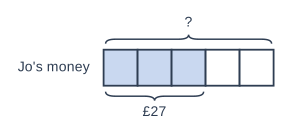
The bar model shows that \(\frac{3}{5}\) of the money in Jo's purse is £27.
How much money is in Jo's purse?
Model answer
3 parts = £27 1 part = 27 ÷ 3 = £9 5 parts = 5 × 9 = £45 There is £45 in Jo's purse.
Explanation
The three shaded boxes together are worth £27, so one box is £9. The whole purse is all 5 boxes, so multiply by 5. A common mistake is to work out \(\frac{3}{5}\) of £27; check your answer instead: \(\frac{3}{5}\) of £45 is £27.
Mark scheme
1 mark
M1 for 27 ÷ 3 (= 9)
oe, e.g. \(\frac{1}{5}\) = 9
1 mark
A1 for £45
cao; correct answer with no working scores full marks
Question 4
3 marks
A restaurant bill is £86.40. A service charge of 12.5% is added to the bill. Four friends share the total cost equally.
How much does each friend pay?
Model answer
Service charge = 12.5% of £86.40 = 0.125 × 86.40 = £10.80 Total = 86.40 + 10.80 = £97.20 Each friend pays 97.20 ÷ 4 = £24.30
Explanation
Add the service charge to the bill first, then share the total between the 4 friends. Adding 12.5% is the same as multiplying by 1.125. A common mistake is to share £86.40 and forget the service charge.
Mark scheme
1 mark
P1 for 86.40 × 1.125 (= 97.20) or 86.40 × 0.125 (= 10.80)
oe
1 mark
P1 for their 97.20 ÷ 4
1 mark
A1 for £24.30
accept £24.3; correct answer with no working scores full marks
Ready to try the rest? Every answer you write is marked against the mark scheme, so you can see exactly where the marks are.
Ctrl + Enter to check
Study HelperHints first, answers after you try
Stuck on this one? Ask for a hint and I’ll point you in the right direction, without giving the answer away. Once you’ve checked your answer, I’ll show you how the marks are awarded.