Practise 29 exam-style questions on Geometric reasoning and proof for Edexcel GCSE Maths (Foundation calculator). Write your answer as you would in the exam and get it marked in seconds against the mark scheme, point by point, with the Study Helper on hand if you get stuck.
29 questions
1–5 marks each
Instant marking
No sign-up needed
20 questions, marked as you go
Sample questions with model answers
Here are 4 of the questions in this topic, each with a model answer, an explanation of why it earns the marks and the mark scheme an examiner would use.
Question 1
1 mark
Here is a statement.
"A square is a rectangle."
Is this statement always true, sometimes true or never true?
Model answer
Always true. A square has four right angles and opposite sides that are equal and parallel, so it has all the properties of a rectangle.
Explanation
A rectangle is any quadrilateral with four right angles (so its opposite sides are equal and parallel). Every square has these properties, so every square is a special kind of rectangle. The opposite is not true: most rectangles are not squares.
Mark scheme
1 mark
B1 for always true
cao
Question 2
2 marks
ABCD is a parallelogram. Angle DAB = 63.5°.
Work out the size of angle ABC. Give a reason for your answer.
Model answer
Angle ABC = 180° − 63.5° = 116.5° AD is parallel to BC, and co-interior angles add up to 180°.
Explanation
In a parallelogram AD is parallel to BC, so angles DAB and ABC are co-interior angles between parallel lines and add up to 180°. Opposite angles of a parallelogram are equal, but A and B are next to each other, not opposite.
Mark scheme
1 mark
B1 for 116.5°
cao; correct values with no working score the calculation marks
1 mark
B1 for co-interior angles add up to 180°
accept 'allied angles add up to 180°' or 'next-door angles in a parallelogram add up to 180°'; do not accept 'C angles'
Question 3
3 marks
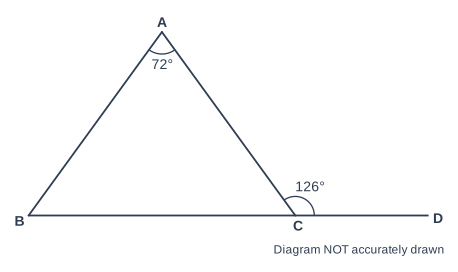
The diagram shows triangle ABC. BCD is a straight line.
Show that triangle ABC is isosceles. Give reasons for your working.
Model answer
Angle ACB = 180° − 126° = 54° (angles on a straight line add up to 180°) Angle ABC = 180° − 72° − 54° = 54° (angles in a triangle add up to 180°) Angle ABC = angle ACB, so triangle ABC has two equal angles. So triangle ABC is isosceles.
Explanation
To show a triangle is isosceles, show that two of its angles are equal. Use the straight line BCD to find the angle inside the triangle at C, then the angle sum to find the angle at B. A triangle with two equal angles also has two equal sides, so it is isosceles.
Mark scheme
1 mark
M1 for angle ACB = 180 − 126 (= 54°)
with reason: angles on a straight line add up to 180°
1 mark
M1 for angle ABC = 180 − 72 − their 54 (= 54°)
with reason: angles in a triangle add up to 180°
1 mark
C1 for a conclusion that angle ABC = angle ACB = 54°, so the triangle has two equal angles and is isosceles, with both reasons given
accept angle ABC found as 126 − 72 using the exterior angle of a triangle
Question 4
4 marks
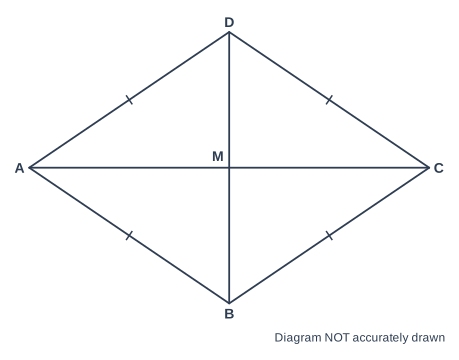
The diagram shows a rhombus ABCD. The diagonals AC and BD meet at M. AC = 16.8 cm and BD = 11.4 cm.
Work out the perimeter of the rhombus. Give your answer correct to 1 decimal place.
Model answer
The diagonals of a rhombus cut each other in half at right angles. AM = 16.8 ÷ 2 = 8.4 cm and BM = 11.4 ÷ 2 = 5.7 cm, with angle AMB = 90°. \(AB^2 = 8.4^2 + 5.7^2 = 70.56 + 32.49 = 103.05\) \(AB = \sqrt{103.05} = 10.1513...\) cm Perimeter = 4 × 10.1513... = 40.6054... Perimeter = 40.6 cm (1 d.p.)
Explanation
Use the property that the diagonals of a rhombus bisect each other at right angles. That makes four right-angled triangles with shorter sides 8.4 cm and 5.7 cm, and each side of the rhombus is a hypotenuse. All four sides of a rhombus are equal, so multiply one side by 4.
Mark scheme
1 mark
B1 for AM = 8.4 and BM = 5.7 with a right angle at M
cao; the diagonals of a rhombus cross at right angles and cut each other in half; may be seen in working
M1 for \(\sqrt{103.05}\) (= 10.151...) and multiplying by 4
1 mark
A1 for 40.6 cm
awrt 40.6 (40.6054...); correct answer with no working scores full marks
Ready to try the rest? Every answer you write is marked against the mark scheme, so you can see exactly where the marks are.
Ctrl + Enter to check
Study HelperHints first, answers after you try
Stuck on this one? Ask for a hint and I’ll point you in the right direction, without giving the answer away. Once you’ve checked your answer, I’ll show you how the marks are awarded.