
Level:
Correct: 0
Incorrect: 0
Marks: 0/0
Exam Practice
Course:
Topics:
Edexcel GCSE Maths (Foundation calculator) Smart practice A mixed round aimed at your weak spots
Unit 1
Number
Unit 2
Algebra
Unit 3
Ratio, proportion and rates of change
Unit 4
Geometry and measures
Unit 5
Probability
Unit 6
Statistics
Avg
score:
–
Topics
done:
0/86

Circles, surface area and volume of solids

Practise 38 exam-style questions on Circles, surface area and volume of solids for Edexcel GCSE Maths (Foundation calculator). Write your answer as you would in the exam and get it marked in seconds against the mark scheme, point by point, with the Study Helper on hand if you get stuck.

  • 38 questions
  • 1–5 marks each
  • Instant marking
  • No sign-up needed
20 questions, marked as you go

Sample questions with model answers

Here are 4 of the questions in this topic, each with a model answer, an explanation of why it earns the marks and the mark scheme an examiner would use.

Question 1

1 mark

Ben works out the volume of a cone with radius 3 cm and height 8 cm.

Volume of a cone = \(\dfrac{1}{3}\pi r^2 h\)

Here is Ben's working.

Volume = π × 3² × 8 = 226.2 cm³

What mistake has Ben made?

Model answer

Ben has not multiplied by \(\frac{1}{3}\).
He should have worked out \(\frac{1}{3} \times \pi \times 3^2 \times 8 = 75.4\) cm³.

Explanation

The formula for the volume of a cone has \(\frac{1}{3}\) at the front. Ben worked out π × 3² × 8, which is the volume of a cylinder with the same radius and height. A cone fills only one third of that cylinder.

Mark scheme
  1. 1 mark

    B1 for saying he has not multiplied by \(\frac{1}{3}\) (or has not divided by 3)

    accept 'he has worked out the volume of a cylinder' or 'he forgot the 1/3'; the correct answer 75.4 cm³ alone does not score
Question 2

2 marks

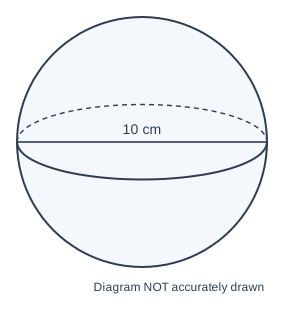
The diagram shows a sphere.
The diameter of the sphere is 10 cm.

Surface area of a sphere = \(4\pi r^2\)

Work out the surface area of the sphere.
Give your answer correct to 3 significant figures.

A sphere drawn in 3D (hidden edges dashed). The diameter is labelled 10 cm (on a line through the centre from one side to the other). The diagram is labelled "Diagram NOT accurately drawn".

Model answer

Radius = 10 ÷ 2 = 5 cm
Surface area = \(4 \times \pi \times 5^2 = 100\pi\)
= 314.159...
= 314 cm² (3 s.f.)

Explanation

The formula uses the radius, so halve the diameter first: r = 5 cm. Then work out 4 × π × 25. Using 10 as the radius gives 1257 cm², which is four times too big.

Mark scheme
  1. 1 mark

    M1 for \(4 \times \pi \times 5^2\)

    oe, e.g. \(100\pi\); radius 5 must be used

  2. 1 mark

    A1 for 314 cm²

    awrt 314 (314.159...); do not accept 1257 (radius 10 used); correct answer with no working scores full marks

Question 3

3 marks

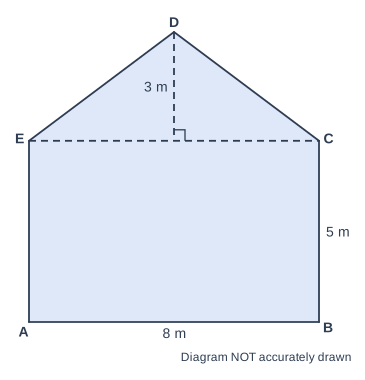
The diagram shows the end wall of a garden shed.
The wall is a rectangle with a triangle on top.
The rectangle is 8 m wide and 5 m tall.
The height of the triangle is 3 m.

Work out the area of the wall.

Geometry diagram, marked "Diagram NOT accurately drawn". Pentagon ABCDE (shaded). Dashed line segments join the midpoint of EC to D. Dashed line segment EC is drawn. Side AB is labelled 8 m. Side BC is labelled 5 m. The line from D to the midpoint of EC is labelled 3 m. The angle at the midpoint of EC between the lines to D and C is marked as a right angle (90°).

Model answer

Rectangle: 8 × 5 = 40 m²
Triangle: \(\frac{1}{2} \times 8 \times 3 = 12\) m²
Total area = 40 + 12 = 52 m²

Explanation

Split the wall into a rectangle and a triangle. The triangle has the same base as the rectangle (8 m) and a height of 3 m, so its area is half of 8 × 3. A common mistake is to forget the half for the triangle.

Mark scheme
  1. 1 mark

    M1 for 8 × 5 (= 40)

  2. 1 mark

    M1 for \(\frac{1}{2} \times 8 \times 3\) (= 12)

  3. 1 mark

    A1 for 52 m²

    cao; dependent on both M marks; correct answer with no working scores full marks

Question 4

4 marks

Leah has a cube of modelling clay.
The edges of the cube are 10 cm long.

She uses the clay to make spheres.
Each sphere has a radius of 1.5 cm.

Volume of a sphere = \(\dfrac{4}{3}\pi r^3\)

Work out the greatest number of spheres Leah can make.

Model answer

Volume of cube = 10 × 10 × 10 = 1000 cm³
Volume of one sphere = \(\frac{4}{3} \times \pi \times 1.5^3 = 14.137...\) cm³
1000 ÷ 14.137... = 70.73...
Leah can make 70 spheres.

Explanation

Work out the volume of clay in the cube and the volume of one sphere, then divide. The answer is 70.7, but she cannot make part of a sphere, so the greatest number is 70. Rounding up to 71 would need more clay than she has.

Mark scheme
  1. 1 mark

    P1 for 10 × 10 × 10 (= 1000)

    correct answer with no working scores full marks

  2. 1 mark

    P1 for \(\frac{4}{3} \times \pi \times 1.5^3\) (= 14.1...)

    oe

  3. 1 mark

    P1 for 1000 ÷ their sphere volume (= 70.7...)

    dependent on at least one previous P mark

  4. 1 mark

    A1 for 70

    cao; do not accept 71

Ready to try the rest? Every answer you write is marked against the mark scheme, so you can see exactly where the marks are.

Study Helper Hints first, answers after you try

Stuck on this one? Ask for a hint and I’ll point you in the right direction, without giving the answer away. Once you’ve checked your answer, I’ll show you how the marks are awarded.