Practise 19 exam-style questions on Constructions and loci for Edexcel GCSE Maths (Foundation calculator). Write your answer as you would in the exam and get it marked in seconds against the mark scheme, point by point, with the Study Helper on hand if you get stuck.
19 questions
1–5 marks each
Instant marking
No sign-up needed
19 questions, marked as you go
Sample questions with model answers
Here are 4 of the questions in this topic, each with a model answer, an explanation of why it earns the marks and the mark scheme an examiner would use.
Question 1
1 mark
Angle PQR = 128°. Kai constructs the bisector of angle PQR.
Work out the size of each of the two angles that the bisector makes with QP and with QR.
Model answer
The bisector cuts the angle into two equal parts. 128 ÷ 2 = 64 Each angle is 64°.
Explanation
To bisect means to cut into two equal parts. The angle bisector splits angle PQR into two equal angles, so halve 128°. Each angle is 64°.
Mark scheme
1 mark
B1 for 64°
cao
Question 2
2 marks
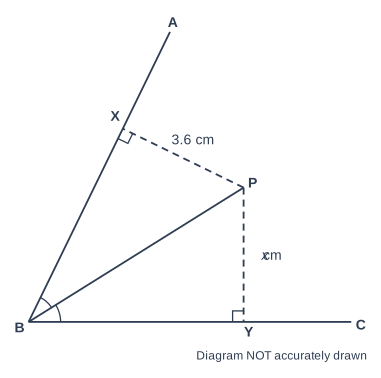
The diagram shows the line BP, which bisects angle ABC. X is the point on BA and Y is the point on BC such that PX and PY are perpendicular to the lines. PX = 3.6 cm.
Write down the value of \(x\). Give a reason for your answer.
Model answer
\(x = 3.6\) P is on the bisector of angle ABC, so P is the same distance from BA as from BC. PX and PY are these perpendicular distances, so PY = PX = 3.6 cm.
Explanation
The angle bisector is the locus of points that are equidistant from the two lines that make the angle. The distance from a point to a line is measured along the perpendicular, so PX and PY are the two distances and they are equal.
Mark scheme
1 mark
B1 for 3.6
cao
1 mark
C1 for a correct reason, e.g. every point on the bisector of an angle is the same distance from both arms (lines) of the angle
accept 'P is on the angle bisector so it is equidistant from BA and BC'
Question 3
2 marks
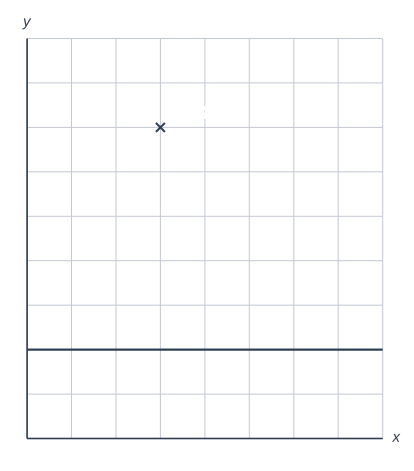
The diagram shows the point P(3, 7) and the line L. The equation of line L is \(y = 2\).
Write down the shortest distance from P to line L. Write down the coordinates of the point on line L that is closest to P.
Model answer
The shortest distance is the perpendicular distance, straight down from P to the line. The closest point on L is directly below P: (3, 2). Distance = 7 − 2 = 5 units
Explanation
The shortest distance from a point to a line is along the perpendicular. L is horizontal, so the perpendicular from P goes straight down, keeping the same x-coordinate, 3. It meets L where y = 2, and the distance is the difference in the y-coordinates.
Mark scheme
1 mark
B1 for 5 (units)
cao; correct answer with no working scores full marks
1 mark
B1 for (3, 2)
cao
Question 4
4 marks
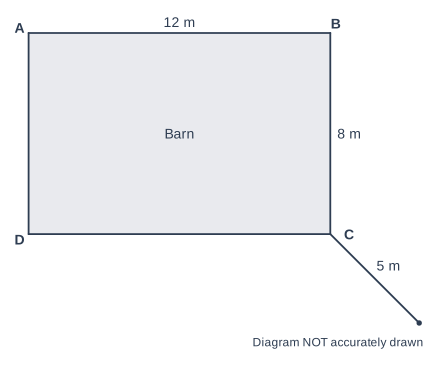
The diagram shows a large rectangular barn ABCD in a field. A goat is tied to the corner C of the barn with a rope 5 m long. The goat cannot go inside the barn.
Work out the area of the field that the goat can reach. Give your answer correct to 1 decimal place.
Model answer
The rope is shorter than both walls, so the goat cannot get round the barn. The goat can reach all points within 5 m of C, except the part inside the barn. The barn takes up a 90° corner, so the goat reaches 360° − 90° = 270° of a circle, which is \(\frac{3}{4}\) of a circle. Area = \(\frac{3}{4} \times \pi \times 5^2 = \frac{3}{4} \times 78.539... = 58.904...\) Area = 58.9 m² (1 d.p.)
Explanation
Without the barn, the goat could reach a full circle of radius 5 m around C. The corner of the barn blocks a right angle, a quarter of the circle, so the goat can reach three quarters of the circle. Work out the area of the full circle with πr², then multiply by three quarters.
Mark scheme
1 mark
P1 for recognising that the region is \(\frac{3}{4}\) of a circle of radius 5 m (an angle of 270° at C)
may be seen in a sketch; correct answer with no working scores full marks
1 mark
P1 for \(\pi \times 5^2\) (= 78.5...)
1 mark
P1 for \(\frac{3}{4} \times \pi \times 5^2\) or \(\frac{270}{360} \times \pi \times 5^2\)
1 mark
A1 for 58.9 m²
awrt 58.9 (58.904...); do not accept 78.5 (a full circle) or 19.6 (a quarter circle)
Ready to try the rest? Every answer you write is marked against the mark scheme, so you can see exactly where the marks are.
Ctrl + Enter to check
Study HelperHints first, answers after you try
Stuck on this one? Ask for a hint and I’ll point you in the right direction, without giving the answer away. Once you’ve checked your answer, I’ll show you how the marks are awarded.