
Level:
Correct: 0
Incorrect: 0
Marks: 0/0
Exam Practice
Course:
Topics:
Edexcel GCSE Maths (Foundation calculator) Smart practice A mixed round aimed at your weak spots
Unit 1
Number
Unit 2
Algebra
Unit 3
Ratio, proportion and rates of change
Unit 4
Geometry and measures
Unit 5
Probability
Unit 6
Statistics
Avg
score:
–
Topics
done:
0/86

Ratios, fractions and linear functions

Practise 18 exam-style questions on Ratios, fractions and linear functions for Edexcel GCSE Maths (Foundation calculator). Write your answer as you would in the exam and get it marked in seconds against the mark scheme, point by point, with the Study Helper on hand if you get stuck.

  • 18 questions
  • 1–5 marks each
  • Instant marking
  • No sign-up needed
18 questions, marked as you go

Sample questions with model answers

Here are 4 of the questions in this topic, each with a model answer, an explanation of why it earns the marks and the mark scheme an examiner would use.

Question 1

1 mark

Amy and Ben share some money.
The bar model shows how they share it.
Each box is the same amount of money.

What fraction of the money does Ben get?
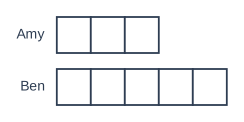
A bar model: 2 bars, one above the other, lined up at the left and drawn to the same scale: bar 1 (labelled "Amy") split into 3 equal boxes; bar 2 (labelled "Ben") split into 5 equal boxes. The bars have lengths in the ratio 3 : 5 (every box is the same size).

Model answer

Amy has 3 boxes and Ben has 5 boxes, so there are 8 boxes altogether.
Ben gets \(\frac{5}{8}\) of the money.

Explanation

The bar model shows the ratio Amy : Ben = 3 : 5. Altogether there are 3 + 5 = 8 equal parts, and Ben has 5 of them, so he gets 5/8. Do not write 5/3 - the bottom of the fraction must be the total.

Mark scheme
  1. 1 mark

    B1 for \(\frac{5}{8}\)

    oe, e.g. 0.625 or 62.5%; do not accept \(\frac{5}{3}\)

Question 2

2 marks

In a choir, the number of boys is \(\dfrac{3}{5}\) of the number of girls.

What fraction of the choir are boys?

Model answer

boys : girls = 3 : 5
Total = 3 + 5 = 8 parts
Boys are \(\frac{3}{8}\) of the choir.

Explanation

If boys are 3/5 of the girls, then for every 3 boys there are 5 girls, so boys : girls = 3 : 5. The whole choir is 3 + 5 = 8 parts, so 3/8 of the choir are boys. 3/5 is the boys as a fraction of the girls, not of the whole choir.

Mark scheme
  1. 1 mark

    M1 for boys : girls = 3 : 5 or 3 + 5 = 8

    or an example, e.g. 30 boys and 50 girls, 80 altogether; correct answer with no working scores full marks

  2. 1 mark

    A1 for \(\frac{3}{8}\)

    oe, e.g. 0.375; do not accept \(\frac{3}{5}\)

Question 3

3 marks

In a car park, \(\dfrac{1}{4}\) of the cars are red and \(\dfrac{1}{3}\) of the cars are silver.
The rest of the cars are black.

Work out the ratio of red cars to silver cars to black cars.
Give your ratio in its simplest form.

Model answer

Red = \(\frac{1}{4} = \frac{3}{12}\), silver = \(\frac{1}{3} = \frac{4}{12}\)
Black = \(1 - \frac{3}{12} - \frac{4}{12} = \frac{5}{12}\)
red : silver : black = 3 : 4 : 5

Explanation

Write the fractions with a common denominator (twelfths), then the black cars are the 5/12 that are left. When all three fractions are out of 12, the ratio is just the numerators: 3 : 4 : 5. Using 12 cars (or 60 cars) as an example gives the same ratio.

Mark scheme
  1. 1 mark

    M1 for \(1 - \frac{1}{4} - \frac{1}{3}\) (= \(\frac{5}{12}\)) black

    oe, e.g. using 12 cars: 3 red, 4 silver, 5 black; correct answer with no working scores full marks

  2. 1 mark

    M1 for \(\frac{3}{12} : \frac{4}{12} : \frac{5}{12}\) or an unsimplified equivalent ratio, e.g. 15 : 20 : 25

    oe

  3. 1 mark

    A1 for 3 : 4 : 5

    cao

Question 4

4 marks

There are 180 counters in a bag.
Each counter is red, blue or yellow.

\(\dfrac{2}{9}\) of the counters are red.
The ratio of the number of blue counters to the number of yellow counters is 3 : 4

What fraction of the counters in the bag are blue?
Give your answer in its simplest form.

Model answer

Red = \(\frac{2}{9} \times 180 = 40\)
Blue and yellow = 180 − 40 = 140
3 + 4 = 7 parts, so 1 part = 140 ÷ 7 = 20
Blue = 3 × 20 = 60
Fraction blue = \(\frac{60}{180} = \frac{1}{3}\)

Explanation

Find the red counters first, then share the rest in the ratio 3 : 4. Blue is 3 out of 7 parts of the 140 counters, so there are 60 blue counters. As a fraction of all 180 counters that is 60/180 = 1/3. Do not give 3/7 - that is the fraction of the blue and yellow counters only.

Mark scheme
  1. 1 mark

    P1 for \(180 \times \frac{2}{9}\) (= 40 red) or \(1 - \frac{2}{9}\) (= \(\frac{7}{9}\))

    correct answer with no working scores full marks

  2. 1 mark

    P1 for 180 − 40 (= 140) and 140 ÷ 7 (= 20)

    or \(\frac{7}{9} \div 7\) (= \(\frac{1}{9}\))

  3. 1 mark

    P1 for 60 blue counters or \(\frac{3}{7} \times \frac{7}{9}\) or \(\frac{60}{180}\)

    oe

  4. 1 mark

    A1 for \(\frac{1}{3}\)

    cao (simplest form)

Ready to try the rest? Every answer you write is marked against the mark scheme, so you can see exactly where the marks are.

Study Helper Hints first, answers after you try

Stuck on this one? Ask for a hint and I’ll point you in the right direction, without giving the answer away. Once you’ve checked your answer, I’ll show you how the marks are awarded.