Practise 28 exam-style questions on Geometry problems on coordinate axes for Edexcel GCSE Maths (Foundation calculator). Write your answer as you would in the exam and get it marked in seconds against the mark scheme, point by point, with the Study Helper on hand if you get stuck.
28 questions
1–5 marks each
Instant marking
No sign-up needed
20 questions, marked as you go
Sample questions with model answers
Here are 4 of the questions in this topic, each with a model answer, an explanation of why it earns the marks and the mark scheme an examiner would use.
Question 1
1 mark
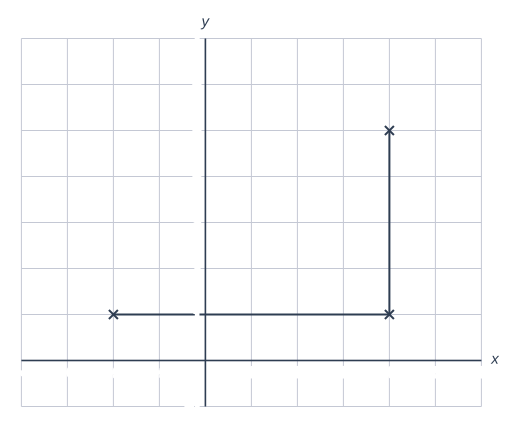
The grid shows three of the vertices, A, B and C, of a rectangle ABCD.
Write down the coordinates of the vertex D.
Model answer
D is directly above A and level with C. D = (−2, 5)
Explanation
In a rectangle the opposite sides are equal and parallel. AB goes across and BC goes up, so D must be the same distance up from A as C is from B. D has the same x-coordinate as A and the same y-coordinate as C.
Mark scheme
1 mark
B1 for (−2, 5)
cao
Question 2
2 marks
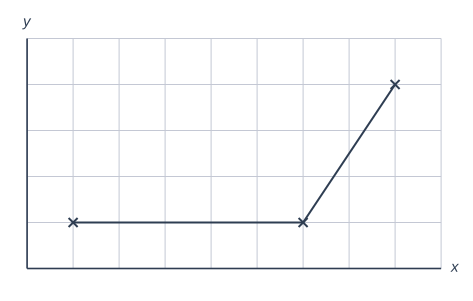
The grid shows three of the vertices, A, B and C, of a parallelogram ABCD.
Work out the coordinates of the vertex D.
Model answer
In a parallelogram, AD is parallel and equal to BC. From B(6, 1) to C(8, 4) is 2 right and 3 up. From A(1, 1), go 2 right and 3 up: D = (3, 4)
Explanation
Opposite sides of a parallelogram are equal and parallel, so the move from A to D is the same as the move from B to C. Check with the other pair of sides: from D(3, 4) to C(8, 4) is 5 right, the same as from A to B.
Mark scheme
1 mark
M1 for using the step from B to C (2 right, 3 up) from A, or the step from B to A (5 left) from C
or one correct coordinate
1 mark
A1 for (3, 4)
cao; correct answer with no working scores full marks
Question 3
3 marks
A is the point (−2, 3). B is the point (4, −1).
Work out the length of AB. Give your answer correct to 1 decimal place.
The horizontal distance is from x = −2 to x = 4, which is 6, and the vertical distance is from y = 3 down to y = −1, which is 4. These are the two shorter sides of a right-angled triangle with AB as the hypotenuse. Square, add, then square root.
Mark scheme
1 mark
M1 for the differences 6 and 4
e.g. 4 − (−2) and 3 − (−1); signs may be ignored
1 mark
M1 for \(\sqrt{6^2 + 4^2}\) (= \(\sqrt{52}\))
1 mark
A1 for 7.2 units
awrt 7.2 (7.2111...); correct answer with no working scores full marks
Question 4
4 marks
A is the point (1, 1). B is the point (5, 3). C is the point (3, 7).
Is triangle ABC a right-angled triangle? You must show your working.
Find the square of each side using the differences in the coordinates. If the squares of the two shorter sides add up to the square of the longest side, Pythagoras' theorem works and the triangle has a right angle opposite the longest side. Here the angle at B is 90°.
Mark scheme
1 mark
M1 for a correct method for the square of one side, e.g. \(AB^2 = 4^2 + 2^2\)
or the length of one side
1 mark
M1 for a correct method for all three sides
1 mark
A1 for \(AB^2 = 20\), \(BC^2 = 20\) and \(AC^2 = 40\)
or AB = BC = 4.47... and AC = 6.32...
1 mark
C1 for yes, because \(AB^2 + BC^2 = AC^2\) (20 + 20 = 40), so there is a right angle at B
accept a correct comparison using gradients 1/2 and −2 with a conclusion
Ready to try the rest? Every answer you write is marked against the mark scheme, so you can see exactly where the marks are.
Ctrl + Enter to check
Study HelperHints first, answers after you try
Stuck on this one? Ask for a hint and I’ll point you in the right direction, without giving the answer away. Once you’ve checked your answer, I’ll show you how the marks are awarded.