Level:
Correct: 0
Incorrect: 0
Marks: 0/0
Exam Practice
Course:
Topics:
Avg
score:
–
Topics
done:
0/35

Waste management

Practise 11 exam-style questions on Waste management for AQA GCSE Combined Science (Biology Paper 2). Write your answer as you would in the exam and get it marked in seconds against the mark scheme, point by point, with the Study Helper on hand if you get stuck.

  • 11 questions
  • 1–6 marks each
  • Instant marking
  • No sign-up needed
11 questions, marked as you go

Sample questions with model answers

Here are 4 of the questions in this topic, each with a model answer, an explanation of why it earns the marks and the mark scheme an examiner would use.

Question 1

2 marks

Humans are producing more waste than ever before.

Give two reasons why.

Model answer

The human population is growing rapidly, and the standard of living has increased, so each person uses more resources and produces more waste.

Explanation

More people, each using more resources, means much more waste. Unless waste and chemical materials are properly handled, this leads to more pollution.

Mark scheme
  1. 1 mark

    rapid growth in the human population

    allow there are more people

  2. 1 mark

    an increase in the standard of living, so each person uses more resources

    allow people buy / use more things

Question 2

3 marks

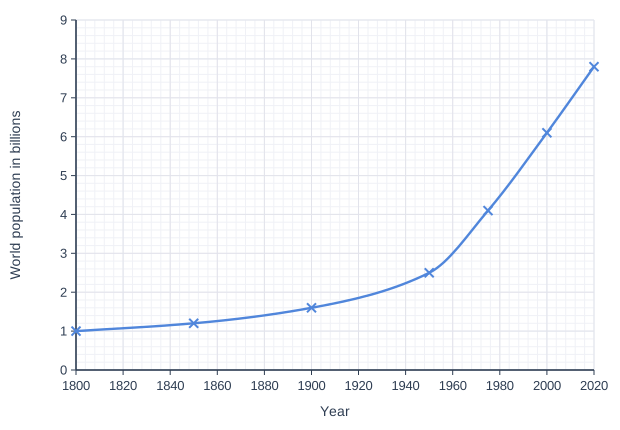
The graph shows how the world's human population has changed since 1800.

Describe the change shown in the graph and explain why this change leads to more pollution.

Line graph of world population in billions (y-axis, 0 to 9) against year (x-axis, 1800 to 2020). The line is a smooth curve through (1800, 1), (1850, 1.2), (1900, 1.6), (1950, 2.5), (1975, 4.1), (2000, 6.1), (2020, 7.8).

Model answer

The world population grew slowly at first, from 1.0 billion in 1800 to 1.6 billion in 1900, and then very rapidly, reaching 7.8 billion in 2020. More people use more resources and produce more waste, and unless this waste is properly handled, it causes more pollution of water, air and land.

Explanation

Rapid growth in the human population, together with a higher standard of living, means more resources are used and more waste is produced. The steepening curve shows the rate of growth increasing.

Mark scheme
  1. 1 mark

    the population increased slowly at first, then very rapidly (from 1.0 billion in 1800 to 7.8 billion in 2020)

    must include data or the idea of the rate increasing

  2. 1 mark

    more people use more resources and produce more waste

  3. 1 mark

    unless the waste and chemicals are properly handled, more pollution is caused

Question 3

3 marks

Explain how landfill sites can reduce biodiversity.

Model answer

Landfill sites take up land, destroying the habitats of the plants and animals that lived there. Toxic chemicals can leak from the waste into the surrounding soil and water, killing plants and animals there too, so fewer species can survive in the area.

Explanation

Landfill pollutes the land and can also pollute water nearby. Pollution kills plants and animals, which can reduce biodiversity.

Mark scheme
  1. 1 mark

    the land used for landfill destroys the habitats of plants and animals

    max 3; allow reduces the land available for other organisms

  2. 1 mark

    toxic chemicals can leak from the waste into the soil and water

  3. 1 mark

    the toxic chemicals kill plants and animals

  4. 1 mark

    so fewer species can live in the area

Question 4

4 marks

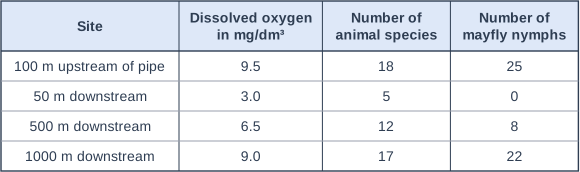
Untreated sewage was leaking into a river from a broken pipe. Scientists measured the dissolved oxygen and counted the number of species of animal at four sites along the river.

The table shows their results.

Describe and explain the effect of the sewage on the river community.

Table with columns "Site", "Dissolved oxygen in mg/dm³", "Number of animal species", "Number of mayfly nymphs". Site: 100 m upstream of pipe; Dissolved oxygen in mg/dm³: 9.5; Number of animal species: 18; Number of mayfly nymphs: 25 | Site: 50 m downstream; Dissolved oxygen in mg/dm³: 3.0; Number of animal species: 5; Number of mayfly nymphs: 0 | Site: 500 m downstream; Dissolved oxygen in mg/dm³: 6.5; Number of animal species: 12; Number of mayfly nymphs: 8 | Site: 1000 m downstream; Dissolved oxygen in mg/dm³: 9.0; Number of animal species: 17; Number of mayfly nymphs: 22.

Model answer

Just below the pipe, the dissolved oxygen fell from 9.5 to 3.0 mg/dm³ and the number of species fell from 18 to 5. Microorganisms feed on the sewage and use up the oxygen in the water for respiration, so animals that need a lot of oxygen, such as mayfly nymphs, cannot survive there. Further downstream the sewage is diluted and broken down, so the oxygen level and the number of species recover, reaching 9.0 mg/dm³ and 17 species at 1000 m.

Explanation

Sewage is a water pollutant that kills animals by reducing oxygen, which reduces biodiversity. Comparing the sites upstream and downstream shows that the sewage, not some other difference, is the likely cause.

Mark scheme
  1. 1 mark

    the number of species fell just below the pipe (from 18 to 5) and oxygen fell (from 9.5 to 3.0 mg/dm³)

    max 4; must use data for this mark

  2. 1 mark

    microorganisms feed on the sewage and use up oxygen in respiration

  3. 1 mark

    animals that need a lot of oxygen (e.g. mayfly nymphs) cannot survive, so only a few tolerant species remain

  4. 1 mark

    further downstream the sewage is diluted / broken down, so oxygen and the number of species recover (17 species at 1000 m)

Ready to try the rest? Every answer you write is marked against the mark scheme, so you can see exactly where the marks are.

Revision notes

Waste management

The big idea

Rapid growth in the human population and an increase in the standard of living mean that more and more resources are used and more waste is produced. Unless waste and chemical materials are properly handled, more pollution will be caused. Pollution can occur in water, in air and on land, and it kills plants and animals, which can reduce biodiversity.

Why we produce more waste

  • More people means more food, water, energy and materials are used, so more waste is produced in total.
  • A higher standard of living means each person buys and uses more goods, packaging and energy, so each person produces more waste.

The two effects multiply together.

Pollution of water, air and land

WhereSourcesHow it kills plants and animals
WaterSewage, fertiliser and toxic chemicalsBacteria feeding on sewage, or on algae that grew because of fertiliser, use up the dissolved oxygen, so fish and other animals die. Toxic chemicals such as pesticides, oil and industrial waste poison organisms. Untreated sewage also contains pathogens.
AirSmoke and acidic gasesSmoke particles settle on leaves and block light, so plants photosynthesise less. Acidic gases such as sulfur dioxide and nitrogen oxides, from burning fossil fuels, dissolve in water in the air to form acid rain, which damages trees and makes soil and lakes acidic, killing fish.
LandLandfill and toxic chemicalsLandfill sites take up land that was habitat, and toxic chemicals can leak from the waste into the soil and ground water. Pesticides, herbicides and industrial waste poison soil organisms and plants.

How fertiliser in a lake kills fish

  1. Rain washes fertiliser off fields into a lake, adding mineral ions such as nitrate.
  2. Algae grow very fast and cover the surface.
  3. The algae block light, so plants below cannot photosynthesise and die; many algae die too.
  4. Bacteria decay the dead plants and algae, and their numbers increase.
  5. The bacteria respire aerobically and use up the oxygen dissolved in the water.
  6. Fish and other animals cannot get enough oxygen for respiration, so they die.

Untreated sewage has a similar effect: bacteria feed on the organic matter in it, multiply and use up the oxygen as they respire.

Some toxic chemicals are not broken down or excreted, so they build up in organisms. Each animal eats many organisms from the level below, so the concentration is highest in the animals at the top of a food chain, which can be poisoned or fail to breed.

Handling waste properly

Pollution can be reduced by treating sewage before it reaches rivers, using fertiliser carefully (not just before heavy rain), fitting filters and scrubbers to chimneys, using renewable energy instead of burning fossil fuels, recycling more waste, and lining landfill sites so that chemicals cannot leak out.

More people, and more waste each

A town's population grew from 40 000 to 60 000 people, and the mean household waste per person rose from 300 kg to 400 kg a year. How many times more waste does the town now produce in a year?

Before: \(40\,000 \times 300 = 12\,000\,000\) kg \(= 12\,000\) tonnes

After: \(60\,000 \times 400 = 24\,000\,000\) kg \(= 24\,000\) tonnes

\(24\,000 \div 12\,000 = 2\) times as much waste. The population rose 1.5 times and the waste per person about 1.3 times, but together they doubled the total.

Using data on land pollution

Example data: a student estimated the percentage cover of plants in quadrats at different distances from an old mine waste heap that leaks toxic chemicals into the soil.

Distance from waste heap in mPlant cover in %
05
2030
4070
6085

Describe and explain the pattern.

  • Describe: plant cover increases with distance from the heap, from 5% at 0 m to 85% at 60 m.
  • Explain: toxic chemicals leak from the waste into the soil and are most concentrated near the heap, so they poison and kill more plants there.
  • Biodiversity: animals that depend on these plants for food and shelter also decline, so fewer species live near the heap.
  • Caution: other factors, such as soil depth or moisture, may also change with distance.

Remember

  • Water is polluted by sewage, fertiliser and toxic chemicals.
  • Air is polluted by smoke and acidic gases.
  • Land is polluted by landfill and toxic chemicals.
  • Pollution kills plants and animals, which can reduce biodiversity.

Common mistakes

  • Saying the fertiliser or sewage itself poisons the fish or uses up the oxygen. It is the bacteria decaying the dead material that use up the oxygen when they respire.
  • Saying only that the algae use up oxygen at night. The main cause is respiration by the bacteria that decay the dead plants and algae.
  • Naming methane or carbon monoxide as the gases that cause acid rain. The main acidic gases are sulfur dioxide and nitrogen oxides.
  • Writing just "pollution" or "waste" as an answer. Name the pollutant and where it ends up (water, air or land).
  • Saying pollution reduces biodiversity because it "harms the environment". Say it kills plants and animals, so some species are lost.

Exam tip

In six-mark questions on pollution, cover all three of water, air and land, with a named source for each, and finish by linking pollution to the death of plants and animals and the loss of biodiversity. In explanation chains, use one step per sentence.

Study Helper Hints first, answers after you try

Stuck on this one? Ask for a hint and I’ll point you in the right direction, without giving the answer away. Once you’ve checked your answer, I’ll show you how the marks are awarded.