Level:
Correct: 0
Incorrect: 0
Marks: 0/0
Exam Practice
Course:
Topics:
Avg
score:
–
Topics
done:
0/35

Genetic inheritance

Practise 18 exam-style questions on Genetic inheritance for AQA GCSE Combined Science (Biology Paper 2). Write your answer as you would in the exam and get it marked in seconds against the mark scheme, point by point, with the Study Helper on hand if you get stuck.

  • 18 questions
  • 1–6 marks each
  • Instant marking
  • No sign-up needed
18 questions, marked as you go

Sample questions with model answers

Here are 4 of the questions in this topic, each with a model answer, an explanation of why it earns the marks and the mark scheme an examiner would use.

Question 1

2 marks

Explain what is meant by the terms homozygous and heterozygous.

Model answer

Homozygous means the organism has two of the same allele for a characteristic, for example BB or bb. Heterozygous means it has two different alleles, for example Bb.

Explanation

Body cells carry two alleles of each gene, one on each chromosome of a pair. 'Homo' means same and 'hetero' means different, which helps you remember the terms.

Mark scheme
  1. 1 mark

    homozygous: the two alleles (for a characteristic) are the same

    allow e.g. BB or bb

  2. 1 mark

    heterozygous: the two alleles are different

    allow e.g. Bb

Question 2

2 marks

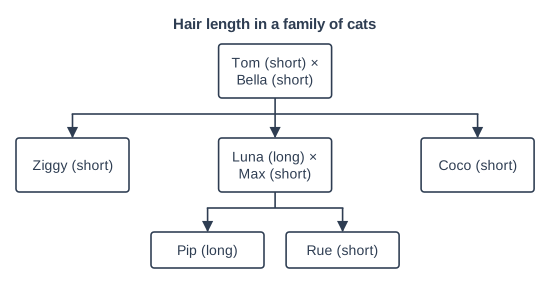
In cats, the allele for short hair (L) is dominant to the allele for long hair (l). The diagram shows a family tree of some cats and their hair length. Each box containing × shows a pair of parent cats, and the arrows lead to their kittens. Max is not a kitten of Tom and Bella.

Give the genotypes of Luna and Max. Give a reason for Max's genotype.

Hair length in a family of cats. Flow chart of 6 boxes joined by arrows, read from top to bottom. The first box is "Tom (short) × Bella (short)". From "Tom (short) × Bella (short)", 3 arrows branch out side by side: the left arrow leads to "Ziggy (short)"; the middle arrow leads to "Luna (long) × Max (short)"; the right arrow leads to "Coco (short)". From "Luna (long) × Max (short)", 2 arrows branch out side by side: the left arrow leads to "Pip (long)"; the right arrow leads to "Rue (short)".

Model answer

Luna has long hair, so she is ll. Max has short hair, so he has at least one L, but his kitten Pip has long hair (ll) and must have received an l from Max. So Max is Ll.

Explanation

Any cat showing the recessive phenotype must be homozygous recessive. To work out the genotype of a dominant-phenotype parent, look at its offspring: a recessive offspring shows that the parent carries the recessive allele.

Mark scheme
  1. 1 mark

    Luna: ll

  2. 1 mark

    Max: Ll, because he has short hair but has a long-haired kitten (Pip), so he must carry l

    genotype and reason both needed for the mark

Question 3

3 marks

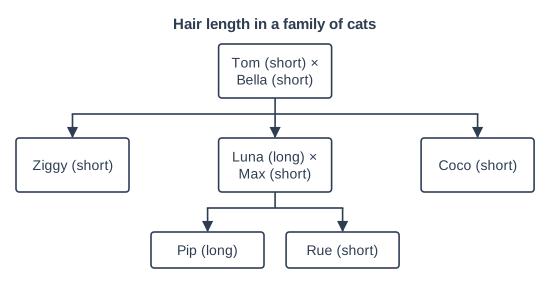
In cats, hair length is controlled by a single gene. The diagram shows a family tree of some cats and their hair length. Each box containing × shows a pair of parent cats, and the arrows lead to their kittens. Max is not a kitten of Tom and Bella.

Explain how the family tree shows that the allele for long hair is recessive.

Hair length in a family of cats. Flow chart of 6 boxes joined by arrows, read from top to bottom. The first box is "Tom (short) × Bella (short)". From "Tom (short) × Bella (short)", 3 arrows branch out side by side: the left arrow leads to "Ziggy (short)"; the middle arrow leads to "Luna (long) × Max (short)"; the right arrow leads to "Coco (short)". From "Luna (long) × Max (short)", 2 arrows branch out side by side: the left arrow leads to "Pip (long)"; the right arrow leads to "Rue (short)".

Model answer

Tom and Bella both have short hair, but one of their kittens, Luna, has long hair. Luna must have received an allele for long hair from each parent, so both Tom and Bella carry the long-hair allele even though they have short hair. The long-hair allele is hidden when the short-hair allele is present, so it is recessive, and Tom and Bella are heterozygous.

Explanation

In a family tree, the clue to a recessive allele is two parents without a characteristic having offspring with it. The parents must be heterozygous carriers of the recessive allele.

Mark scheme
  1. 1 mark

    Tom and Bella both have short hair but have a kitten with long hair (Luna)

  2. 1 mark

    so Tom and Bella must both carry the allele for long hair without showing it

    allow both parents are heterozygous

  3. 1 mark

    an allele that is not expressed when another allele is present is recessive / long hair is only expressed with two copies

Question 4

4 marks

In mice, the allele for black fur (B) is dominant to the allele for brown fur (b). A breeder has a black mouse but does not know whether its genotype is BB or Bb.

Explain how the breeder could find out the genotype of the black mouse by breeding it with a brown mouse.

Model answer

The brown mouse must be bb, so all its gametes contain b. If the black mouse is BB, every offspring gets B from it and is Bb, so all the offspring are black. If the black mouse is Bb, half of its gametes carry b, so about half of the offspring will be bb and brown. So if any brown offspring appear, the black mouse must be Bb. The breeder should look at a large number of offspring before deciding the mouse is BB, because a Bb mouse could have only a few offspring that all happen to be black.

Explanation

Crossing with a homozygous recessive organism reveals the alleles in the other parent's gametes, because the recessive parent adds only recessive alleles. One recessive offspring proves the parent is heterozygous; all-dominant offspring only suggest homozygous, and the evidence gets stronger with more offspring.

Mark scheme
  1. 1 mark

    the brown mouse is bb, so it can only pass on b

    max 4

  2. 1 mark

    if the black mouse is BB, all the offspring will be black (Bb)

  3. 1 mark

    if the black mouse is Bb, about half the offspring will be brown (1 : 1 ratio)

    allow Bb × bb gives Bb and bb

  4. 1 mark

    so if any offspring are brown, the black mouse must be Bb

  5. 1 mark

    a large number of offspring is needed before concluding BB, because a Bb mouse could have only black offspring by chance

Ready to try the rest? Every answer you write is marked against the mark scheme, so you can see exactly where the marks are.

Revision notes

Genetic inheritance

The big idea

You inherit one copy of each gene from each parent. Different versions of a gene, called alleles, explain why offspring can look like one parent, both parents or neither. For characteristics controlled by a single gene, a Punnett square lets you predict the chance of each outcome.

The key terms

TermMeaningExample (pea pods)
GameteA sex cell; it carries one allele of each genePollen or egg cell
ChromosomeA long molecule of DNA carrying many genes; body cells have them in pairsPea body cells have 7 pairs
GeneA small section of DNA that codes for a proteinThe gene for pod colour
AlleleA different form (version) of a geneG (green pods) or g (yellow pods)
DominantAn allele that is always expressed, even if only one copy is presentG
RecessiveAn allele that is only expressed if two copies are present (no dominant allele)g
HomozygousThe two alleles are the sameGG or gg
HeterozygousThe two alleles are differentGg
GenotypeThe alleles an organism hasGG, Gg or gg
PhenotypeThe characteristic that is expressedGreen pods or yellow pods

A dominant allele is written as a capital letter and the recessive allele as the same letter in lower case. GG and Gg plants have the same phenotype (green pods), because G is dominant. Only gg plants have yellow pods.

The alleles (genotype) work at a molecular level: they code for proteins, such as an enzyme that makes a pigment, and the proteins produce the characteristic (phenotype).

One gene or many?

Some characteristics are controlled by a single gene, such as fur colour in mice and red-green colour blindness in humans. These fall into a few clear groups and can be predicted with a Punnett square. But most characteristics are a result of multiple genes interacting, such as height. They show a wide range of values and cannot be predicted by a simple cross.

Punnett squares and probability

Each parent has two alleles but passes on only one in each gamete. A Punnett square shows every way the gametes can combine, and each box is an equally likely outcome.

Punnett square. Green-podded plant (genotype Gg) is shown along the top with gametes G and g in circles; Green-podded plant (genotype Gg) is shown down the left side with gametes G and g in circles. The four offspring boxes contain: top-left GG, top-right Gg, bottom-left Gg, bottom-right gg (shaded). A key shows that a shaded box means "Yellow pods" and an unshaded box means "Green pods". Marker's notes: The parent along the top (Green-podded plant) is Gg (heterozygous); the parent down the side (Green-podded plant) is Gg (heterozygous). Offspring genotypes: 1 of 4 GG (probability 0.25, 25%), 2 of 4 Gg (probability 0.5, 50%), 1 of 4 gg (probability 0.25, 25%); ratio 1 : 2 : 1 GG : Gg : gg. Shaded phenotype "Yellow pods": 1 of 4 (probability 0.25, 25%); "Green pods": 3 of 4; ratio 1 : 3.
Crossing two heterozygous plants gives genotypes GG : Gg : gg in the ratio 1 : 2 : 1, so green : yellow pods is 3 : 1.

From this square:

  • the probability of yellow pods (gg) is 1 box in 4: \(\tfrac{1}{4}\), 0.25 or 25%;
  • the ratio of green to yellow is 3 : 1;
  • the probability of a heterozygous plant (Gg) is 2 in 4, or 50%.

These are only chances. The chance is the same for every offspring, and real results are close to, but rarely exactly, the predicted ratio, because which gametes fuse is random. Predictions are most reliable with large numbers of offspring.

Using a probability to predict numbers

Two heterozygous pea plants (Gg) are crossed, and 360 seeds grow into plants. How many are expected to have yellow pods?

Probability of yellow pods (gg) \(= \tfrac{1}{4}\)

Expected number \(= \tfrac{1}{4} \times 360 = 90\) plants (direct proportion: probability \(\times\) total)

If the grower actually counts 85, that is close to 90; the small difference is due to chance.

Higher tier only

Constructing a cross. Higher papers can ask you to build the cross yourself. In pea plants, a heterozygous green-podded plant is crossed with a yellow-podded plant.

  1. Parents' genotypes: Gg and gg (yellow is recessive, so the yellow plant must be gg).
  2. Gametes: G and g from the first parent; g and g from the second.
  3. Draw the grid and fill each box with one allele from each gamete: Gg, Gg, gg, gg.
  4. Predict: green : yellow = 2 : 2 = 1 : 1, so the probability of yellow pods is \(\tfrac{1}{2}\) (50%).

Family trees

Family trees show how a characteristic is inherited. Males are squares, females are circles, and people with the characteristic are shaded. Two clues are worth learning:

  • Two unaffected parents with an affected child: the allele is recessive, and both parents are heterozygous.
  • Two affected parents with an unaffected child: the allele is dominant, and both parents are heterozygous.

To give someone's genotype, use their own phenotype plus what they must have received from a parent or passed to a child.

Common mistakes

  • Defining an allele as "a gene". An allele is a different form of a gene.
  • Saying dominant means "stronger" or "more common". It means always expressed, even if only one copy is present.
  • Giving a phenotype when asked for a genotype ("yellow" instead of gg), or the reverse.
  • Writing a probability as a ratio, such as 1 : 4. Write it as \(\tfrac{1}{4}\), 0.25 or 25%.
  • Thinking that after one affected child the next three will be unaffected. The chance is the same for every child.

Exam tip

When you complete a Punnett square, fill each box with one allele from the top and one from the side, writing the dominant allele first (Gg, not gG). Then count boxes: give a ratio in the order the question asks for (for example "green to yellow"), and keep the genotype ratio (1 : 2 : 1) separate from the phenotype ratio (3 : 1).

Study Helper Hints first, answers after you try

Stuck on this one? Ask for a hint and I’ll point you in the right direction, without giving the answer away. Once you’ve checked your answer, I’ll show you how the marks are awarded.