Practise 14 exam-style questions on How materials are cycled for AQA GCSE Combined Science (Biology Paper 2). Write your answer as you would in the exam and get it marked in seconds against the mark scheme, point by point, with the Study Helper on hand if you get stuck.
14 questions
1–6 marks each
Instant marking
No sign-up needed
14 questions, marked as you go
Sample questions with model answers
Here are 4 of the questions in this topic, each with a model answer, an explanation of why it earns the marks and the mark scheme an examiner would use.
Question 1
1 mark
In the water cycle, water vapour condenses to form clouds.
Name the process by which water then falls from clouds onto the land and sea.
Model answer
Precipitation.
Explanation
Water is continuously evaporated and precipitated. Precipitation is water falling as rain, snow, sleet or hail, and it provides fresh water for plants and animals on land.
Mark scheme
1 mark
precipitation
allow rain / snow / hail / sleet; do not accept condensation
Question 2
2 marks
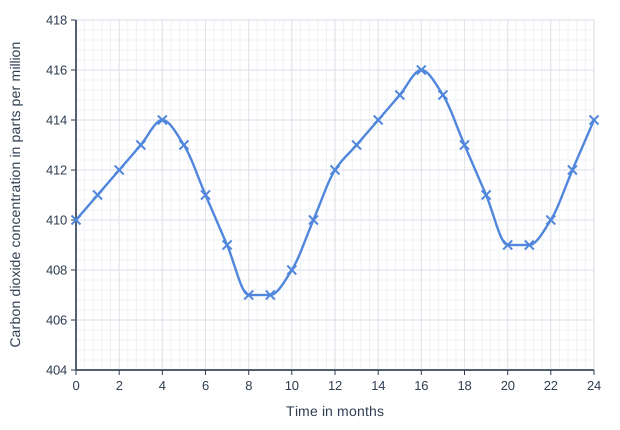
The graph shows the concentration of carbon dioxide in the air measured each month for two years at a monitoring station in the northern hemisphere. Month 0 is January of the first year.
The concentration of carbon dioxide is higher in the second year than in the first year. Suggest why.
Model answer
Burning fossil fuels releases extra carbon dioxide into the air, and deforestation reduces photosynthesis. More carbon dioxide is released each year than is removed by photosynthesis, so the concentration rises from one year to the next.
Explanation
In a balanced carbon cycle, the carbon dioxide released by respiration roughly equals the amount removed by photosynthesis. Burning carbon that was locked up in fossil fuels for millions of years adds extra carbon dioxide, so the balance is upset.
Mark scheme
1 mark
combustion of (fossil) fuels releases (extra) carbon dioxide
allow deforestation means less carbon dioxide is removed by photosynthesis
1 mark
more carbon dioxide is released into the air than is removed by photosynthesis
Question 3
3 marks
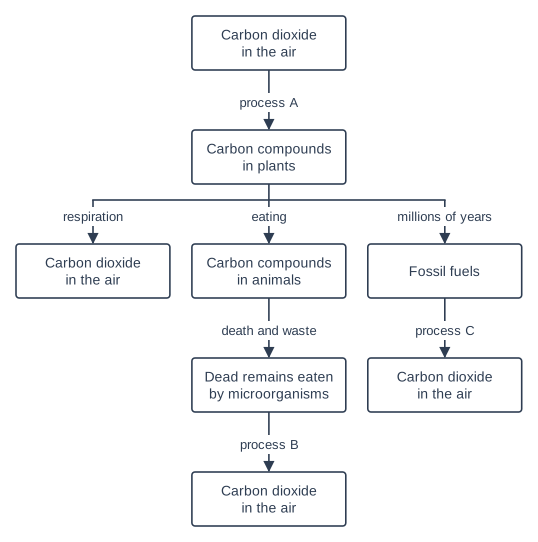
The diagram shows part of the carbon cycle. Some of the processes are labelled A, B and C.
Name processes A, B and C.
Model answer
A is photosynthesis. B is respiration by the microorganisms. C is combustion (burning).
Explanation
Photosynthesis is the only process in the diagram that takes carbon dioxide out of the air. Microorganisms that feed on dead remains and waste release carbon dioxide by respiration, and burning fossil fuels releases carbon dioxide by combustion.
Mark scheme
1 mark
A: photosynthesis
1 mark
B: respiration (by microorganisms)
allow decay / decomposition
1 mark
C: combustion / burning
Question 4
6 marks
Describe how carbon is cycled between the atmosphere and living organisms.
Model answer
Carbon is found in the atmosphere as carbon dioxide. Plants and algae take in carbon dioxide and use it in photosynthesis to make glucose, which they turn into other carbon compounds that make up their bodies. When animals eat plants, the carbon compounds pass to them, and then along the food chain to other animals.
Plants and animals respire, releasing some of the carbon back into the atmosphere as carbon dioxide. When organisms die, or produce waste such as faeces, microorganisms feed on the remains. The microorganisms respire, returning the carbon to the atmosphere as carbon dioxide, ready to be used again in photosynthesis.
Some carbon from dead organisms has been locked up in fossil fuels for millions of years. When fossil fuels or wood are burned, combustion releases this carbon as carbon dioxide.
Explanation
Follow the carbon in order: air, photosynthesis, food chains, respiration, death and decay by microorganisms, and back to the air, with combustion as an extra route. A good answer names each process and says which way the carbon moves.
Mark scheme
1 mark
carbon is in the atmosphere as carbon dioxide
Level of response question: credit a coherent, logically linked answer; max 6.
1 mark
plants and algae take in carbon dioxide for photosynthesis, making glucose / carbon compounds
1 mark
carbon passes to animals when they eat plants, and along food chains
1 mark
plants and animals respire, releasing carbon dioxide back into the atmosphere
1 mark
when organisms die or produce waste, microorganisms feed on / break down the remains
1 mark
microorganisms respire, returning carbon to the atmosphere as carbon dioxide
1 mark
some carbon is locked in fossil fuels for millions of years; combustion of fuels releases it as carbon dioxide
Ready to try the rest? Every answer you write is marked against the mark scheme, so you can see exactly where the marks are.
Ctrl + Enter to check
Study HelperHints first, answers after you try
Stuck on this one? Ask for a hint and I’ll point you in the right direction, without giving the answer away. Once you’ve checked your answer, I’ll show you how the marks are awarded.