Level:
Correct: 0
Incorrect: 0
Marks: 0/0
Exam Practice
Course:
Topics:
Avg
score:
–
Topics
done:
0/35

Sexual and asexual reproduction

Practise 12 exam-style questions on Sexual and asexual reproduction for AQA GCSE Combined Science (Biology Paper 2). Write your answer as you would in the exam and get it marked in seconds against the mark scheme, point by point, with the Study Helper on hand if you get stuck.

  • 12 questions
  • 1–6 marks each
  • Instant marking
  • No sign-up needed
12 questions, marked as you go

Sample questions with model answers

Here are 4 of the questions in this topic, each with a model answer, an explanation of why it earns the marks and the mark scheme an examiner would use.

Question 1

1 mark

Asexual reproduction produces offspring that are genetically identical to their parent.

What name is given to genetically identical offspring?

Model answer

Clones.

Explanation

In asexual reproduction there is only one parent and no mixing of genetic information, so the offspring are clones - genetically identical to the parent and to each other.

Mark scheme
  1. 1 mark

    clones

    allow clone

Question 2

2 marks

Hydra is a small freshwater animal. A small bud grows on the side of a Hydra. The bud grows into a new Hydra and then breaks off.

Is this sexual or asexual reproduction? Give a reason for your answer.

Model answer

It is asexual reproduction, because there is only one parent and no fusion of gametes.

Explanation

Budding produces a new individual from part of a single parent by mitosis, with no gametes. Any process with one parent and no fusion of gametes is asexual and gives a clone.

Mark scheme
  1. 1 mark

    asexual

  2. 1 mark

    only one parent / no gametes fuse / no mixing of genetic information / only mitosis is involved

    allow the new Hydra is a clone of the parent

Question 3

3 marks

Strawberry plants grow long side shoots called runners. New strawberry plants grow from the runners.

Explain why the new plants are genetically identical to the parent plant.

Model answer

Growing new plants from runners is asexual reproduction, so there is only one parent and no fusion of gametes, which means there is no mixing of genetic information. The new cells are made only by mitosis, which produces genetically identical cells, so the new plants are clones of the parent.

Explanation

Asexual reproduction involves one parent and only mitosis. Because mitosis copies the genetic information exactly, every new plant has the same genetic information as the parent.

Mark scheme
  1. 1 mark

    this is asexual reproduction with only one parent

    max 3

  2. 1 mark

    there is no fusion of gametes / no mixing of genetic information

  3. 1 mark

    only mitosis is involved

  4. 1 mark

    mitosis produces genetically identical cells

    allow so the plants are clones

Question 4

4 marks

A gardener grew two groups of plants from the same parent plant.

Group A was grown from runners of the parent plant.
Group B was grown from seeds made after the parent plant's egg cells were fertilised by pollen from a different plant.

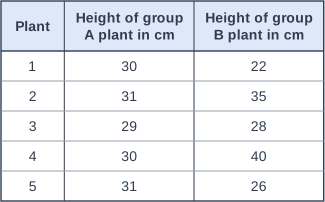
The table shows the heights of the plants after 8 weeks. Both groups were grown in the same conditions.

Compare the variation in height of the two groups and explain the difference.

Table with columns "Plant", "Height of group A plant in cm", "Height of group B plant in cm". Plant: 1; Height of group A plant in cm: 30; Height of group B plant in cm: 22 | Plant: 2; Height of group A plant in cm: 31; Height of group B plant in cm: 35 | Plant: 3; Height of group A plant in cm: 29; Height of group B plant in cm: 28 | Plant: 4; Height of group A plant in cm: 30; Height of group B plant in cm: 40 | Plant: 5; Height of group A plant in cm: 31; Height of group B plant in cm: 26.

Model answer

Group B shows much more variation in height than group A. The heights in group B range from 22 cm to 40 cm (a range of 18 cm), but those in group A only range from 29 cm to 31 cm (2 cm). Group B was produced by sexual reproduction, so the fusion of gametes mixed genetic information from two parents and the plants are genetically different. Group A was produced by asexual reproduction, so the plants are clones with identical genetic information; their small differences in height must be caused by small differences in their environment.

Explanation

Use the range to compare variation. The interesting point is that both groups have the same mean (30.2 cm) but very different spreads: genetic variation from sexual reproduction makes group B much more varied.

Mark scheme
  1. 1 mark

    group B shows more variation: range 18 cm (22-40 cm) compared with 2 cm (29-31 cm) for group A

    max 4; allow use of any correct data comparison

  2. 1 mark

    group B was produced by sexual reproduction: fusion of gametes mixes genetic information from two parents

  3. 1 mark

    so the plants in group B are genetically different

    allow gametes are made by meiosis so are genetically different

  4. 1 mark

    group A are clones produced by asexual reproduction / mitosis, so they are genetically identical

  5. 1 mark

    the small variation in group A must be caused by small differences in the environment

Ready to try the rest? Every answer you write is marked against the mark scheme, so you can see exactly where the marks are.

Revision notes

Sexual and asexual reproduction

The big idea

Living things make new individuals in one of two ways. Sexual reproduction joins cells from two parents, so the offspring are all different from each other. Asexual reproduction needs only one parent, so the offspring are exact genetic copies. The difference comes down to the type of cell division involved: meiosis makes non-identical cells, while mitosis makes identical cells.

Sexual reproduction

Sexual reproduction involves the joining (fusion) of a male gamete and a female gamete. A gamete is a sex cell. The moment the two gametes fuse is called fertilisation.

OrganismsMale gameteFemale gamete
AnimalsSperm cellEgg cell
Flowering plantsPollen (the nucleus inside the pollen grain)Egg cell
  • Gametes are made by meiosis in the reproductive organs, so every gamete is genetically different.
  • At fertilisation the genetic information from the two parents is mixed.
  • This mixing of genetic information leads to variety in the offspring. That is why brothers and sisters (apart from identical twins) look different: each one grew from a different sperm and a different egg.

After fertilisation, the fertilised egg divides by mitosis to grow into an embryo. So sexual reproduction uses both kinds of cell division: meiosis to make the gametes, then mitosis to build the new organism.

Asexual reproduction

Asexual reproduction involves only one parent and no fusion of gametes. There is no mixing of genetic information, and only mitosis is involved. So the offspring are genetically identical to the parent and to each other: they are clones.

Examples you may meet:

  • yeast, a single-celled fungus, grows a small bud that breaks away as a new cell;
  • strawberry plants grow runners that root and become new plants;
  • daffodils form new bulbs, and potato plants grow from tubers;
  • gardeners take cuttings from a plant they want to copy.

Clones have the same genes, but they are not always the same in every way. Different amounts of light, water or food (the environment) can make one clone bigger than another, and a rare mutation (a change in the DNA) can make one differ genetically.

Comparing the two

FeatureSexual reproductionAsexual reproduction
ParentsTwoOne
GametesMale and female gametes fuseNo gametes, no fusion
Cell divisionMeiosis makes the gametesMitosis only
Genetic informationMixed from two parentsNot mixed
OffspringGenetically different (variety)Genetically identical (clones)

The key link to learn: meiosis gives non-identical cells and mitosis gives identical cells. That is why sexual reproduction gives variety and asexual reproduction gives clones.

Chromosomes in clones and in gametes

The body cells of a meadow plant contain 20 chromosomes. The plant spreads by runners, and its flowers make pollen. How many chromosomes are there in (a) a leaf cell of a new plant grown from a runner and (b) the nucleus of a pollen grain?

(a) A runner is asexual reproduction, so the new plant's cells are made by mitosis. They have the same chromosomes as the parent: 20.

(b) Pollen is a gamete, made by meiosis, which halves the number of chromosomes: \(20 \div 2 = 10\). Answer: 10.

How quickly clones build up

One yeast cell buds once every 2 hours, and every new cell does the same. Starting with one cell, how many cells are there after 10 hours, if none die?

Number of times the cells divide: \(10 \div 2 = 5\)

The number doubles each time: \(1 \to 2 \to 4 \to 8 \to 16 \to 32\), which is \(2^5 = 32\) cells.

All 32 cells are clones of the first cell, because only mitosis was involved.

Remember

  • Sexual reproduction: fusion of male and female gametes (sperm and egg in animals, pollen and egg in flowering plants).
  • Gametes are made by meiosis; mixing genetic information at fertilisation gives variety.
  • Asexual reproduction: one parent, no fusion of gametes, no mixing of genetic information, only mitosis.
  • Offspring of asexual reproduction are clones: genetically identical to the parent.

Common mistakes

  • Calling fertilisation "mating" or "pollination". Fertilisation is the fusion of a male and a female gamete; pollination is only pollen landing on a flower.
  • Thinking a plant that pollinates itself reproduces asexually. If gametes fuse it is sexual, and the seeds still vary because meiosis makes every gamete different.
  • Writing that asexual reproduction uses gametes or meiosis. It uses no gametes and only mitosis.
  • Naming the seed as the gamete. A seed forms after fertilisation; the plant gametes are pollen and egg cells.
  • Defining a clone as "looks the same". A clone is genetically identical (has the same genetic information) to its parent.

Exam tip

In a "give two differences" question, each answer must say what happens in both types: "sexual reproduction needs two parents, whereas asexual reproduction needs only one". In a 6-mark comparison, cover parents, gametes, type of cell division and the genetic information of the offspring, and link each cause to its result (meiosis and fertilisation lead to variety; mitosis alone leads to clones).

Study Helper Hints first, answers after you try

Stuck on this one? Ask for a hint and I’ll point you in the right direction, without giving the answer away. Once you’ve checked your answer, I’ll show you how the marks are awarded.