The big idea
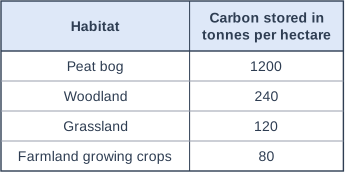
Humans reduce the amount of land available for other animals and plants by building, quarrying, farming and dumping waste. Every area used in these ways is habitat lost for other species, so biodiversity falls. Peat bogs are an important example: destroying them reduces biodiversity and also adds carbon dioxide to the atmosphere.
Four ways humans take land
| Use of land | What it involves |
|---|
| Building | Houses, roads, towns, factories and airports |
| Quarrying | Digging out rock, stone, sand and gravel for building materials |
| Farming | Clearing land for crops and grazing animals to produce food |
| Dumping waste | Landfill sites for the waste that is not recycled |
As the human population grows, more land is needed for all four. Each one reduces biodiversity in the same way:
- the habitat is destroyed or the area of habitat is reduced;
- plants, animals and microorganisms lose their food, shelter and places to breed;
- their populations fall, and some species are lost from the area;
- because species are interdependent, the species that depended on them are affected too.
The habitat that is left is often split into small, separate patches, and noise, dust and pollution can disturb organisms nearby. Building on land that has been used before, such as an old factory site, avoids taking more habitat from other species.
Peat bogs
Peat forms in bogs, where the ground is waterlogged and acidic. The water fills the spaces in the soil, so there is very little oxygen. Most decomposers need oxygen for aerobic respiration, so dead plants, mainly bog mosses, only partly decay. Over thousands of years they build up as peat, very slowly (about 1 mm a year in many bogs). Peat is therefore a large store of carbon, taken out of the air by photosynthesis long ago.
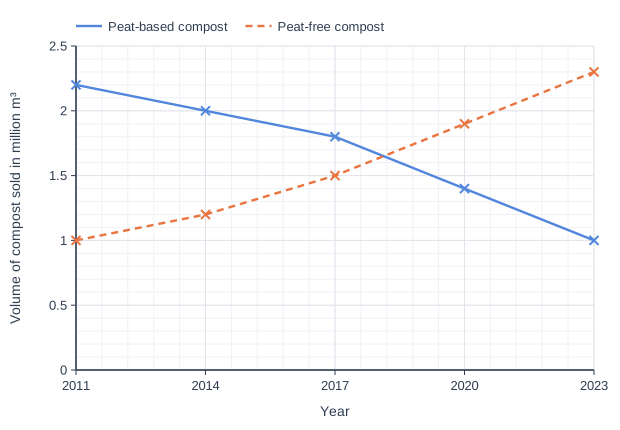
Peat bogs and other areas of peat are destroyed to produce garden compost, and in some places peat is dried and burned as a fuel.
Effect on biodiversity
The destruction of peat bogs reduces the area of this habitat, and so reduces the variety of different plant, animal and microorganism species that live there (biodiversity). Many bog species, such as sundews and some dragonflies, are adapted to wet, acidic conditions and are not found elsewhere. Draining the bog also dries out the surrounding area, so the damage spreads beyond the part that is dug.
Effect on the atmosphere
The decay or burning of the peat releases carbon dioxide into the atmosphere:
- Decay: draining lets air into the peat. Decomposers such as bacteria and fungi can now respire aerobically, so they break the peat down and release carbon dioxide, both in the drained bog and later in gardens where the compost is used.
- Burning: combustion releases the stored carbon as carbon dioxide.
Bog plants are also removed, so less carbon dioxide is absorbed by photosynthesis and no new peat forms. Carbon dioxide is a greenhouse gas, so this adds to global warming. Using peat-free compost, made from materials such as bark and garden waste, avoids both problems. Peat forms so slowly that it is a non-renewable resource.
Peat: how long to form, how fast removed
A bog has peat 2.4 m deep, which formed at about 1 mm per year. The peat was dug out in 8 years. How long did it take to form, and how many times faster was it removed?
Depth in mm: \(2.4 \times 1000 = 2400\) mm
Time to form: \(2400 \div 1 = 2400\) years
Rate of removal: \(2400 \div 8 = 300\) mm per year
\(300 \div 1 = 300\) times faster than it formed
Percentage change in land use
A county has an area of 2500 km². In 1990, 6% of it was built on; in 2020, 9% was built on. Calculate the percentage increase in the built-on area.
1990: \(\dfrac{6}{100} \times 2500 = 150\text{ km}^2\)
2020: \(\dfrac{9}{100} \times 2500 = 225\text{ km}^2\)
Increase: \(225 - 150 = 75\text{ km}^2\)
\(\text{percentage increase} = \dfrac{75}{150} \times 100 = 50\%\)
The answer is not 3%: that is the change in the share of the county (6% to 9%), not the percentage increase in the area.
Common mistakes
- Saying "the peat respires" or "the peat breathes out carbon dioxide". The decomposers respire and release it.
- Saying that destroying a habitat means "fewer animals". Biodiversity is about the number of different species, so say fewer species can live there.
- Giving "pollution" as a way humans use land. The four uses are building, quarrying, farming and dumping waste.
- Forgetting to convert metres to millimetres before using a rate in mm per year.
- Dividing by the newer value in a percentage change. Divide by the original value.
Exam tip
Peat questions often carry six marks and need both halves: the loss of habitat and biodiversity, and the release of carbon dioxide. For the atmosphere, give the full chain: draining lets oxygen in, decomposers respire aerobically, carbon dioxide is released.