Level:
Correct: 0
Incorrect: 0
Marks: 0/0
Exam Practice
Course:
Topics:
Avg
score:
–
Topics
done:
0/35

Inherited disorders

Practise 11 exam-style questions on Inherited disorders for AQA GCSE Combined Science (Biology Paper 2). Write your answer as you would in the exam and get it marked in seconds against the mark scheme, point by point, with the Study Helper on hand if you get stuck.

  • 11 questions
  • 1–6 marks each
  • Instant marking
  • No sign-up needed
11 questions, marked as you go

Sample questions with model answers

Here are 4 of the questions in this topic, each with a model answer, an explanation of why it earns the marks and the mark scheme an examiner would use.

Question 1

2 marks

Cystic fibrosis is an inherited disorder.

What part of the cell does cystic fibrosis affect, and what type of allele causes it?

Model answer

Cystic fibrosis is a disorder of cell membranes. It is caused by a recessive allele.

Explanation

Because the cystic fibrosis allele is recessive, a person must inherit two copies (one from each parent) to have the disorder. People with one copy are carriers.

Mark scheme
  1. 1 mark

    cell membranes

    do not accept cell wall

  2. 1 mark

    a recessive allele

Question 2

2 marks

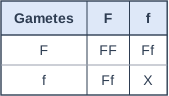
The allele for cystic fibrosis (f) is recessive to the normal allele (F). The Punnett square shows a cross between two parents who are both carriers.

Give the genotype X, and the probability that a child of these parents will be a carrier.

Table with columns "Gametes", "F", "f". Gametes: F; F: FF; f: Ff | Gametes: f; F: Ff; f: X.

Model answer

X is ff.
Carriers are heterozygous (Ff), which is 2 of the 4 outcomes, so the probability is 2/4 = 0.5.

Explanation

A carrier has one recessive allele and one normal allele, so only the Ff boxes count. FF children are not carriers and ff children have cystic fibrosis.

Mark scheme
  1. 1 mark

    X = ff

  2. 1 mark

    probability of a carrier = 0.5

    allow 1/2, 2/4, 50%; carriers are Ff

Question 3

3 marks

Polydactyly is caused by a dominant allele (D). The normal allele is d.

Two parents both have polydactyly and both are heterozygous.

Use a genetic cross to find the probability that their child will not have polydactyly.

Model answer

Parents: Dd × Dd
Gametes: D and d from each parent
Offspring: DD, Dd, Dd, dd
Only dd children do not have polydactyly.
Probability = 1/4 = 0.25

Explanation

Because polydactyly is dominant, DD and Dd children both have the disorder. Only dd children, who inherit d from both parents, have the normal number of fingers and toes.

Mark scheme
  1. 1 mark

    parents Dd × Dd / gametes D and d from each parent

    a correct answer of 0.25 with a correct cross scores 3 marks

  2. 1 mark

    offspring DD, Dd, Dd, dd

  3. 1 mark

    probability = 0.25

    allow 1/4, 25%, 1 in 4; dd is the only genotype without polydactyly

Question 4

4 marks

In one country, treating a person with cystic fibrosis costs about £30 000 each year, and people with cystic fibrosis live for 45 years on average. Screening embryos during IVF costs about £8000 per couple.

Calculate the average cost of treating one person with cystic fibrosis for their whole life. Then use your answer to give one economic argument for embryo screening, and give one ethical argument against it.

Model answer

Lifetime cost = £30 000 × 45 = £1 350 000
Economic argument: screening costs about £8000, which is much less than the £1 350 000 needed to treat one person with cystic fibrosis, so screening could save the health service a lot of money.
Ethical argument: embryos that have the disorder are destroyed, and some people believe that every embryo has a right to life.

Explanation

Economic arguments are about money, so compare the cost of screening with the cost of treatment. Ethical arguments are about right and wrong, such as whether it is acceptable to destroy embryos; a cost comparison cannot answer that question.

Mark scheme
  1. 1 mark

    30 000 × 45

    an answer of £1 350 000 scores the first 2 marks

  2. 1 mark

    £1 350 000

    allow 1.35 million

  3. 1 mark

    economic: screening (£8000) costs much less than lifetime treatment (about 170 times less), so it could save money

    allow ecf from an incorrect lifetime cost

  4. 1 mark

    ethical: embryos with the disorder are destroyed / some believe embryos have a right to life / it could lead to designer babies / suggests lives with disorders are less valuable

Ready to try the rest? Every answer you write is marked against the mark scheme, so you can see exactly where the marks are.

Revision notes

Inherited disorders

The big idea

Some disorders are inherited: they are caused by inheriting certain alleles from your parents. AQA uses two examples. Polydactyly is caused by a dominant allele, and cystic fibrosis by a recessive allele. Because we can now test embryos for these alleles, you also need to weigh up the issues raised by embryo screening.

Polydactyly: a dominant allele

Polydactyly means having extra fingers or toes. It is caused by a dominant allele (D).

  • One copy of the allele is enough, so people with polydactyly are DD or Dd.
  • People without polydactyly are always dd.
  • There are no healthy "carriers": anyone who has the allele shows it. So an affected child must have at least one affected parent, and the condition cannot skip a generation.
  • It is usually not serious, and an extra digit can often be removed by surgery.

Remember that dominant does not mean common: polydactyly is rare.

Cystic fibrosis: a recessive allele

Cystic fibrosis is a disorder of cell membranes. It is caused by a recessive allele (f) that codes for a faulty protein in cell membranes. As a result, the body makes thick, sticky mucus:

  • in the lungs, the mucus blocks airways and is hard to clear, so bacteria trapped in it cause frequent lung infections;
  • in the digestive system, it can block the tube from the pancreas, so fewer digestive enzymes reach the small intestine and food is not fully digested.

A person must inherit two copies of the recessive allele (ff) to have cystic fibrosis. A person who is Ff is a carrier: they do not have the disorder, because the dominant allele is expressed, but they can pass the recessive allele on. That is why two healthy parents can have a child with cystic fibrosis.

Family tree with three generations, labelled I, II and III from top to bottom. Squares are males and circles are females; horizontal lines join couples, and lines down from a couple lead to their children. The key shows: an unshaded square = Unaffected male; an unshaded circle = Unaffected female; a shaded square = Male with cystic fibrosis; a shaded circle = Female with cystic fibrosis. In generation I, person 1 (male, unaffected, genotype Ff) and person 2 (female, unaffected, genotype Ff) are a couple; their two children in generation II, from left to right, are person 3 (male, unaffected) and person 4 (female, has cystic fibrosis, genotype ff). Person 4 and person 5 (male, unaffected, genotype FF), whose parents are not shown, are a couple; their two children in generation III, from left to right, are person 6 (male, unaffected, genotype Ff) and person 7 (female, unaffected, genotype Ff). Marker's notes: The condition is caused by a recessive allele (affected people are homozygous recessive; carriers are heterozygous). Genotypes given for marking (not shown on the figure): person 1 Ff, person 2 Ff, person 4 ff, person 5 FF, person 6 Ff, person 7 Ff.
Persons 1 and 2 do not have cystic fibrosis but their daughter (4) does, so both must be carriers (Ff). Person 4's children have no symptoms, but each has inherited one recessive allele from her, so they are carriers.
PolydactylyCystic fibrosis
Type of alleleDominantRecessive
Copies needed to have the disorderOne (DD or Dd)Two (ff)
Carriers without symptoms?NoYes (Ff)
Can affected children have two unaffected parents?NoYes, if both parents are carriers

A carrier and a non-carrier

A man is a carrier of cystic fibrosis (Ff). His partner has two normal alleles (FF). What is the probability that their child will have cystic fibrosis, and that it will be a carrier?

F (from the man)f (from the man)
F (from the partner)FFFf

No box is ff, so the probability of cystic fibrosis is 0.

Two boxes out of four are Ff, so the probability of a carrier is \(\tfrac{2}{4} = \tfrac{1}{2}\), or 50%.

Embryo screening

In embryo screening, eggs are fertilised in a laboratory (IVF). At the ball-of-cells stage, a single cell is taken from each embryo and checked for the allele. Only embryos that do not have the disorder are put into the mother's uterus; embryos with the disorder are destroyed. You may be asked to make informed judgements about it, using information given in the question.

Type of issuePoints for screeningPoints against screening
Economic (money)Lifelong treatment for a disorder such as cystic fibrosis is very expensive, so screening could save moneyIVF and testing are expensive, and several attempts may be needed
Social (people and society)Fewer children are born with a serious disorder, so less suffering for children and familiesIt may suggest that people living with a disorder are less valued; it could lead to choosing embryos for other features ("designer babies")
Ethical (right and wrong)Parents can make an informed choiceEmbryos are destroyed, which some people believe is wrong; removing a cell carries a small risk to the embryo

Remember

  • Polydactyly (extra fingers or toes) is caused by a dominant allele: one copy is enough.
  • Cystic fibrosis is a disorder of cell membranes caused by a recessive allele: two copies are needed.
  • Carriers (Ff) do not have cystic fibrosis but can pass the allele on; two carriers have a 1 in 4 chance of an affected child each time.
  • Embryo screening raises economic, social and ethical issues.

Common mistakes

  • Saying cystic fibrosis is "a lung disease". AQA describes it as a disorder of cell membranes; the mucus in the lungs is a symptom.
  • Writing "cell wall" instead of cell membrane. Human cells have no cell wall.
  • Calling someone a "carrier of polydactyly". A dominant allele is always expressed, so there are no symptomless carriers.
  • Giving a probability as a ratio such as 1 : 3. Write 0.25, \(\tfrac{1}{4}\) or 25%.
  • Answering "embryo screening is unethical" with no reason. Name the issue, for example embryos are destroyed.

Exam tip

Embryo screening questions usually say "evaluate" or "give a conclusion". Give points for and against, use the numbers in the question (costs, chances of success, risks), and finish with a conclusion that follows from your points. Either conclusion can score full marks if it is justified.

Study Helper Hints first, answers after you try

Stuck on this one? Ask for a hint and I’ll point you in the right direction, without giving the answer away. Once you’ve checked your answer, I’ll show you how the marks are awarded.