Level:
Correct: 0
Incorrect: 0
Marks: 0/0
Exam Practice
Course:
Topics:
Avg
score:
–
Topics
done:
0/35

Abiotic factors

Practise 11 exam-style questions on Abiotic factors for AQA GCSE Combined Science (Biology Paper 2). Write your answer as you would in the exam and get it marked in seconds against the mark scheme, point by point, with the Study Helper on hand if you get stuck.

  • 11 questions
  • 1–6 marks each
  • Instant marking
  • No sign-up needed
11 questions, marked as you go

Sample questions with model answers

Here are 4 of the questions in this topic, each with a model answer, an explanation of why it earns the marks and the mark scheme an examiner would use.

Question 1

2 marks

Give two abiotic factors that could affect the community of plants growing in a field.

Model answer

Light intensity and soil pH.

Explanation

The abiotic factors in the specification are light intensity, temperature, moisture levels, soil pH and mineral content, wind intensity and direction, carbon dioxide levels for plants and oxygen levels for aquatic animals. Any two that affect plants are correct here.

Mark scheme
  1. 1 mark

    light intensity

    max 2; any two from the list

  2. 1 mark

    temperature

  3. 1 mark

    moisture levels / amount of water in the soil

  4. 1 mark

    soil pH

  5. 1 mark

    mineral content of the soil

    allow mineral ions in the soil

  6. 1 mark

    wind intensity / wind direction

  7. 1 mark

    carbon dioxide level

    do not accept oxygen level for plants in a field; do not accept biotic factors such as grazing animals or pests

Question 2

2 marks

A student measured the light intensity in an open field as 50 000 lux. On the floor of a dense forest nearby, the light intensity was 2000 lux.

Calculate the percentage of the light intensity in the open field that reaches the forest floor.

Model answer

Percentage = 2000 ÷ 50 000 × 100 = 4%

Explanation

Divide the forest-floor value by the open-field value and multiply by 100. Only 4% of the light reaches the forest floor, which is why few plants can grow there unless they are adapted to low light intensity.

Mark scheme
  1. 1 mark

    2000 ÷ 50 000 × 100

    an answer of 4 (%) scores 2 marks

  2. 1 mark

    4 (%)

    an answer of 0.04 scores 1 mark

Question 3

3 marks

In the Arctic tundra the temperature is below 0 °C for most of the year. Only a few species of plant grow there, and they are all small.

Explain why the low temperature means that few plants grow in the tundra, and that the plants are small.

Model answer

Low temperatures slow down enzyme-controlled reactions such as photosynthesis, so the plants make less glucose and grow very slowly. The water in the soil is frozen for most of the year, so it cannot be absorbed. The growing season is short and only a few species can survive the cold, so there are few species and they stay small.

Explanation

Temperature is an abiotic factor because it affects the rate of enzyme-controlled reactions in organisms. In very cold places it also affects the availability of liquid water, another abiotic factor.

Mark scheme
  1. 1 mark

    low temperature slows down enzyme-controlled reactions such as photosynthesis

    max 3

  2. 1 mark

    so plants make less glucose and grow slowly

  3. 1 mark

    water in the soil is frozen, so plants cannot absorb it for most of the year

    allow low moisture levels available to plants

  4. 1 mark

    the growing season is short, and few species can survive freezing

Question 4

4 marks

Bluebells grow on the floor of some oak woodlands. Their leaves appear in February, they flower in April and their leaves have died back by June.

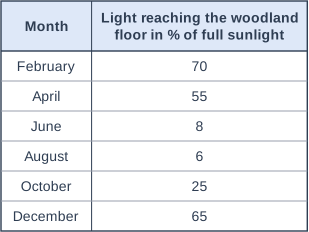
The table shows the percentage of full sunlight that reaches the floor of an oak woodland in different months.

Use the data to explain why bluebells grow and flower at this time of year.

Table with columns "Month", "Light reaching the woodland floor in % of full sunlight". Month: February; Light reaching the woodland floor in % of full sunlight: 70 | Month: April; Light reaching the woodland floor in % of full sunlight: 55 | Month: June; Light reaching the woodland floor in % of full sunlight: 8 | Month: August; Light reaching the woodland floor in % of full sunlight: 6 | Month: October; Light reaching the woodland floor in % of full sunlight: 25 | Month: December; Light reaching the woodland floor in % of full sunlight: 65.

Model answer

In February and April a high percentage of sunlight, 70% and 55%, reaches the woodland floor, because the oak trees have not yet grown their leaves. The bluebells can photosynthesise and grow during this time. By June the oak leaves have opened and block most of the light, so only 8% reaches the floor and the bluebells could not photosynthesise enough. By growing early, they avoid competing with the trees for light.

Explanation

Light intensity is an abiotic factor that changes through the year in a deciduous woodland. Bluebells complete their growth while light intensity at the woodland floor is high.

Mark scheme
  1. 1 mark

    from February to April a high percentage of light reaches the floor (70% and 55%)

    must use data for this mark

  2. 1 mark

    because the oak trees have not yet grown their leaves

  3. 1 mark

    so the bluebells can photosynthesise / make glucose and grow

  4. 1 mark

    by June the oak leaves block the light (only 8% reaches the floor), so bluebells could not photosynthesise enough then

    allow avoids competing with the trees for light

Ready to try the rest? Every answer you write is marked against the mark scheme, so you can see exactly where the marks are.

Revision notes

Abiotic factors

The big idea

Abiotic factors are the non-living parts of an environment, such as light, temperature and water. They decide which organisms can live in a place and how well they grow. A change in one abiotic factor can change a whole community, because the organisms it affects directly are linked to others by food webs. In the exam you are usually given data or a new context and asked to explain the effect of a change.

The abiotic factors you need to know

Abiotic factorHow it affects organisms
Light intensityPlants need light for photosynthesis. In shade, for example under a tree canopy or in deep water (water absorbs light), plants make less glucose and grow less.
TemperatureControls the rate of enzyme-controlled reactions such as photosynthesis, respiration and growth. Cold slows organisms down; warm water also holds less dissolved oxygen.
Moisture levelsPlants need water for photosynthesis and to keep their cells firm. Many small animals, such as woodlice and slugs, lose water easily and live only in damp places.
Soil pH and mineral contentPlants absorb mineral ions, such as nitrate ions to make proteins, so poor soil means slow growth. Each species grows best in a certain pH range; heather, for example, does well in acidic soil.
Wind intensity and directionStrong wind increases water loss by transpiration and can break or uproot plants. Where the wind usually blows from one direction, trees often grow branches only on the sheltered side.
Carbon dioxide levels (for plants)A raw material for photosynthesis. When light and temperature are high, a low carbon dioxide level can limit growth.
Oxygen levels (for aquatic animals)Fish and insect larvae need dissolved oxygen for aerobic respiration. Some species can live only in water with a high oxygen concentration.

Remember

  • Abiotic means non-living: light intensity, temperature, moisture, soil pH and mineral content, wind, carbon dioxide (plants) and oxygen (aquatic animals).
  • Dead leaves and dead animals came from living things, so they are not abiotic factors.
  • Plants respire all the time; they only photosynthesise when there is light.

Explaining the effect of a change

Build your answer as a chain:

  1. Say how the factor changes, using the data.
  2. Say which process it affects: photosynthesis, respiration, water loss or the rate of enzyme-controlled reactions.
  3. Say what happens to the population: it grows less, dies, moves away or is outcompeted.
  4. Follow the knock-on effects through the food web, for example animals that ate those plants lose food.

Measuring abiotic factors

In fieldwork you measure abiotic factors at each sampling point:

  • light intensity with a light meter, held at the same height and angle each time;
  • temperature with a thermometer or temperature probe;
  • soil moisture with a moisture meter;
  • soil pH by shaking soil with distilled water, letting it settle, adding universal indicator and matching the colour to a pH chart (or with a pH probe);
  • dissolved oxygen in water with an oxygen meter.

You cannot control abiotic factors outdoors, so take readings under the same conditions, for example all within a short time, because light intensity changes as the sun moves and clouds pass. Field data usually show a correlation, and several factors often change together, so measure the others before deciding which one is the cause.

Calculating a change in light intensity

At midday, a student measured the light intensity in an open meadow and under a thick hedge next to it.

Meadow: 15 000 lux. Under the hedge: 2 400 lux.

Calculate the percentage decrease in light intensity under the hedge.

Decrease: \(15\,000 - 2400 = 12\,600\) lux

\(\text{percentage decrease} = \dfrac{12\,600}{15\,000} \times 100 = 84\%\)

Divide by the starting value (the meadow), not by the value under the hedge.

Describing and explaining data

On a rocky shore, seaweed higher up the shore is uncovered by the tide for longer each day.

Time uncovered each day in hoursSeaweed cover in %
285
660
1025
140

Describe and explain the pattern.

As the time uncovered increases, the seaweed cover decreases, from 85% at 2 hours to 0% at 14 hours. Out of the water the seaweed loses water and dries out, and the longer it is uncovered the more water it loses, so less of it survives. Other factors, such as temperature, also change up the shore, so moisture may not be the only cause.

Common mistakes

  • Calling dead leaves or dead animals "abiotic". They came from living organisms; abiotic factors are physical or chemical, like light and pH.
  • Giving biotic factors (predators, food, disease) when the question asks for abiotic ones.
  • Saying sewage in a river "uses up the oxygen". The bacteria feeding on the sewage respire and use up the oxygen.
  • Saying plants respire only at night. They respire all the time; at night they simply stop photosynthesising, so oxygen in a pond falls until dawn.
  • Concluding that one factor causes a pattern from field data alone. Other factors may change at the same time.

Exam tip

"Suggest" questions give you a context you have not met, such as a windy hilltop or a deep lake. Name the abiotic factor, link it to a process (photosynthesis, respiration or water loss), then say what happens to the organisms. Quote figures with units when a table or graph is given.

Study Helper Hints first, answers after you try

Stuck on this one? Ask for a hint and I’ll point you in the right direction, without giving the answer away. Once you’ve checked your answer, I’ll show you how the marks are awarded.