Level:
Correct: 0
Incorrect: 0
Marks: 0/0
Exam Practice
Course:
Topics:
Avg
score:
–
Topics
done:
0/35

Genetic engineering

Practise 18 exam-style questions on Genetic engineering for AQA GCSE Combined Science (Biology Paper 2). Write your answer as you would in the exam and get it marked in seconds against the mark scheme, point by point, with the Study Helper on hand if you get stuck.

  • 18 questions
  • 1–6 marks each
  • Instant marking
  • No sign-up needed
18 questions, marked as you go

Sample questions with model answers

Here are 4 of the questions in this topic, each with a model answer, an explanation of why it earns the marks and the mark scheme an examiner would use.

Question 1

2 marks

Genetic engineering is used to produce crop plants and bacteria with useful characteristics.

Describe what is meant by genetic engineering.

Model answer

Genetic engineering is modifying the genome of an organism by introducing a gene from another organism, so that it has a desired characteristic.

Explanation

The key idea is that a gene is taken from one organism and put into the genome of another, often a different species. This is different from selective breeding, which only combines genes that are already present in the species by choosing which individuals breed.

Mark scheme
  1. 1 mark

    modifying / changing the genome of an organism

    allow changing the DNA / genes / genetic material of an organism

  2. 1 mark

    by introducing a gene from another organism (to give a desired characteristic)

    allow inserting / adding a gene from a different organism or species; do not accept selective breeding or cross-breeding

Question 2

2 marks

Some crop plants have been genetically modified to produce a toxin that kills the caterpillars of insects that feed on them.

Suggest two concerns that people might have about growing these crops.

Model answer

The toxin might also kill insects that are not pests, such as butterflies, which would reduce food for birds. Some people also feel that the effects of eating GM crops on human health have not been fully explored.

Explanation

Concerns about GM crops include their effect on populations of wild flowers and insects, and the worry that the effects of eating them on human health have not been fully studied. Any harm to insects can spread through food chains to other animals in the community.

Mark scheme
  1. 1 mark

    the toxin may kill insects that are not pests / harmless or useful insects (e.g. bees, butterflies)

    max 2

  2. 1 mark

    fewer insects means less food for other animals (e.g. birds), so food chains / the community are affected

    allow reduces biodiversity

  3. 1 mark

    the gene could spread to wild plants (e.g. by pollen), affecting populations of wild flowers or insects

  4. 1 mark

    the effects of eating the GM crop on human health have not been fully explored

    allow the toxin might harm people / long-term health effects unknown

  5. 1 mark

    the pest insects may become resistant to the toxin

Question 3

3 marks

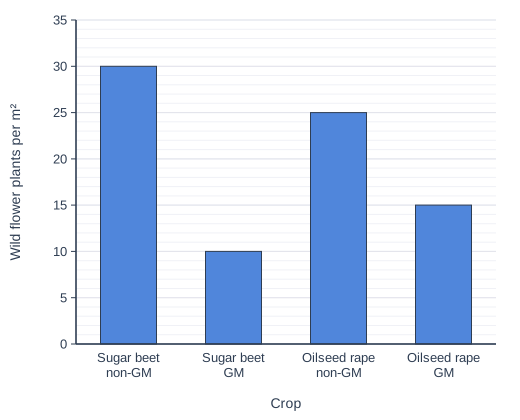
Farmers growing herbicide-resistant GM crops can spray herbicide over the whole field while the crop is growing. Scientists compared the number of wild flower plants growing in fields of GM and non-GM sugar beet and oilseed rape.

The bar chart shows their results.

Describe the effect of growing the GM crops on wild flower plants, and suggest how this could affect insect populations.

Bar chart of wild flower plants per m² for each crop: Sugar beet non-GM 30, Sugar beet GM 10, Oilseed rape non-GM 25, Oilseed rape GM 15.

Model answer

There were fewer wild flower plants in the GM fields for both crops. In sugar beet the number fell from 30 per m² to 10 per m², and in oilseed rape from 25 per m² to 15 per m². With fewer wild flowers there would be less nectar, pollen and shelter for insects such as bees and butterflies, so their populations would fall.

Explanation

The herbicide kills the wild flowers but not the resistant crop, which is why there are fewer wild flowers in GM fields. This is one of the main concerns about GM crops: the effect on populations of wild flowers and on the insects that depend on them.

Mark scheme
  1. 1 mark

    there were fewer wild flower plants in the GM fields (for both crops)

    max 3

  2. 1 mark

    correct use of data, e.g. sugar beet 30 → 10 per m² / a third as many / oilseed rape 25 → 15 per m²

    allow the difference was greater for sugar beet (20 per m²) than for oilseed rape (10 per m²)

  3. 1 mark

    fewer wild flowers means less food (nectar / pollen) or shelter for insects, so insect populations fall

    allow fewer pollinating insects such as bees or butterflies

  4. 1 mark

    animals that feed on these insects (e.g. birds) would also decrease / biodiversity is reduced

Question 4

4 marks

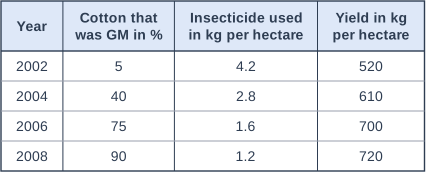
Cotton plants have been genetically modified to produce a toxin that kills caterpillars. The table shows data from one cotton-growing region over six years.

A scientist claimed: "Growing GM cotton is good for farmers and good for the environment."

Evaluate this claim. Use the data in the table and your own knowledge.

Table with columns "Year", "Cotton that was GM in %", "Insecticide used in kg per hectare", "Yield in kg per hectare". Year: 2002; Cotton that was GM in %: 5; Insecticide used in kg per hectare: 4.2; Yield in kg per hectare: 520 | Year: 2004; Cotton that was GM in %: 40; Insecticide used in kg per hectare: 2.8; Yield in kg per hectare: 610 | Year: 2006; Cotton that was GM in %: 75; Insecticide used in kg per hectare: 1.6; Yield in kg per hectare: 700 | Year: 2008; Cotton that was GM in %: 90; Insecticide used in kg per hectare: 1.2; Yield in kg per hectare: 720.

Model answer

The data support the claim. As the percentage of GM cotton rose from 5% to 90%, the insecticide used fell from 4.2 to 1.2 kg per hectare and the yield rose from 520 to 720 kg per hectare, so farmers earn more and spend less on insecticide. Less spraying should mean fewer harmless insects are killed. However, the data only show a correlation from one region, and other factors such as the weather could have affected the yield. The toxin in the GM plants could still harm insects that are not pests, so the claim about the environment is not fully supported.

Explanation

An evaluation needs points on both sides, backed by data, and a judgement. A correlation between two trends does not prove that one causes the other, and data from a single region over a few years may not apply everywhere.

Mark scheme
  1. 1 mark

    as the percentage of GM cotton increased, the mass of insecticide used fell (from 4.2 to 1.2 kg per hectare)

    max 4; max 3 if only arguments for, or only arguments against, the claim are given

  2. 1 mark

    yield increased (from 520 to 720 kg per hectare), which is good for farmers / farmers spend less on insecticide

  3. 1 mark

    less insecticide sprayed means fewer non-pest insects are killed / less pollution, which is good for the environment

  4. 1 mark

    the data show a correlation but other factors (e.g. weather, fertiliser, irrigation) could have increased the yield

    allow data from only one region / only four years recorded

  5. 1 mark

    the toxin in the GM cotton could still harm insects that are not pests / the gene could spread to wild plants

  6. 1 mark

    pests may become resistant to the toxin over time

Ready to try the rest? Every answer you write is marked against the mark scheme, so you can see exactly where the marks are.

Revision notes

Genetic engineering

The big idea

Genetic engineering is a process which involves modifying the genome of an organism by introducing a gene from another organism to give a desired characteristic. It works because all organisms read DNA in the same way, so a human gene put into a bacterium still codes for the human protein. You need to know its uses and weigh up its benefits and risks.

How it works and what it is used for

Genes from the chromosomes of humans and other organisms can be 'cut out' and transferred to the cells of other organisms. The organism that receives a gene makes the protein it codes for, so it gains the new characteristic.

Organism modifiedGene addedResult
BacteriaThe human insulin geneThe bacteria make human insulin, used to treat diabetes
Crop plantsA gene for a toxin that kills insectsCrops resistant to insect attack
Crop plantsA gene for resistance to a weedkillerCrops resistant to herbicides
Crop plantsGenes for disease resistance or fruit qualityCrops resistant to diseases, or with bigger, better fruits

Crops that have had their genes modified in this way are called genetically modified (GM) crops. GM crops generally show increased yields:

  • Insect-resistant crops are damaged less by insect pests, so more of each plant survives to be harvested.
  • Herbicide-resistant crops can be sprayed with a herbicide that kills the weeds but not the crop, so the crop has less competition for light, water and mineral ions.

In medicine, insulin made by GM bacteria is identical to human insulin and can be made cheaply in large amounts. Modern medical research is also exploring the possibility of using genetic modification to overcome some inherited disorders, such as cystic fibrosis, by putting a working copy of a gene into a patient's cells.

Genetic engineering and selective breeding

Both change the genes of organisms to give useful characteristics, but:

Genetic engineeringSelective breeding
Can move a gene between completely different speciesOnly uses alleles already present in organisms that can interbreed
Can give the characteristic in one generationTakes many generations
Transfers one chosen geneMixes many genes, so unwanted characteristics may be passed on too

Benefits, risks and objections

Potential benefits

  • More food from the same area of land, to feed a growing population.
  • Less insecticide sprayed, which saves money and harms fewer other insects.
  • Crops can be given extra nutrients, such as vitamins, for people with a poor diet.
  • Medicines such as insulin made reliably and cheaply, without using animals.
  • Some inherited disorders might one day be cured rather than just treated.

Risks and concerns

  • Effects on populations of wild flowers and insects: herbicide sprayed on herbicide-resistant crops kills the wild flowers in and around the fields, so insects that feed on their nectar and pollen lose their food.
  • Genes could spread in pollen to related wild plants, producing weeds the herbicide cannot kill.
  • Some people feel the effects of eating GM crops on human health have not been fully explored: GM crops have only been widely eaten for a few decades, and long-term effects could take years to appear.
  • Insect pests can evolve resistance to the toxin in an insect-resistant crop, and GM seed can be too expensive for poorer farmers.
  • Most treatments for inherited disorders are still being researched: the gene could end up in the wrong place in the DNA, and changing gametes or embryos would affect future generations.

Some people object because they feel it is unnatural or wrong to move genes between species, or because of concerns for the welfare of GM animals.

Higher tier only

The main steps of genetic engineering

  1. Enzymes are used to isolate (cut out) the required gene.
  2. The gene is inserted into a vector, usually a bacterial plasmid or a virus. The plasmid is cut open with the same enzyme, so the cut ends match and the gene can be joined in.
  3. The vector is used to insert the gene into the required cells.
  4. Genes are transferred to the cells of animals, plants or microorganisms at an early stage in their development. As the organism grows, the gene is copied into every new cell, so it develops with the desired characteristic.

To make insulin, the plasmid carrying the human insulin gene is put into a bacterium, and the bacteria are grown in large numbers in a fermenter. Each time one divides, the plasmid is copied, so all the offspring make insulin, which is collected and purified. In research on inherited disorders, a harmless virus is often the vector that carries a working allele into a patient's cells.

The vector is the plasmid or virus that carries the gene, not the bacterium.

Percentage increase in yield

In a field trial, an insect-resistant GM variety of a vegetable crop gave a mean yield of 3.6 kg per plant. The non-GM variety gave 3.0 kg per plant. Calculate the percentage increase in yield.

Increase: \(3.6 - 3.0 = 0.6\) kg per plant

Divide by the original (non-GM) value:

\[\text{percentage increase} = \dfrac{0.6}{3.0} \times 100 = 20\%\]

Common mistakes

  • Saying GM crops are produced by selective breeding. A gene from another organism is inserted by genetic engineering.
  • Writing that herbicide-resistant crops "kill weeds". The farmer sprays the herbicide; it kills the weeds but does not harm the crop.
  • Giving a vague objection such as "it is bad". Name a specific concern, such as unknown long-term effects on human health.
  • Thinking that putting a working allele into a patient's lung cells stops their children inheriting the disorder. Only the treated body cells change; the gametes still carry the faulty allele.
  • Dividing by the new value in a percentage change. Always divide by the original value.

Exam tip

"Evaluate" questions on GM crops or GM medicines need benefits and risks, using any data you are given, then a justified conclusion. Either conclusion can score if your reasons support it.

Study Helper Hints first, answers after you try

Stuck on this one? Ask for a hint and I’ll point you in the right direction, without giving the answer away. Once you’ve checked your answer, I’ll show you how the marks are awarded.