Level:
Correct: 0
Incorrect: 0
Marks: 0/0
Exam Practice
Course:
Topics:
Avg
score:
–
Topics
done:
0/35

Extinction

Practise 9 exam-style questions on Extinction for AQA GCSE Combined Science (Biology Paper 2). Write your answer as you would in the exam and get it marked in seconds against the mark scheme, point by point, with the Study Helper on hand if you get stuck.

  • 9 questions
  • 1–6 marks each
  • Instant marking
  • No sign-up needed
9 questions, marked as you go

Sample questions with model answers

Here are 4 of the questions in this topic, each with a model answer, an explanation of why it earns the marks and the mark scheme an examiner would use.

Question 1

2 marks

The dodo was a large bird that could not fly. It lived only on the island of Mauritius, where it nested on the ground.

Sailors began to visit Mauritius in the 1590s. They hunted the birds and brought rats, pigs and monkeys with them. They also cut down forests. The last dodo was seen in the 1660s.

Suggest two reasons why the dodo became extinct.

Model answer

The sailors hunted the dodos for food. The rats, pigs and monkeys they brought were new predators that ate the dodos' eggs and chicks, which were easy to reach in ground nests.

Explanation

New predators, hunting and habitat destruction are all factors that can contribute to extinction. The dodo was especially at risk because it lived on only one island and could not fly away from predators.

Mark scheme
  1. 1 mark

    humans hunted / killed them for food

    max 2

  2. 1 mark

    new predators (rats / pigs / monkeys) ate their eggs or chicks

    allow new predators arrived

  3. 1 mark

    the introduced animals competed with the dodo for food

  4. 1 mark

    their habitat was destroyed when forests were cut down

Question 2

2 marks

Some species live in only one small area, such as a single lake or island.

Explain why these species are more at risk of extinction than species that live in many places.

Model answer

One change in that area, such as a new predator, a new disease or the destruction of the habitat, could affect every individual. Because the population is small and there are no other populations elsewhere, the whole species could die out.

Explanation

A widespread species is unlikely to be wiped out by one local event, because some populations survive elsewhere. A species found in one place has all its individuals exposed to the same threat.

Mark scheme
  1. 1 mark

    a single change (e.g. a new predator, disease or habitat destruction) could affect every individual

  2. 1 mark

    the population is small / there are no other populations elsewhere to survive

    allow so all the individuals could die

Question 3

3 marks

A species of flightless bird lived only on one small island. In 1900, stoats were accidentally brought to the island. Stoats are predators that eat birds and their eggs.

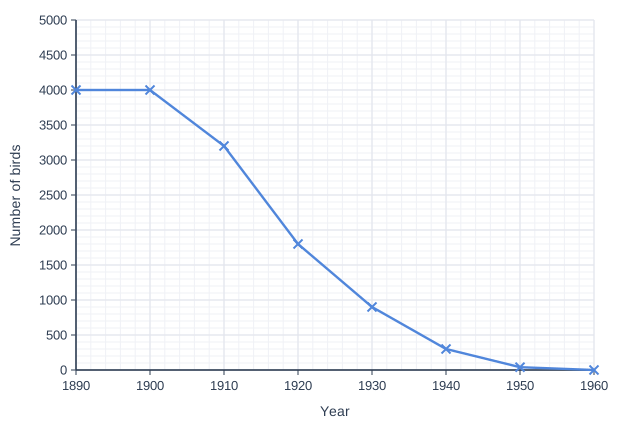
The graph shows the population of the bird from 1890 to 1960.

Describe the change in the population and explain why the bird became extinct.

Line graph of number of birds (y-axis, 0 to 5000) against year (x-axis, 1890 to 1960). The line joins the points (1890, 4000), (1900, 4000), (1910, 3200), (1920, 1800), (1930, 900), (1940, 300), (1950, 40), (1960, 0).

Model answer

The population stayed at about 4000 until the stoats arrived in 1900, then fell steadily to 0 by 1960. The stoats were a new predator, and the flightless birds could not escape them. The stoats ate birds and eggs faster than the birds could reproduce, and because the birds lived only on this island, there was no other population left, so the species became extinct.

Explanation

New predators are a major cause of extinction, especially on islands where species have evolved without them. Always use data from the graph, such as the year the decline began and when the population reached zero.

Mark scheme
  1. 1 mark

    the population stayed at about 4000 until 1900, then fell to 0 by 1960

    max 3; allow fell rapidly after the stoats arrived

  2. 1 mark

    the stoats were a new predator, and the birds could not fly away / had no defences against them

  3. 1 mark

    the stoats ate birds and eggs faster than the birds could reproduce

    allow too few birds were left to breed

  4. 1 mark

    the birds lived only on this island, so there was no other population

Question 4

4 marks

A lake contains a species of snail that feeds on algae. A new species of snail arrives in the lake. It also feeds on algae, and it reproduces faster than the native snail.

Explain how the arrival of the new species could cause the native snail to become extinct.

Model answer

Both species compete for the same food, algae. The new species reproduces faster, so it soon outnumbers the native snail and eats most of the algae. The native snails get less food, so fewer survive and reproduce. Their numbers fall until there are not enough to breed, and if this lake is the only place they live, the species becomes extinct.

Explanation

A new, more successful competitor is one of the factors that can cause extinction. One species outcompeting another can reduce its numbers until they are no longer sufficient to breed.

Mark scheme
  1. 1 mark

    both species compete for the same food (algae)

  2. 1 mark

    the new species is more successful / gets more of the food because it reproduces faster

    allow outcompetes the native snail

  3. 1 mark

    the native snails get less food, so fewer survive and reproduce

  4. 1 mark

    their numbers fall until there are not enough to breed, so the species becomes extinct (if it lives only in this lake)

    allow the population falls to zero

Ready to try the rest? Every answer you write is marked against the mark scheme, so you can see exactly where the marks are.

Revision notes

Extinction

The big idea

Extinctions occur when there are no remaining individuals of a species still alive. A species becomes extinct when its individuals die faster than they are replaced by reproduction, until none are left. Fossils show that most species that have ever lived are now extinct. You need to describe the factors that may contribute to the extinction of a species.

A species with very few individuals left is endangered, not extinct: it can still recover if it is protected.

Factors that may contribute to extinction

FactorHow it can wipe out a species
New predatorsIndividuals are eaten faster than they can reproduce. Species that evolved without that predator have no defences against it
New diseasesIndividuals have no immunity or resistance, so the disease spreads and kills many of them
New, more successful competitorsThey take the food, water or space the species needs, so fewer individuals survive to breed
Changes to the environment over geological timeA change in climate, such as an ice age, leaves the species no longer adapted, and it may not evolve quickly enough
Single catastrophic eventsMassive volcanic eruptions or asteroid collisions kill huge numbers at once, for example by blocking sunlight so that food chains collapse
Human activitiesHunting, destroying habitats (for example by cutting down forests), pollution, and moving predators, competitors and diseases to new places

Many extinctions have several causes acting together. For example, a species whose habitat is shrinking because of a change in climate is more easily wiped out by hunting or a new disease.

Which species are most at risk?

  • Species with small populations. They have little genetic variation, so it is less likely that any individual has the alleles needed to survive a new disease or a change in conditions, and a single event could kill them all.
  • Species that live in only one place, such as a single island.
  • Species that depend on a single food source or one type of habitat.
  • Species that reproduce slowly, so they cannot replace their losses quickly.

People can help to prevent extinctions by protecting habitats, banning hunting and trade, breeding endangered animals in captivity, and controlling species that have been introduced.

Calculating a loss of species

In 1900, a group of islands had 48 species of land snail that were found nowhere else in the world. By 2000, only 18 of these species were still alive. Calculate the percentage of the species that became extinct.

Number that became extinct: \(48 - 18 = 30\)

\[\text{percentage} = \dfrac{30}{48} \times 100 = 62.5\%\]

Check which value the question wants: 62.5% became extinct, so 37.5% survived.

Common mistakes

  • Defining extinction as "very few left". That is endangered; extinct means no individuals remain alive.
  • Writing "humans" as a factor without saying how. Name the activity, such as hunting, habitat destruction or pollution.
  • Writing that a species "could not adapt", with no reason. Explain that no individuals had the variation needed to survive, or that the change was too fast for natural selection.
  • Giving the number that became extinct when the question asks how many survived.

Exam tip

For "describe and explain the factors" questions, explain how each factor makes individuals die faster than they can reproduce, rather than just listing the factors.

Study Helper Hints first, answers after you try

Stuck on this one? Ask for a hint and I’ll point you in the right direction, without giving the answer away. Once you’ve checked your answer, I’ll show you how the marks are awarded.