The use of hormones to treat infertility (HT only)
Practise 16 exam-style questions on The use of hormones to treat infertility (HT only) for AQA GCSE Combined Science (Biology Paper 2). Write your answer as you would in the exam and get it marked in seconds against the mark scheme, point by point, with the Study Helper on hand if you get stuck.
16 questions
1–6 marks each
Instant marking
No sign-up needed
16 questions, marked as you go
Sample questions with model answers
Here are 4 of the questions in this topic, each with a model answer, an explanation of why it earns the marks and the mark scheme an examiner would use.
Question 1
2 marks
At the start of IVF treatment, the mother is given injections of FSH and LH.
Explain why.
Model answer
FSH and LH stimulate the maturation of several eggs at the same time. This means several eggs can be collected and fertilised, which increases the chance of producing healthy embryos.
Explanation
Normally only one egg matures in each cycle. In IVF the hormones make several eggs mature so that doctors can collect them, fertilise them and choose embryos to transfer.
Mark scheme
1 mark
to stimulate the maturation of several eggs
'to make eggs mature' scores this mark only if more than one egg is implied
1 mark
so that several eggs can be collected, increasing the chance of success
allow so more embryos can be produced
Question 2
2 marks
Fertility treatment can be very emotionally and physically stressful for the woman.
Give one reason why it is physically stressful and one reason why it is emotionally stressful.
Model answer
It is physically stressful because the woman has repeated hormone injections and a procedure to collect her eggs. It is emotionally stressful because success rates are not high, so treatment often fails and she may have to go through several cycles.
Explanation
The physical stress comes from the medical procedures and hormones. The emotional stress comes mainly from the uncertainty and the low success rate, which can mean repeated disappointment.
Mark scheme
1 mark
physical: hormone injections / side effects of the hormones / the procedure to collect eggs / inserting embryos
1 mark
emotional: success rates are not high, so treatment often fails / disappointment / anxiety / several cycles may be needed
allow the cost causes worry
Question 3
3 marks
IVF was developed in the 1970s and has improved greatly since then.
Explain how developments in microscopy techniques have led to modern IVF treatments.
Model answer
Improved microscopes give higher magnification and resolution, so eggs, sperm and embryos can be seen clearly. Using micro-tools under the microscope, scientists can handle eggs and even inject a single sperm directly into an egg, which helps men who produce few sperm. Embryologists can also watch the embryos developing and choose the healthiest ones to insert into the uterus.
Explanation
IVF works with single cells, so it depends on microscopes. As microscopy techniques improved, it became possible to see and manipulate eggs, sperm and embryos, increasing the success of treatment.
Mark scheme
1 mark
better microscopes allow eggs, sperm and embryos to be seen clearly / in more detail
max 3; allow higher magnification and resolution
1 mark
microscopes with micro-tools allow eggs and sperm to be handled / a single sperm can be injected into an egg
allow helps men who produce few sperm
1 mark
fertilisation and embryo development can be checked / healthy embryos can be selected for insertion
1 mark
a cell can be removed from an embryo for screening
Question 4
5 marks
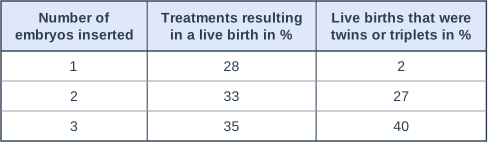
The table shows data from IVF clinics about the number of embryos inserted into the uterus.
Use the data to evaluate whether doctors should insert one embryo or two embryos. Consider the points of view of both patients and doctors.
Model answer
Inserting two embryos instead of one only increases the live birth rate from 28% to 33%, but it increases the percentage of multiple births from 2% to 27%, about 13 times as many. Multiple births are a risk to the babies, which are more likely to be premature with a low birth weight, and to the mother, who is more likely to have complications. Patients might prefer two embryos, because inserting one may mean they need more cycles of treatment, which is stressful and expensive. Doctors, however, have to protect the health of the mother and babies. Overall, doctors should usually insert one embryo, because the small increase in success is outweighed by the large increase in risk.
Explanation
Use numbers from the table to compare the benefit (live birth rate) with the risk (multiple births). Patients and doctors may see the balance differently, so give both points of view and then reach a justified conclusion.
Mark scheme
1 mark
two embryos increase the live birth rate only slightly, from 28% to 33%
max 5; to reach 5 marks a justified conclusion is needed
1 mark
but the percentage of multiple births rises greatly, from 2% to 27% / about 13 times
allow three embryos: 35% live births but 40% multiple births
1 mark
multiple births are a risk to the babies (e.g. premature birth, low birth weight)
1 mark
multiple births are a risk to the mother (e.g. complications in pregnancy)
1 mark
patients may prefer two embryos because with one embryo more cycles may be needed (more cost / stress)
allow some couples want twins
1 mark
doctors must protect the health of the mother and babies
allow multiple births cost the health service more
1 mark
justified conclusion, e.g. insert one embryo because the small gain in success is outweighed by the large increase in risk
Ready to try the rest? Every answer you write is marked against the mark scheme, so you can see exactly where the marks are.
Ctrl + Enter to check
Study HelperHints first, answers after you try
Stuck on this one? Ask for a hint and I’ll point you in the right direction, without giving the answer away. Once you’ve checked your answer, I’ll show you how the marks are awarded.