Level:
Correct: 0
Incorrect: 0
Marks: 0/0
Exam Practice
Course:
Topics:
Avg
score:
–
Topics
done:
0/35

Biodiversity

Practise 12 exam-style questions on Biodiversity for AQA GCSE Combined Science (Biology Paper 2). Write your answer as you would in the exam and get it marked in seconds against the mark scheme, point by point, with the Study Helper on hand if you get stuck.

  • 12 questions
  • 1–6 marks each
  • Instant marking
  • No sign-up needed
12 questions, marked as you go

Sample questions with model answers

Here are 4 of the questions in this topic, each with a model answer, an explanation of why it earns the marks and the mark scheme an examiner would use.

Question 1

2 marks

The future of the human species on Earth relies on us maintaining a good level of biodiversity.

Give two reasons why.

Model answer

We depend on many different organisms for food, including the insects that pollinate our crops. Many medicines also come from plants and other organisms, and species that have not yet been studied may provide new ones.

Explanation

Humans depend on other species for food, medicines, materials and a stable environment. Every species lost reduces these resources, which is why measures have recently been taken to stop the reduction in biodiversity.

Mark scheme
  1. 1 mark

    many organisms provide us with food (crops, animals, fish)

    max 2

  2. 1 mark

    many medicines come from plants / other organisms (and undiscovered species may provide new ones)

  3. 1 mark

    insects such as bees pollinate food crops

  4. 1 mark

    organisms provide materials such as wood and fibres

  5. 1 mark

    biodiversity keeps ecosystems stable and maintains the physical environment, e.g. clean air, water and fertile soil

    allow plants produce oxygen / absorb carbon dioxide

Question 2

2 marks

Scientists estimate that only a small proportion of the species on Earth have been identified and named.

Suggest why it is difficult to measure the total biodiversity of the Earth.

Model answer

Many species have not yet been discovered, because some habitats, such as the deep sea and the tops of rainforest trees, are very hard to reach and survey. Many organisms, such as microorganisms and insects, are also very small and difficult to tell apart.

Explanation

Biodiversity is the variety of all the different species on Earth, but most species are small, live in hard-to-reach places or have never been studied. Some may become extinct before they are ever discovered.

Mark scheme
  1. 1 mark

    many species have not yet been discovered / identified

    max 2

  2. 1 mark

    some habitats are hard to reach or survey (e.g. deep sea, rainforest canopy, soil)

  3. 1 mark

    many species are very small (e.g. microorganisms, insects) / look very similar to each other

  4. 1 mark

    species are becoming extinct, sometimes before they are discovered

Question 3

3 marks

Explain how deforestation can reduce biodiversity.

Model answer

Deforestation destroys the habitats of many species. The trees and other plants are removed, and the animals lose their food and shelter. Their populations fall, and species that live only in that forest may become extinct, so biodiversity falls.

Explanation

Tropical forests contain a very large number of species, many found nowhere else. Removing the forest removes the food and shelter these species need, so deforestation is one of the main causes of the loss of biodiversity.

Mark scheme
  1. 1 mark

    it destroys the habitats of many species

    max 3

  2. 1 mark

    the animals lose their food and shelter (and the plants are removed)

  3. 1 mark

    so populations fall and some species may become extinct / are lost from the area

    allow species found only in that forest may become extinct

  4. 1 mark

    the land is often replaced by a single crop, which supports far fewer species

Question 4

4 marks

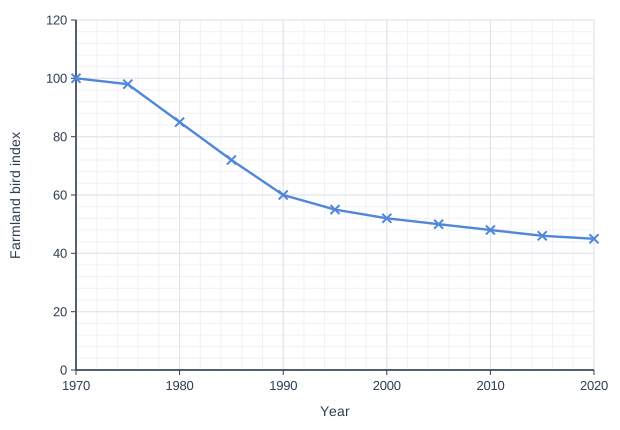
The farmland bird index is a measure of the populations of 19 species of bird that live on farmland in the UK. The index was set at 100 in 1970.

The graph shows how the index changed between 1970 and 2020.

Describe the trend shown in the graph and suggest reasons for it.

Line graph of farmland bird index (y-axis, 0 to 120) against year (x-axis, 1970 to 2020). The line joins the points (1970, 100), (1975, 98), (1980, 85), (1985, 72), (1990, 60), (1995, 55), (2000, 52), (2005, 50), (2010, 48), (2015, 46), (2020, 45).

Model answer

The index fell from 100 in 1970 to about 45 in 2020, so farmland bird populations more than halved. The fall was fastest between 1975 and 1990 and has slowed since 2000. Farmers removed hedgerows and field margins to make bigger fields, destroying nesting sites, and growing only one crop and using pesticides and herbicides reduced the insects and weed seeds the birds eat. The slower decline may be because measures have recently been taken to protect wildlife on farms.

Explanation

Describing a trend means giving the overall direction, using data, and noting any change in the rate. Reasons should link human activities to the loss of food and habitat for birds.

Mark scheme
  1. 1 mark

    the index fell from 100 in 1970 to about 45 in 2020 (it more than halved)

    max 4; allow 44-46

  2. 1 mark

    the fall was fastest between about 1975 and 1990, and has slowed since about 2000

  3. 1 mark

    loss of habitats, e.g. hedgerows and field margins removed to make larger fields

  4. 1 mark

    growing only one type of crop / using pesticides and herbicides means less food (insects, weed seeds) for birds

  5. 1 mark

    the slower decline may be because measures have been taken to protect farmland wildlife

    allow reintroduction of field margins and hedgerows

Ready to try the rest? Every answer you write is marked against the mark scheme, so you can see exactly where the marks are.

Revision notes

Biodiversity

The big idea

Biodiversity is the variety of all the different species of organisms on Earth, or within an ecosystem. It is about how many different species there are, not how many individual organisms: a field of a million wheat plants has very low biodiversity. A great biodiversity keeps ecosystems stable, and the future of the human species depends on it, yet many human activities are reducing it.

Why great biodiversity makes ecosystems stable

A great biodiversity ensures the stability of ecosystems by reducing the dependence of one species on another for food, shelter and the maintenance of the physical environment.

  • Food: in a complex food web, most animals eat several species. If one prey species declines, a predator can switch to others, so it survives and the effect is spread out.
  • Shelter: where there are many kinds of tree, shrub and plant, animals that lose one source of shelter or nest sites can use another.
  • The physical environment: many species help keep conditions suitable, for example tree roots holding soil together, plants shading and holding moisture in the soil, and decomposers recycling dead leaves.

In an ecosystem with few species, each species depends heavily on just a few others, so losing one can cause a chain of losses. A field of a single crop is very unstable: one pest or disease can destroy it, and it survives only because farmers add fertiliser and pesticides.

Why humans need biodiversity

The future of the human species on Earth relies on us maintaining a good level of biodiversity:

  • food: crops, farm animals and fish, and wild relatives of crops that carry alleles (such as for disease resistance) that can be bred into new varieties;
  • medicines: many drugs were first found in plants and microorganisms, and undiscovered species may contain more;
  • pollination: insects pollinate many food crops, and having many pollinator species makes this more reliable;
  • materials: such as timber and fibres;
  • services from ecosystems: decomposers recycle mineral ions, and plants absorb carbon dioxide and release oxygen.

Extinction is permanent: once a species is lost, its genes and any benefits it could have given us are lost too.

Human activities that reduce biodiversity

Many human activities are reducing biodiversity, and only recently have measures been taken to try to stop this. As the human population grows and uses more resources, the pressure on other species increases:

  • destroying habitats by building, quarrying, farming and dumping waste, cutting down forests, draining wetlands and digging peat (see also: Land use);
  • pollution of water, air and land (see also: Waste management);
  • global warming, which changes where species can live;
  • overfishing and hunting;
  • introducing species that outcompete native species or bring new diseases;
  • growing single crops, removing hedgerows and spraying pesticides, which kill useful insects as well as pests.

Measures have come only recently partly because the losses have speeded up as the population has grown, and partly because scientists now have the data to show how much is being lost and a better understanding of how much humans depend on biodiversity.

Calculating a loss of species

Surveys of a river found 28 species of invertebrate in 1990 and 19 species in 2020. Calculate the percentage decrease in the number of species. Give your answer to 2 significant figures.

Decrease: \(28 - 19 = 9\) species

\(\text{percentage decrease} = \dfrac{9}{28} \times 100 = 32.1\%\)

To 2 significant figures: 32%

Divide by the 1990 value, because that is the starting value.

Explaining stability

Orchard A is visited by 12 species of pollinating insect; orchard B by only 2. Explain why the apple harvest in orchard A is likely to be more reliable from year to year.

  • Apple flowers must be pollinated to form fruit, so the harvest depends on the pollinators.
  • In orchard B, the trees depend on just 2 species. If one of them declines, for example because of a disease or a cold spring, many flowers are not pollinated and fewer apples form.
  • In orchard A, the trees depend less on any one species: if one declines, the other species still pollinate the flowers.
  • So greater biodiversity makes pollination, and the harvest, more stable.

Remember

  • Biodiversity is the variety of different species on Earth or in an ecosystem.
  • Great biodiversity reduces the dependence of one species on another for food, shelter and the maintenance of the physical environment, so ecosystems are more stable.
  • Humans depend on biodiversity for food, medicines, pollination, materials and the recycling of materials.

Common mistakes

  • Defining biodiversity as the number of organisms. It is the variety of species.
  • Writing that great biodiversity makes species depend on each other more. It reduces the dependence of one species on another.
  • Giving vague reasons such as "we need nature". Name specific benefits: food, crop genes, medicines, pollination.
  • Comparing the number of species found in two places that were sampled differently. Use the same number and size of quadrats, placed at random.
  • Dividing by the newer value in a percentage change. Divide by the starting value.

Exam tip

When asked why biodiversity makes an ecosystem stable, use the specification's wording: it "reduces the dependence of one species on another for food, shelter and the maintenance of the physical environment". Then add what happens if one species is lost.

Study Helper Hints first, answers after you try

Stuck on this one? Ask for a hint and I’ll point you in the right direction, without giving the answer away. Once you’ve checked your answer, I’ll show you how the marks are awarded.