Level:
Correct: 0
Incorrect: 0
Marks: 0/0
Exam Practice
Course:
Topics:
Avg
score:
–
Topics
done:
0/35

Contraception

Practise 16 exam-style questions on Contraception for AQA GCSE Combined Science (Biology Paper 2). Write your answer as you would in the exam and get it marked in seconds against the mark scheme, point by point, with the Study Helper on hand if you get stuck.

  • 16 questions
  • 1–6 marks each
  • Instant marking
  • No sign-up needed
16 questions, marked as you go

Sample questions with model answers

Here are 4 of the questions in this topic, each with a model answer, an explanation of why it earns the marks and the mark scheme an examiner would use.

Question 1

2 marks

Oral contraceptives contain hormones.

Explain how oral contraceptives prevent pregnancy.

Model answer

The hormones in the pill inhibit the production of FSH by the pituitary gland. FSH is needed for eggs to mature, so no eggs mature and none can be fertilised.

Explanation

FSH causes eggs to mature in the ovary. Oral contraceptives contain hormones that stop FSH being produced, so no egg matures and there is no egg to be fertilised.

Mark scheme
  1. 1 mark

    the hormones inhibit FSH production

    allow reduce / stop FSH release from the pituitary gland

  2. 1 mark

    so no eggs mature (so none can be released or fertilised)

Question 2

2 marks

Many oral contraceptive pills contain oestrogen. The woman takes a pill every day, which keeps the level of oestrogen in her blood high.

Explain how keeping the oestrogen level high prevents pregnancy.

Model answer

A high level of oestrogen inhibits the production of FSH by the pituitary gland. Without FSH, no eggs mature in the ovaries, so there is no egg to be fertilised.

Explanation

In the natural menstrual cycle, oestrogen inhibits FSH. The pill uses this: by keeping oestrogen high all the time, FSH stays low, so eggs never mature.

Mark scheme
  1. 1 mark

    oestrogen inhibits FSH production (by the pituitary gland)

  2. 1 mark

    so no eggs mature (and none are released)

Question 3

3 marks

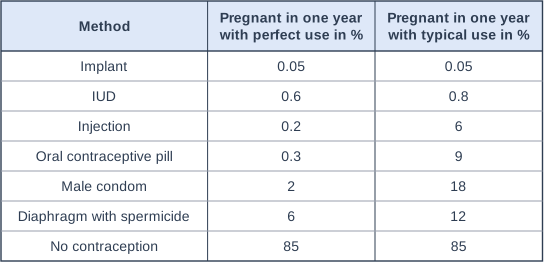
The table shows the percentage of women who become pregnant in one year when using different methods of contraception.

2000 women use male condoms (typical use) and 2000 women use implants.

Calculate how many more women would be expected to become pregnant in one year in the condom group than in the implant group.

Table with columns "Method", "Pregnant in one year with perfect use in %", "Pregnant in one year with typical use in %". Method: Implant; Pregnant in one year with perfect use in %: 0.05; Pregnant in one year with typical use in %: 0.05 | Method: IUD; Pregnant in one year with perfect use in %: 0.6; Pregnant in one year with typical use in %: 0.8 | Method: Injection; Pregnant in one year with perfect use in %: 0.2; Pregnant in one year with typical use in %: 6 | Method: Oral contraceptive pill; Pregnant in one year with perfect use in %: 0.3; Pregnant in one year with typical use in %: 9 | Method: Male condom; Pregnant in one year with perfect use in %: 2; Pregnant in one year with typical use in %: 18 | Method: Diaphragm with spermicide; Pregnant in one year with perfect use in %: 6; Pregnant in one year with typical use in %: 12 | Method: No contraception; Pregnant in one year with perfect use in %: 85; Pregnant in one year with typical use in %: 85.

Model answer

Condom group: 2000 × 18 ÷ 100 = 360 women
Implant group: 2000 × 0.05 ÷ 100 = 1 woman
Difference = 360 − 1 = 359 more women

Explanation

Use the typical-use figures, because the question asks about typical use. Find each percentage of 2000 separately before subtracting; 0.05% is one in two thousand, so it is easy to misplace the decimal point.

Mark scheme
  1. 1 mark

    condoms: 2000 × 18 ÷ 100 = 360

    an answer of 359 scores 3 marks

  2. 1 mark

    implant: 2000 × 0.05 ÷ 100 = 1

  3. 1 mark

    difference = 360 − 1 = 359

    allow ecf from incorrect values; an answer of 360 scores 2 marks

Question 4

5 marks

A 38-year-old woman has three children and is sure she does not want any more. She is choosing between female sterilisation and a contraceptive implant that lasts for 3 years.

Evaluate the two methods for this woman.

Model answer

Both methods are almost 100% effective. Sterilisation is permanent, so she would never need to think about contraception again, and it involves no hormones, so there are no hormonal side effects. However, it needs surgery, which carries a risk of infection, and it is very difficult to reverse if her circumstances change. The implant does not need surgery in the same way and can be removed if she changes her mind, but it releases progesterone, which can cause side effects such as irregular bleeding, and it has to be replaced every 3 years. Because she is sure she does not want more children, sterilisation is probably the better choice, as long as she accepts that it is permanent.

Explanation

Consider effectiveness, permanence and reversibility, side effects and the risks of the procedure, and relate them to the person described. The conclusion should follow from the information given about her.

Mark scheme
  1. 1 mark

    both methods are very effective / almost 100% effective

    max 5; to reach 5 marks a justified conclusion is needed

  2. 1 mark

    sterilisation is permanent, so she never needs to think about contraception again

  3. 1 mark

    sterilisation needs surgery, with a risk of infection / complications

  4. 1 mark

    sterilisation is difficult to reverse if her circumstances change

  5. 1 mark

    sterilisation contains no hormones, so no hormonal side effects

  6. 1 mark

    the implant is reversible / can be removed, but must be replaced every 3 years

  7. 1 mark

    the implant releases progesterone, which may cause side effects

    allow e.g. irregular bleeding, mood changes

  8. 1 mark

    justified conclusion, e.g. sterilisation suits her because she is sure she wants no more children

Ready to try the rest? Every answer you write is marked against the mark scheme, so you can see exactly where the marks are.

Revision notes

Contraception

The big idea

Fertility can be controlled by a variety of hormonal and non-hormonal methods of contraception. Each method stops pregnancy at a different stage: it stops eggs maturing or being released, stops sperm reaching an egg, or stops an embryo implanting in the uterus. You need to explain how each method works and evaluate the methods against each other.

Hormonal methods

MethodHow it prevents pregnancy
Oral contraceptives (the pill)Contain hormones that inhibit FSH production, so no eggs mature. A pill is taken every day
Injection, implant or skin patchRelease progesterone slowly, which inhibits the maturation and release of eggs for months (an injection lasts about 3 months) or years (an implant lasts up to about 3 years)
Some intrauterine devices (IUDs)Release a hormone into the uterus

Some pills contain oestrogen and progesterone, and others contain progesterone only. A hormone works wherever the blood carries it, so a patch on the skin still affects the ovaries.

Non-hormonal methods

MethodHow it prevents pregnancy
Barrier methods: condoms and diaphragmsPrevent the sperm reaching an egg. A condom covers the penis (or lines the vagina); a diaphragm covers the entrance to the uterus
Intrauterine devices (IUDs), such as the copper coilPrevent the implantation of an embryo
Spermicidal agentsKill or disable sperm. Not very effective alone, so they are used with a diaphragm
Abstaining from intercourse when an egg may be in the oviductNo sperm meet the egg around the time of ovulation
Surgical sterilisationMale: the sperm ducts are cut or tied. Female: the oviducts are cut or tied. Usually permanent

Evaluating methods

When you evaluate, weigh up these points:

  • Effectiveness. With typical use (the way people really use a method, including mistakes), methods that depend on the user every time fail more often: pills can be forgotten, condoms can split, and ovulation is hard to predict. Implants, injections, IUDs and sterilisation do not rely on remembering, so they fail far less.
  • Side effects. Hormonal methods can cause side effects such as mood changes, irregular bleeding or a higher risk of blood clots.
  • Protection against sexually transmitted infections. Only condoms protect against infections such as HIV, because they stop the exchange of body fluids.
  • Reversibility. Sterilisation is usually permanent. After stopping injections it can take months for fertility to return, while an implant can be removed.
  • Personal or religious beliefs, and whether a doctor or nurse is needed to fit the method.

Abstaining is one of the least reliable methods: cycle length varies, so ovulation is hard to predict, and sperm can survive for several days inside the woman's body.

Using contraception data

With typical use, 6 out of every 100 women using contraceptive injections become pregnant in a year, compared with 0.8 out of every 100 using a copper IUD. A woman wants to avoid pregnancy for several years. Use the data to compare the two methods.

Percentage of women who do not become pregnant in a year: injection \(100 - 6 = 94\%\); copper IUD \(100 - 0.8 = 99.2\%\)

  • The IUD is more effective: once fitted it stays in place for years and needs nothing to be remembered, whereas injections can be missed or given late.
  • The copper IUD contains no hormones, so it has no hormonal side effects, but it can make periods heavier and must be fitted inside the uterus by a doctor or nurse.
  • Fertility returns as soon as an IUD is removed, but it can take months after the last injection.
  • Conclusion: the copper IUD suits her better, but neither method protects against sexually transmitted infections, so she would also need condoms if that is a risk.

Remember

  • The pill inhibits FSH, so no eggs mature.
  • Injections, implants and patches release progesterone slowly, inhibiting the maturation and release of eggs.
  • Barriers stop sperm reaching the egg; IUDs prevent implantation of an embryo (or release a hormone); spermicides kill or disable sperm.
  • Only condoms protect against sexually transmitted infections.

Common mistakes

  • Calling an IUD a barrier method. It works by preventing implantation, or by releasing a hormone.
  • Saying the pill "kills eggs" or "stops sperm". Its hormones inhibit FSH, so no eggs mature.
  • Saying an implant releases oestrogen. Implants, injections and patches release progesterone.
  • Saying hormonal methods or IUDs protect against infections. Only condoms do.
  • Ending an "evaluate" answer without a conclusion. You must give a judgement supported by your points.

Exam tip

"Evaluate" means advantages and disadvantages, using any data given, then a justified conclusion. Apply your points to the person in the question: a new partner points to infection risk (condoms), wanting children later points to a reversible method, and a risk of blood clots points away from pills containing oestrogen.

Study Helper Hints first, answers after you try

Stuck on this one? Ask for a hint and I’ll point you in the right direction, without giving the answer away. Once you’ve checked your answer, I’ll show you how the marks are awarded.