Practise 10 exam-style questions on Sex determination for AQA GCSE Combined Science (Biology Paper 2). Write your answer as you would in the exam and get it marked in seconds against the mark scheme, point by point, with the Study Helper on hand if you get stuck.
10 questions
1–4 marks each
Instant marking
No sign-up needed
10 questions, marked as you go
Sample questions with model answers
Here are 4 of the questions in this topic, each with a model answer, an explanation of why it earns the marks and the mark scheme an examiner would use.
Question 1
2 marks
Ordinary human body cells contain 23 pairs of chromosomes.
How many pairs carry the genes that determine sex, and how many pairs control characteristics only?
Model answer
One pair carries the genes that determine sex. The other 22 pairs control characteristics only.
Explanation
Of the 23 pairs, 22 pairs carry genes for other characteristics only. The remaining pair - the sex chromosomes, XX or XY - carries the genes that determine sex.
Mark scheme
1 mark
1 pair determines sex
1 mark
22 pairs control characteristics only
Question 2
2 marks
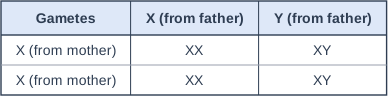
The Punnett square shows how sex is inherited in humans.
Use the Punnett square to explain why it is the father's gamete that determines the sex of a baby.
Model answer
All of the mother's eggs contain an X chromosome, so she always passes on X. The father's sperm contain either X or Y. If a sperm carrying X fertilises the egg, the baby is XX and a girl; if a sperm carrying Y fertilises it, the baby is XY and a boy. So the sperm decides the sex.
Explanation
The parent with two different sex chromosomes (the father, XY) makes two kinds of gamete. Which kind fertilises the egg determines the sex of the baby.
Mark scheme
1 mark
the mother's eggs all contain an X chromosome
1 mark
the father's sperm contain X or Y, so whether an X or a Y sperm fertilises the egg decides if the baby is a girl (XX) or a boy (XY)
Question 3
3 marks
A hospital recorded 2400 births in one year. 1236 of the babies were boys.
Calculate the percentage of babies that were boys, and suggest why this is not exactly the percentage expected from a genetic cross.
Model answer
Percentage of boys = (1236 ÷ 2400) × 100 = 51.5% A genetic cross predicts 50% boys, but this is only a probability: whether a sperm carrying X or a sperm carrying Y fertilises each egg is a matter of chance, so the actual numbers vary.
Explanation
A 1 : 1 ratio means each baby has a 50% chance of being a boy, not that exactly half of any group will be boys. Real data are usually close to, but not exactly, the predicted ratio.
Mark scheme
1 mark
(1236 ÷ 2400) × 100
an answer of 51.5 (%) scores the first 2 marks
1 mark
51.5 (%)
1 mark
fertilisation is random / whether an X or Y sperm fertilises the egg is due to chance, so the 50% is only a probability
Question 4
4 marks
A sperm cell fertilises an egg cell, and the baby that develops is a boy.
Give: the number of chromosomes in the sperm cell the sex chromosome in the sperm cell the sex chromosome in the egg cell the number of chromosomes in the fertilised egg cell.
Model answer
The sperm cell has 23 chromosomes, including a Y chromosome. The egg cell contains an X chromosome. The fertilised egg has 46 chromosomes (23 pairs), with the sex chromosomes XY.
Explanation
Gametes have a single set of 23 chromosomes, including one sex chromosome. A boy is XY, and his X must have come from the egg, so the sperm carried the Y. Fertilisation restores the full number of 46.
Mark scheme
1 mark
sperm cell: 23 chromosomes
1 mark
sex chromosome in the sperm: Y
1 mark
sex chromosome in the egg: X
1 mark
fertilised egg: 46 chromosomes
allow 23 pairs
Ready to try the rest? Every answer you write is marked against the mark scheme, so you can see exactly where the marks are.
Ctrl + Enter to check
Study HelperHints first, answers after you try
Stuck on this one? Ask for a hint and I’ll point you in the right direction, without giving the answer away. Once you’ve checked your answer, I’ll show you how the marks are awarded.