Practise 13 exam-style questions on Homeostasis for AQA GCSE Combined Science (Biology Paper 2). Write your answer as you would in the exam and get it marked in seconds against the mark scheme, point by point, with the Study Helper on hand if you get stuck.
13 questions
1–5 marks each
Instant marking
No sign-up needed
13 questions, marked as you go
Sample questions with model answers
Here are 4 of the questions in this topic, each with a model answer, an explanation of why it earns the marks and the mark scheme an examiner would use.
Question 1
2 marks
What is meant by homeostasis?
Model answer
Homeostasis is the regulation of the internal conditions of a cell or organism to maintain optimum conditions for function, in response to internal and external changes.
Explanation
Homeostasis is about keeping internal conditions, such as blood glucose concentration, within narrow limits. The point of doing this is to keep conditions at the optimum for enzymes and all cell functions, even when conditions inside or outside the body change.
Mark scheme
1 mark
regulation of the internal conditions of a cell or organism
allow keeping the internal environment (of the body) constant; ignore 'keeping the body the same'
1 mark
to maintain optimum conditions for (enzyme action and cell) function
allow in response to internal and external changes for this mark if optimum conditions are not mentioned
Question 2
2 marks
Effectors are part of every automatic control system in the body.
Name the two types of effector and describe what effectors do in a control system.
Model answer
The two types of effector are muscles and glands. Effectors bring about responses (muscles contract, glands secrete chemicals such as hormones) which restore the internal conditions to their optimum levels.
Explanation
Effectors are the 'doing' part of a control system. They receive information from the coordination centre and respond, and in homeostasis the response brings the condition back to its optimum level.
Mark scheme
1 mark
muscles and glands
both needed for the mark
1 mark
they bring about a response that restores optimum levels / conditions
allow muscles contract or glands secrete (hormones) to bring about a response; 'bring about a response' alone is not enough
Question 3
3 marks
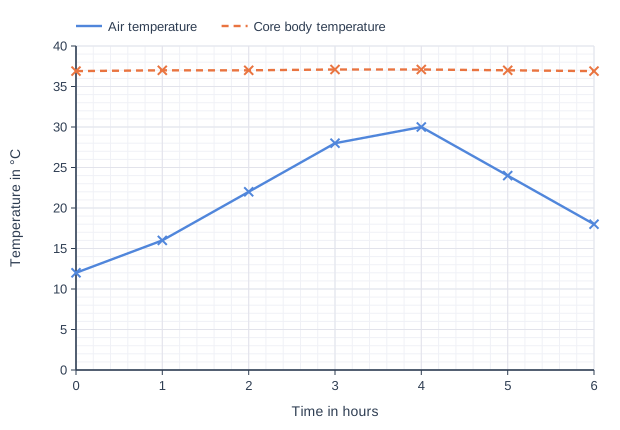
The graph shows the air temperature around a person and the person's core body temperature, measured every hour for 6 hours on a summer day.
Explain how the data show that the person's body uses homeostasis. Use data from the graph in your answer.
Model answer
The air temperature changes a lot during the 6 hours, rising from 12 °C to 30 °C and then falling to 18 °C. Over the same time the core body temperature stays almost constant at about 37 °C. This shows that an internal condition is being regulated in response to changes in the external environment, which is homeostasis.
Explanation
Homeostasis keeps internal conditions steady even when the outside environment changes. The evidence is the contrast between the large change in air temperature and the almost unchanged body temperature, so quote values for both.
Mark scheme
1 mark
the air temperature changes a lot, from 12 °C to 30 °C
allow a change of 18 °C; allow values within 1 °C
1 mark
the body temperature stays almost constant at about 37 °C
allow stays between 36.9 and 37.1 °C / changes by less than 1 °C
1 mark
so the internal condition (body temperature) is regulated / kept constant despite external changes
allow kept at the optimum for enzymes / cell function
Question 4
4 marks
A house has a central heating system.
A sensor in the thermostat detects the air temperature in the house. A control box compares this with the temperature chosen by the owner. If the house is too cold, the control box switches on the boiler, which heats the radiators. When the house is warm enough, the boiler is switched off.
Compare the central heating system with an automatic control system in the human body.
Model answer
The sensor in the thermostat works like a receptor because it detects a change in conditions. The control box is like a coordination centre such as the brain, because it receives and processes the information and decides on a response. The boiler and radiators are like effectors, because they bring about the response. Both systems are automatic and act to bring the condition back to a set level and keep it there. One difference is that the body carries information as nerve impulses or hormones rather than as electrical signals in wires.
Explanation
A good comparison matches each part of the heating system to a part of a control system and states the shared purpose: restoring a condition to its set or optimum level. Including a difference as well as similarities shows a full comparison.
Mark scheme
1 mark
the sensor is like a receptor (it detects the change / stimulus)
max 4
1 mark
the control box is like a coordination centre (it receives and processes information)
allow like the brain / spinal cord / pancreas
1 mark
the boiler / radiators are like effectors (they bring about the response)
allow like muscles or glands
1 mark
both are automatic and bring the condition back to a set / optimum level
allow both respond to a change to keep conditions constant
1 mark
difference: the body carries information by nerve impulses or hormones, the heating system by electrical signals in wires
allow any valid difference, e.g. the body has many receptors / the body controls several conditions
Ready to try the rest? Every answer you write is marked against the mark scheme, so you can see exactly where the marks are.
Ctrl + Enter to check
Study HelperHints first, answers after you try
Stuck on this one? Ask for a hint and I’ll point you in the right direction, without giving the answer away. Once you’ve checked your answer, I’ll show you how the marks are awarded.