Level:
Correct: 0
Incorrect: 0
Marks: 0/0
Exam Practice
Course:
Topics:
Avg
score:
–
Topics
done:
0/35

Fossils

Practise 15 exam-style questions on Fossils for AQA GCSE Combined Science (Biology Paper 2). Write your answer as you would in the exam and get it marked in seconds against the mark scheme, point by point, with the Study Helper on hand if you get stuck.

  • 15 questions
  • 1–6 marks each
  • Instant marking
  • No sign-up needed
15 questions, marked as you go

Sample questions with model answers

Here are 4 of the questions in this topic, each with a model answer, an explanation of why it earns the marks and the mark scheme an examiner would use.

Question 1

1 mark

Some fossils are preserved traces of organisms rather than parts of the organism itself. A dinosaur footprint is one example.

Give one other example of a preserved trace of an organism.

Model answer

A burrow (or rootlet traces).

Explanation

Trace fossils record what an organism did rather than what it was made of: footprints, burrows and rootlet traces are the examples in the specification. They can survive even when no part of the organism is preserved.

Mark scheme
  1. 1 mark

    a burrow

    allow rootlet traces / root traces; allow fossilised droppings / nests / tooth marks; do not accept footprint (given) or a body part such as a bone or shell

Question 2

2 marks

Fossils of horseshoe crabs that lived 450 million years ago look very similar to horseshoe crabs living today.

Suggest why horseshoe crabs have changed very little in 450 million years.

Model answer

The conditions where horseshoe crabs live have changed very little, and the crabs were already well adapted to them, so new variations gave no advantage and were not selected.

Explanation

We can learn from fossils how much or how little organisms have changed. Natural selection only produces change when some variants survive and reproduce better than others; in a stable environment, a well-adapted species may change very little.

Mark scheme
  1. 1 mark

    their environment / living conditions have changed very little

    allow few new predators or competitors

  2. 1 mark

    they were already well adapted, so new variations gave no advantage / were not selected

Question 3

3 marks

Scientists cannot be certain about how life began on Earth.

Explain why the fossil record cannot show how life began.

Model answer

Many of the earliest forms of life were soft-bodied, so they left very few traces behind. Most of the traces that did form have since been destroyed by geological activity, so there is almost no fossil evidence of how life began.

Explanation

Soft bodies decay before they can be fossilised, and the oldest rocks have had the longest time to be changed or destroyed by geological activity. That is why the earliest part of the fossil record is so sparse.

Mark scheme
  1. 1 mark

    many early forms of life were soft-bodied

  2. 1 mark

    so they left few traces / few fossils

    allow soft tissue decays (quickly) so is rarely fossilised

  3. 1 mark

    the traces there were have mainly been destroyed by geological activity

    allow destroyed by movement of rocks / erosion / heat and pressure in the Earth

Question 4

4 marks

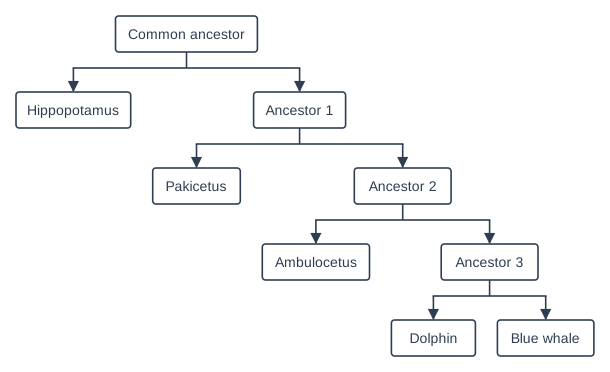
The diagram shows an evolutionary tree. It shows how scientists think whales are related to some other mammals. Pakicetus and Ambulocetus are extinct.

Fossils show that Pakicetus lived about 50 million years ago, had four legs and lived mostly on land. Ambulocetus lived about 49 million years ago and used its large back feet for swimming as well as walking.

Describe what the tree and the fossils suggest about how whales evolved, and explain why scientists cannot be certain.

Flow chart of 9 boxes joined by arrows, read from top to bottom. The first box is "Common ancestor". From "Common ancestor", 2 arrows branch out side by side: the left arrow leads to "Hippopotamus"; the right arrow leads to "Ancestor 1". From "Ancestor 1", 2 arrows branch out side by side: the left arrow leads to "Pakicetus"; the right arrow leads to "Ancestor 2". From "Ancestor 2", 2 arrows branch out side by side: the left arrow leads to "Ambulocetus"; the right arrow leads to "Ancestor 3". From "Ancestor 3", 2 arrows branch out side by side: the left arrow leads to "Dolphin"; the right arrow leads to "Blue whale".

Model answer

The fossils suggest that whales evolved from four-legged mammals that lived on land, like Pakicetus. Later animals such as Ambulocetus used their feet for swimming, so the ancestors of whales gradually became adapted to life in water. The tree shows that whales share a common ancestor with the hippopotamus. Scientists cannot be certain because the fossil record is incomplete, with only a few fossils found, and the extinct animals may be relatives rather than direct ancestors.

Explanation

Evolutionary trees show how scientists believe organisms are related, using fossil data for extinct organisms. Because the fossil record has gaps, any tree is a best interpretation of the evidence and can change when new fossils are found.

Mark scheme
  1. 1 mark

    whales evolved from (four-legged) mammals that lived on land

    max 4

  2. 1 mark

    whales share a common ancestor with the hippopotamus / the hippopotamus is the most closely related living animal shown

  3. 1 mark

    the ancestors gradually became adapted to living in water (e.g. legs / feet used for swimming)

    allow change happened gradually over millions of years

  4. 1 mark

    not certain because the fossil record is incomplete / few fossils have been found / there are gaps

  5. 1 mark

    not certain because Pakicetus and Ambulocetus may be relatives on side branches rather than direct ancestors of whales

    allow the tree is based on what scientists believe, from the evidence available

Ready to try the rest? Every answer you write is marked against the mark scheme, so you can see exactly where the marks are.

Revision notes

Fossils

The big idea

Fossils are the 'remains' of organisms from millions of years ago, which are found in rocks. They are evidence of how life on Earth has developed: we can learn from them how much or how little different organisms have changed. You need to know three ways fossils form, why there is so little fossil evidence of early life, and how to read evolutionary trees.

How fossils are formed

Decay is carried out by microorganisms, which need a suitable temperature, water and oxygen. Most dead organisms decay completely, so fossils only form in unusual conditions.

How the fossil formsWhat happensExamples
From parts that have not decayedOne or more of the conditions needed for decay are absentFrozen in ice (too cold); trapped in amber (no oxygen, and microorganisms cannot reach it); waterlogged, acidic peat bogs (very little oxygen); very dry places (no water)
Parts replaced by mineralsHard parts decay slowly and are replaced by minerals as they decayBones, teeth and shells
Preserved traces of organismsMarks the organism left behind are preserved in rockFootprints, burrows and rootlet traces

Most fossil bones and shells form by mineral replacement. The dead organism is buried in sediment such as mud. Soft parts decay quickly, but hard parts decay very slowly. As they decay, minerals from water in the sediment gradually replace them, forming rock in the same shape. Trace fossils contain no part of the organism, but they show how it lived, for example its size and how it moved.

Why we cannot be certain how life began

  • Many early forms of life were soft-bodied, so they have left few traces behind: soft tissue decays quickly and rarely forms fossils.
  • What traces there were have mainly been destroyed by geological activity, as rocks were heated, folded and worn away.

This is why scientists cannot be certain about how life began on Earth. The fossil record as a whole is incomplete too, so a missing fossil does not prove that an organism was absent.

What fossils show

  • Rock layers usually form one on top of another, so deeper layers are older. Older rocks contain simpler organisms, and more complex organisms appear in younger rocks.
  • Some organisms have changed very little over hundreds of millions of years, because their environment stayed much the same and they were already well adapted. Others, whose environment changed, have changed a lot.
  • Fossils are the main evidence about extinct species. Together with classification data for living organisms, they are used to build evolutionary trees.

Reading evolutionary trees

An evolutionary tree shows how scientists believe organisms are related.

  • Each tip is a species, and each branch point is a common ancestor.
  • Two species are most closely related when they share the most recent common ancestor: follow their lines back to where they join.
  • With a time axis, read across from a branch point to find when two groups separated.
  • A line that stops before the present shows a species that became extinct.
Evolutionary tree titled "An evolutionary tree of five species". The species are along the top, from left to right: Species J, Species K, Species L, Species M and Species N. A time axis labelled "Millions of years ago" runs from 0 (the present, at the species) to 40 at the bottom, marked every 5, with faint grid lines across the tree. The tree starts from a single line at the bottom, which splits at 35 million years ago (at a dot labelled Z) into two branches: a branch leading to Species J, Species K and Species L; a branch leading to Species M and Species N. The branch leading to Species J, Species K and Species L splits at 20 million years ago (at a dot labelled Y) into two branches: a line to Species J; a branch leading to Species K and Species L. Species K and Species L branch apart at 8 million years ago (at a dot labelled X). Species M and Species N branch apart at 25 million years ago. Species M became extinct 10 million years ago (its line stops early and ends in a short bar). A key shows that a line ending in a short bar is the line of a species that became extinct. Marker's notes: Most closely related (most recent common ancestor): Species K and Species L (common ancestor 8 million years ago). Tree structure (closest relatives grouped in brackets): ((Species J, (Species K, Species L)), (Species M, Species N)). Point Z is the most recent common ancestor of Species J, Species K, Species L, Species M and Species N, 35 million years ago. Point Y is the most recent common ancestor of Species J, Species K and Species L, 20 million years ago. Point X is the most recent common ancestor of Species K and Species L, 8 million years ago. Extinct: Species M.
Branch points X, Y and Z are common ancestors. The line of species M stops before the present.

Using an evolutionary tree

Use the tree above.

  1. Which species is most closely related to species K? Species L: their lines join at X, so K and L share the most recent common ancestor.
  2. How many million years ago did the line leading to species J separate from the line leading to K and L? Follow J down to where it joins, at point Y: 20 million years ago.
  3. Which species is extinct, and when did it die out? Species M, which died out 10 million years ago.
  4. What does point Z show? The common ancestor of all five species, which lived 35 million years ago.

Common mistakes

  • Defining a fossil as "an old bone". A fossil is the remains or traces of an organism from millions of years ago, found in rock.
  • Saying bones "turn into rock". They are gradually replaced by minerals as they decay.
  • Writing "traces" without an example. Give footprints, burrows or rootlet traces.
  • Judging relationships by which species are next to each other along the top of a tree. Follow the branches back to the most recent common ancestor.
  • Saying humans evolved from chimpanzees. Living species share common ancestors; neither evolved from the other.

Exam tip

Questions on why scientists cannot be certain how life began want two linked points: early life was soft-bodied, so it left few traces, and most of those traces were destroyed by geological activity.

Study Helper Hints first, answers after you try

Stuck on this one? Ask for a hint and I’ll point you in the right direction, without giving the answer away. Once you’ve checked your answer, I’ll show you how the marks are awarded.